

At this year’s scientific colloquium hosted by the Thuringian Energy Research Institute (ThEFI) at the Technical University of Ilmenau – the Energia Connecticum – direct current (DC) technologies took center stage as “Key Technologies for the Future of Energy Supply.”
While for a long time, alternating current (AC) power supply seemed to be the gold standard, direct current (DC) has gained importance in recent years: Many power generators, storage systems, and consumers operate internally on direct current. DC technologies open up opportunities to reduce losses during energy conversion, significantly increase efficiency, and develop innovative system concepts. DC technology is therefore becoming increasingly important in practice and is also receiving growing attention in research.
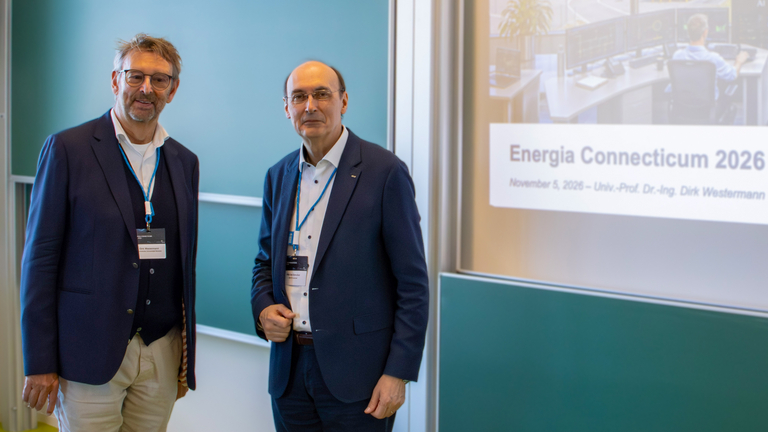
“The TU Ilmenau is a key player in DC research,” emphasized Prof. Stefan Sinzinger, Vice President for Research and Yound Scientist, in his opening remarks. Research on this topic had been conducted continuously at the TU Ilmenau, even during times when DC technology was largely overlooked at other universities.
In his introductory lecture, ThEFI Director Prof. Dirk Westermann outlined the concept of the All-Electric Society, in which electricity will play a prominent role in all sectors – that is, in industry, transportation, and households, while fossil fuels would continue to lose importance:
DC technology is indispensable for realizing this vision of the future.
While DC has already been implemented in the transmission grid sector, its use in distribution grids is still pending. Westermann identified competitive prices for components central to grid operation – such as power converters and circuit breakers – as well as, above all, an adjustment to the regulatory framework as key prerequisites for the widespread adoption of superior DC technology. He emphasized that new business models must be developed for DC distribution grids that foster innovation. Within the narrow regulatory framework of existing AC distribution grids, the necessary investments would be virtually impossible to make.
Finite copper reserves and the potential for “Urban Mining”
“A secure and sustainable energy supply is not possible without direct current (DC) technology”: That was the main takeaway from the keynote address by Prof. Rik De Doncker of RWTH Aachen University. In his presentation, he emphasized the need for a far-reaching transition to DC technology. Using the example of global copper reserves, a key resource for the energy transition and digitalization, the renowned expert in DC technology forcefully illustrated that all known copper deposits combined would not be sufficient to bring about the upcoming transformations if we continue with AC technology as we have been. He therefore advocated for a shift to DC technology, which was significantly more resource-efficient.
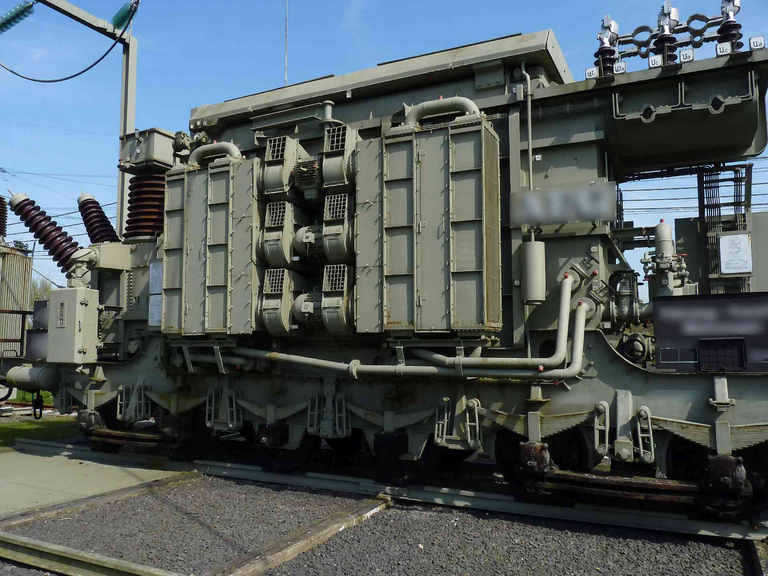
He also illustrated the urgent need for this by pointing to the price of copper, which has more than doubled in the last five years alone and is expected to rise significantly further. At the same time, he sees a shift from AC to DC as an opportunity for greater independence. While global copper reserves are increasingly falling under China’s influence, he sees great potential in Germany for “urban mining” once the old AC technology is phased out. The copper from the large transformers that will then no longer be needed could make a significant contribution and help reduce dependence on imports.
Challenges and resource-efficient approaches in DC technology
While the opening presentations addressed the necessity, challenges, and significant opportunities of the transformation, the subsequent presentations focused on the specific – and above all technical – challenges of DC technology. Even though DC technology has a long history and is already used in many sectors worldwide, there are still many unanswered questions – particularly in the area of distribution grids – that doctoral students and postdocs at the TU Ilmenau are working to address.
In particular, as part of the VERNEDCT project funded by the Carl Zeiss Foundation, a great deal of fundamental research on direct current grids is currently underway – ranging from grid design calculations to the development of an efficient and resource-conserving safety architecture.
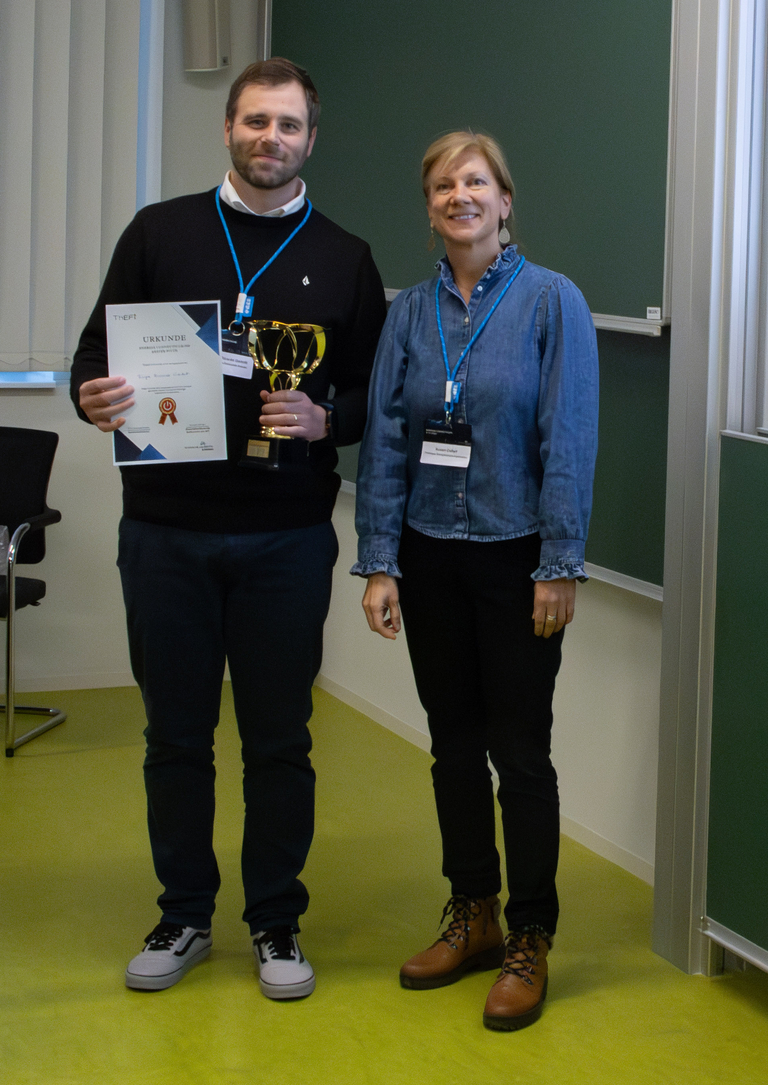
The presentation by Filipe Gadotti, whose doctoral thesis focuses on “Multi-zone Protection Algorithm for DC Distribution Grids,” was recognized as the best contribution in this technology-oriented part of the conference. In his presentation, he introduced, among other things, a resource-efficient approach that eliminates the need for extensive sensor installation – a factor that contributed to the award. After all, promoting sustainable solutions was also a central focus of this year’s Energia Connecticum.
A significant knowledge gap
However, many of the contributions made it clear that even compelling technical solutions will not automatically gain acceptance if they are not widely known. For example, the paper by Anna Skripchenko, Dorothee Arlt, and Jens Wolling, Head of Media Research and Political Communication at the TU Ilmenau, shows that even among those who could and should be using the technology – the distribution network operators – there is a significant knowledge gap. According to research conducted by the department, one-third of the more than 800 distribution network operators in Germany have not yet heard of the possibility of a DC-based distribution network. Of the remainder, only a small minority has already explored the possibilities in depth. One conclusion of the event, according to Prof. Jens Wolling, is therefore:
All participants in the ThEFI colloquium agreed that this must change and that the Energia Connecticum should serve as a catalyst to increase knowledge of the technology and raise awareness of its benefits among companies, policymakers, and regulatory authorities alike.
Original publication
Skripchenko, A., Arlt, D., & J. Wolling (2026). Application areas and advantages of DC technologies from the perspective of distribution system operators (DSO). Energia Connecticum, Ilmenau.
More about the VERNEDCT project: Resource-efficient energy distribution network through DC technology
About the Thuringian Energy Research Institute (ThEFI)
The Thuringian Energy Research Institute (ThEFI) brings together 12 groups from four departments at the Technische Universität Ilmenau, thereby strengthening interdisciplinary research. Its focus is on knowledge transfer and the further development of research expertise in the fields of energy, environmental, and systems engineering. The research findings are also actively transferred to academia and industry.
With the research infrastructure it has built up in recent years, ThEFI offers excellent conditions for basic research at both the simulation and experimental levels. The infrastructure and the necessary workstations are also available for research projects outside of course-related activities.