

How can the acoustics of a historic space be preserved for the future? A team from Technische Universität Ilmenau, in collaboration with researchers from Trinity College Dublin, investigated this question at the National Library of Ireland. As part of an extensive measurement campaign, they conducted an acoustic survey of the historic Main Reading Room, a reading room that is approximately 140 years old. The data is now being analyzed at the TU Ilmenau and at Trinity College Dublin.
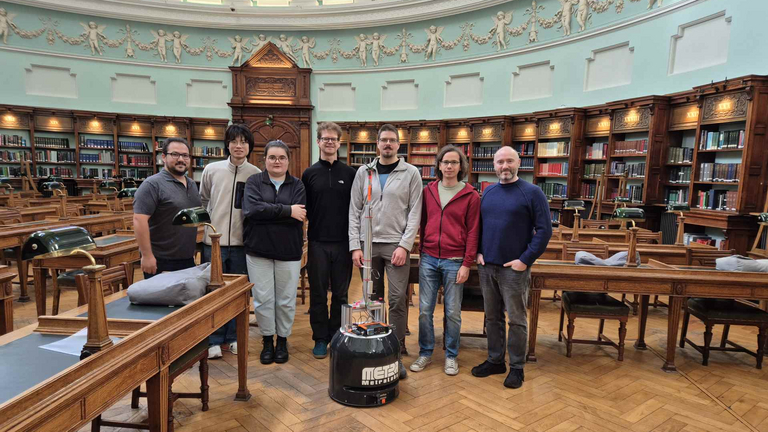
The timing of the study was deliberately chosen: The Main Reading Room is scheduled to be renovated next year. Among other things, plans call for a visitor platform that will shield visitors from the ongoing reading activities. “The structural changes will also alter the room’s acoustics,” explains Georg Stolz, a research assistant in TU Ilmenau's Electronic Media Technology Group. As an expert in spatial audio, he was therefore invited, along with his colleague Dr. Lukas Treybig and researchers from Trinity College Dublin, to measure the acoustics of the reading room.
In conjunction with this, the two Ilmenau researchers also designed a course for students, doctoral candidates, and interested parties at Trinity College. In doing so, they drew on their experience from MusicSphere, a major European project aimed at digitizing historical musical instruments across Europe.
“We’re here to document the acoustics as they are today. This will give us a baseline so that in a few years we can investigate how the acoustics of this room have changed,” explains Dr. Nils Peters, Assistant Professor of Acoustic Signal Processing at Trinity College Dublin.
A tour of the reading room with Ilmenau robotics
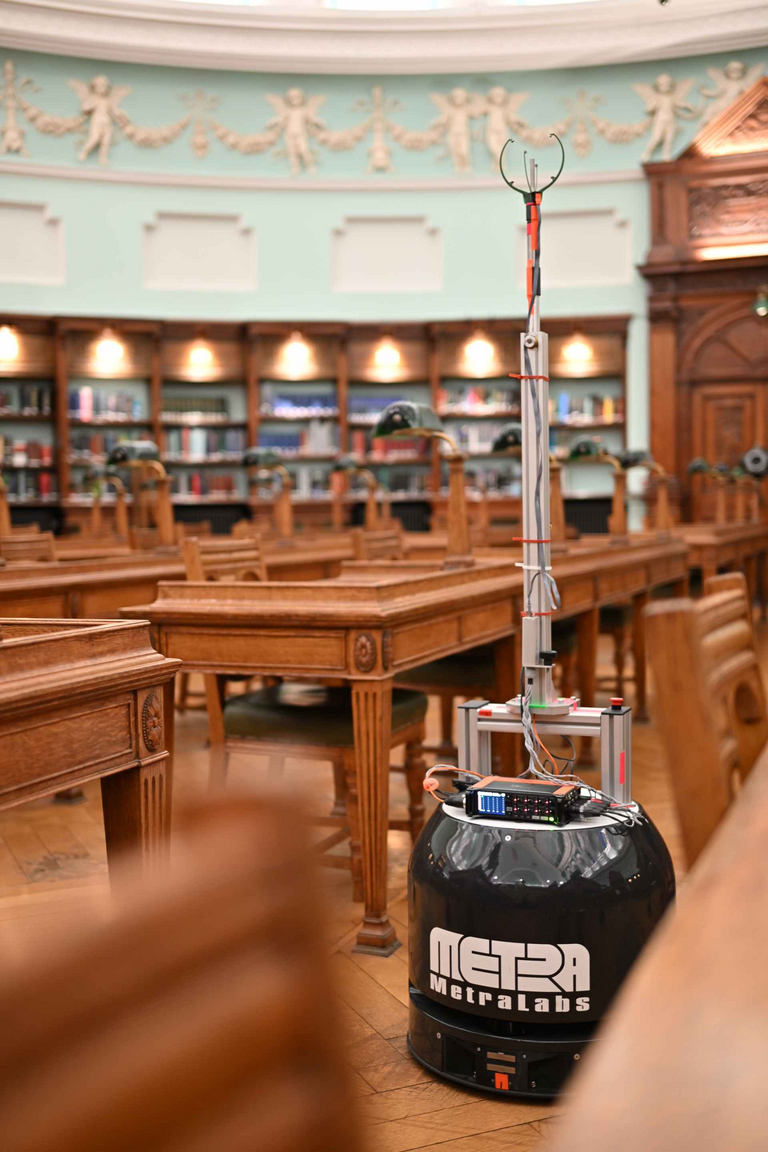
For the measurements, the scientists used an acoustic measurement robot developed at TU Ilmenau in collaboration with the Ilmenau-based company Metralabs. This robot automatically moved a microphone array through the historic reading room, enabling measurements to be taken at 162 measurement points. Five speakers served as sound sources. The goal, according to Georg Stolz:
We want to capture a complete picture of a room’s acoustics. To do that, we need measurements at many different positions, i.e. basically at every position where a person might be standing in the room.
Whereas a manual measurement would require repeatedly repositioning the microphone and determining its exact location each time, the robotic system performs these tasks automatically and with high precision. This also makes it possible to conduct long measurement campaigns without accuracy being compromised by human fatigue, explains Stolz:
If such measurements were to be performed manually over a period of 70 hours, it would be virtually impossible for a human to do so. The robot, on the other hand, doesn’t need sleep. It just needs to recharge its batteries and can then continue taking measurements with consistent accuracy.
An acoustic snapshot
While the acoustics are usually barely noticeable to readers in the reading room – since quiet is part of everyday life in the library – the researchers hope their measurements will also draw attention to how strongly a room’s design influences what people hear and how they experience a place.
“We want to uncover something that is actually constantly around us, but of which we are unaware,” says Peters. Unlike churches and concert halls, the room acoustics of many historic libraries have hardly been studied or documented to date. Upon entering such spaces, one is often struck silent with admiration and awe. The silence, which invites one to read, also makes it clear how sensitive the acoustic environment is to sound: even quiet sounds are amplified by the space and reverberate. In this way, the room acoustics contribute to the special atmosphere of these spaces.
The analysis of the collected data is now intended to reveal precisely this hidden dimension of the space. How does sound propagate in the reading room? How does the acoustic experience change at different locations? And what will change as a result of the planned renovation?
For John Kennedy, Associate Professor of Vibrations, Acoustics, and Dynamics at Trinity College Dublin, this is also about preserving a piece of cultural history:
In Ireland, we have a number of significant historic spaces where the acoustic environment has hardly been taken into account until now. Yet the experience people have in a space is shaped to a large extent by its acoustics. We must document and preserve these characteristics while adapting the environment for future generations.
When history comes to life
Acoustics thus becomes part of cultural memory in its own right. In the future, the data collected in Dublin will help highlight changes and preserve historical spaces not only through images and documents, but also through their acoustic properties.
The measurement campaign at the National Library of Ireland is just the beginning. The researchers plan to apply this robot-assisted method to other historic spaces in the future. Among the sites under consideration is the famous Old Library at Trinity College Dublin.
Trinity Centre for Digital Humanities: From Silence to Story
TU Ilmenau: Digitally Preserving Historical Sounds
TU Ilmenau: Students on Board: With a Microphone and 3D Scanner on the Museum Ship SEEFALKE
Contact
Dr. Stephan Werner
Fachgebietsleiter (kommissarisch) Elektronische Medientechnik