

Intelligent therapy robots that assist patients with gait training in hospitals, during outpatient therapy sessions, and at home: That is the vision of a research team at Technische Universität Ilmenau. Together with the Ilmenau-based technology companies MetraLabs and TEDIRO Healthcare Robotics, as well as BARMER Thüringen, they are working on technologies to help people with orthopedic, neurological, or oncological conditions regain their mobility. A robot recently arrived at the Ilm-Kreis-Klinik in Arnstadt for initial tests and studies and demonstrated its capabilities to Thuringia’s Minister President Mario Voigt.
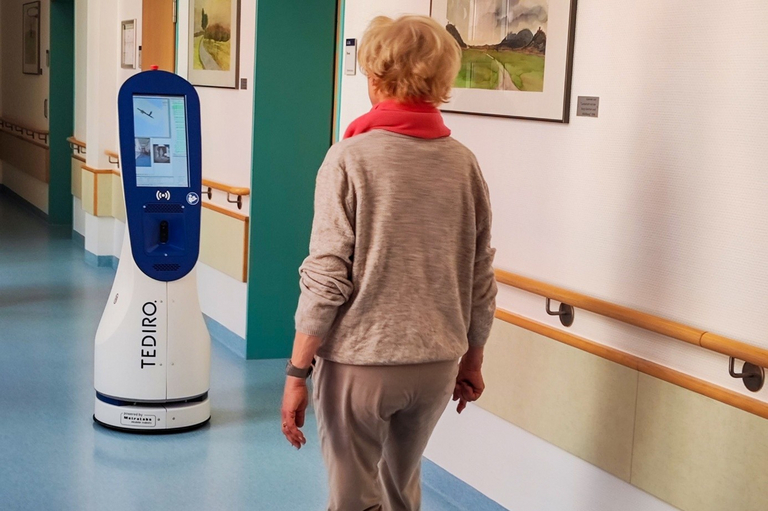
Hello, I’m your assistant robot, and I’m here to help you get back on your feet!
A blue-and-white robot greets Heike Poppitz warmly in the hallway of the Ilm-Kreis-Klinik in Arnstadt. Slowly, the patient puts one foot in front of the other. The THERY robot moves alongside her, recording her movement patterns; in the future, it will be designed to detect uncertainties and errors in her gait and provide Heike Poppitz with real-time feedback. This will allow the patient to adjust her movements in dialogue with the gait robot to achieve the best possible training results.
Gait robotics has been the subject of research in Ilmenau for many years. This is because when patients have to relearn how to walk after surgery, a stroke, or a serious illness, they require intensive therapeutic support, a great deal of repetition, and time – time that the accompanying physical therapists lack, given the shortage of skilled professionals, for other, more complex hands-on therapies.
This is precisely where a new research project on robot-assisted mobilization of patients – involving clinical trials – comes in. It is part of the WIR! Alliance’s “wecare” initiative and is funded by the Federal Ministry of Research, Technology, and Space. The goal of the ROMOBIL project is not to replace therapists, but to support them with intelligent technology. This is because patients should also be given opportunities for independent, safe, and motivating training.
Research in the Real-World Laboratory
Since April 2026, data has been collected in Arnstadt that will be used to write programs and integrate them into a training robot. “The goal is to enable patients to engage in robot-assisted self-training that does not require the presence of a therapist. The key feature is that the robot provides immediate feedback on whether the walking exercises are being performed correctly,” says Professor Horst-Michael Groß, project coordinator in the Neuroinformatics and Cognitive Robotics Lab at TU Ilmenau.
This approach is intended to prevent training errors – which often go undetected during independent practice – thereby enhancing therapeutic progress and accelerating patients’ rehabilitation. At the same time, it is expected to alleviate the burden on the limited number of therapy staff.
Coordination and Muscle Building
“The exercises performed during gait training specifically strengthen balance and coordination, thereby making an important contribution to fall prevention. Supportive feedback from the therapy robot helps improve movement patterns and perform them safely. At the same time, coordination and muscle development are promoted – key prerequisites for mobility and independence,” says Sandy Mumot, director of therapy at the Ilm-Kreis-Kliniken. These skills are particularly crucial for patients with neurological conditions, such as those who have suffered a stroke, in leading an independent daily life.
A cornerstone of a modern healthcare system
Robert Büssow, BARMER’s regional director, sees great potential in robotics and artificial intelligence to improve the healthcare system:
When properly integrated, robotics is a building block for a modern, connected, and adaptive healthcare system. If it helps prevent complications, shorten recovery times, and make treatments more precise and safer, that’s a real benefit for our insured members.
Over a period of five months, data will be collected, AI-based methods for a robot-assisted training approach will be developed, and the approach will be tested for its suitability for everyday use with the participation of outpatients and inpatients at the Ilm-Kreis-Klinik in Arnstadt.
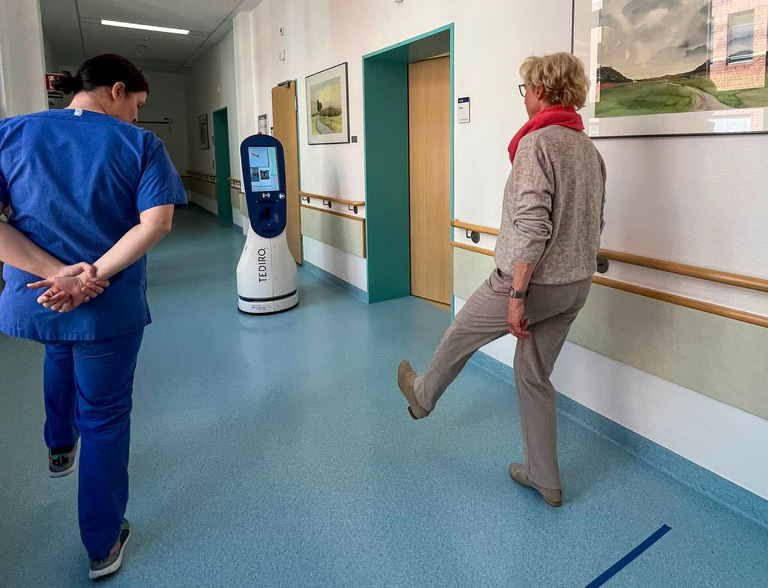
Exercise programs are also available for patients who do not use walking aids
Project Coordinator Professor Horst-Michael Groß is convinced:
Robot-assisted gait training could become an essential component of rehabilitation for certain patient groups in the future.
The positive effects of a training robot were already demonstrated in a small user study conducted from 2016 to 2019 at the Waldkliniken Eisenberg. There, people who had undergone hip surgery practiced walking correctly with crutches with the help of a robot.
The ROMOBIL project now aims to develop robot-assisted training programs that can be used for various patient groups, including those without traditional walking aids.
Technologically, the project takes a decisive step forward. In the “ROMOBIL-ML” subproject, gait and movement data captured by sensors are analyzed online. Using machine learning and deep learning methods, the system is designed to recognize whether movements are being performed correctly and identify any errors in gait patterns, thereby enabling a much more individualized evaluation of movement sequences and better tailoring training programs to patients’ needs.
Opportunities for people in rural areas
The posture analysis is designed to work independently of any specific device and, in the future, to be usable on PCs or smartphones as well. This would allow rehabilitative gait training to be continued flexibly at home or in outpatient rehabilitation facilities. This could make a significant difference, especially for people in rural areas who face long commutes to therapeutic facilities.
Close collaboration between research and clinical practice plays a central role in this effort. The developments do not originate in a laboratory far removed from everyday life, but are directly guided by the demands of clinical practice.
As such, the project also serves as an example of how basic research at TU Ilmenau addresses societal challenges and translates scientific findings into concrete solutions for everyday life in collaboration with regional partners in the field. Prof. Groß:
Innovations arise where science, industry, and society work closely together. Thuringia and Ilmenau offer excellent conditions for this.
Tina Rudolph, State Secretary at the Thuringian Ministry of Social Affairs, Health, Labor, and Family, was also able to see for herself during a visit to TU Ilmenau how innovative robotics and human-machine interaction can help strengthen independence and alleviate the burden on caregivers. Click here to see highlights from the visit on Instagram.
Contact
Prof. Dr.-Ing. Horst-Michael Groß
Fachgebiet Neuroinformatik und Kognitive Robotik