

Defossilization, resource efficiency and the circular economy are important cornerstones when it comes to making the European economy sustainable and competitive by 2050. Bio-based materials can make a significant contribution to this. A new research group at TU Ilmenau is working on the combination of different materials such as bioplastics, wood fibers or natural fibers and their use in components that are both sustainable and efficient. We spoke to research group leader Prof. Florian Puch, Head of Plastics Technology at TU Ilmenau.
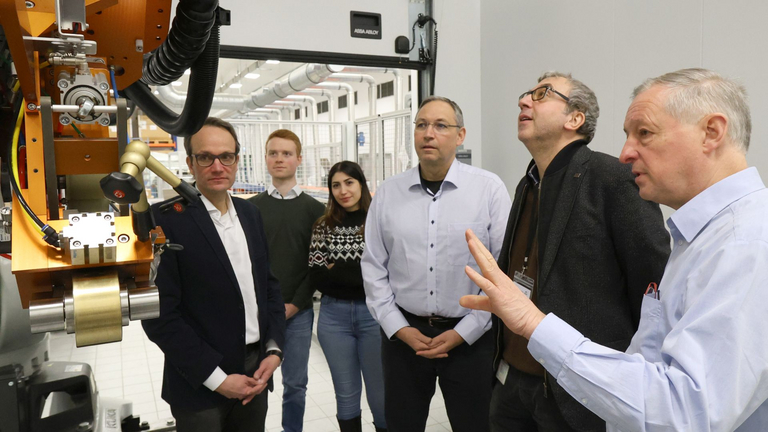
Professor Puch, in the FunkiBioVerbund you are working on "functionally integrated biogenic composite materials". What exactly does this mean - and what challenges in industry are you addressing with this research group?
Essentially, it's about developing more sustainable materials for technical applications - especially for sectors such as the automotive industry, where manufacturers will have to significantly reduce the CO2 emissions of their vehicles by 2030, from raw material extraction through production to the end of their service life, if they want to avoid high penalties. We work with bio-based materials such as bioplastics, natural fibers or wood fibers and combine them into composite materials. The challenge is that such materials often do not fulfill the same functions as conventional plastics or metal components. This is why we integrate functional elements during production, such as local reinforcements or connection points. This allows us to create components that are both sustainable and technically efficient.
Several fields of research at TU Ilmenau are involved in the research group, as well as TITK e.V, an affiliated institute of TU Ilmenau and an industry-oriented research institution specializing in modifying polymers to create materials with completely new, functional properties. How do research institutions and different fields of research work together here in concrete terms, and what expertise does each partner contribute?
The project thrives on interdisciplinary collaboration. Here at TU Ilmenau, both Plastics Technology and Production Engineering are involved. The focus here is more on the manufacturing processes, such as injection molding or additive manufacturing, and on the design of the components. The TITK in particular contributes its experience in the development and processing of bio-based materials. This combination allows us to think about material development, process development and component design together - this is crucial in order to develop functioning prototypes in the end.
If the project is successful, what does this mean in practice - for example for the automotive industry or for companies in the region? What advantages could bio-based composite components bring in the future?
In the long term, the project can help to reduce the use of fossil raw materials and at the same time make components lighter and more resource-efficient. This is particularly important for the automotive industry because it has to significantly reduce its CO₂ emissions over the entire life cycle of a vehicle. If we can show that bio-based composite components work technically and can also be recycled, this opens up new possibilities for more sustainable lightweight products that are widely applicable to society, which is why sustainable lightweight construction is also a focus in our Master's degree program in mechanical engineering: from medical technology, mobility and mechanical engineering to energy generation and supply, buildings and household, right through to sport and leisure. At the same time, regional companies benefit because the results and findings from the project can be transferred directly into industrial practice: Part of the project also includes a feasibility study on recycling the composite components produced, the results of which will then be made directly available to regional companies. In order to further improve the recyclability of composite materials, we are using an innovation voucher to look at ways of developing self-reinforced composite materials. This means that the reinforcing fiber and the surrounding matrix are made of the same plastic, thus enabling mechanical recycling.
The research group funded by the Free State of Thuringia is co-financed by the European Social Fund Plus. The innovation voucher supported by the Free State of Thuringia is co-financed by funds from the European Union as part of the European Regional Development Fund (ERDF).

Contact
Prof. Florian Puch
Head of Plastics Technology and Scientific Head TITK