

How can quality, for example, in manufacturing, the construction industry, or the timber industry, be reliably ensured when image processing is increasingly based on machine learning? This question was the focus of the 94th Heidelberg Image Processing Forum, “Quality Assurance with Image Processing,” which took place on November 3 at the TU Ilmenau. Scientists and industry representatives discussed current developments, challenges, and prospects at the intersection of image processing, artificial intelligence, and quality assurance.
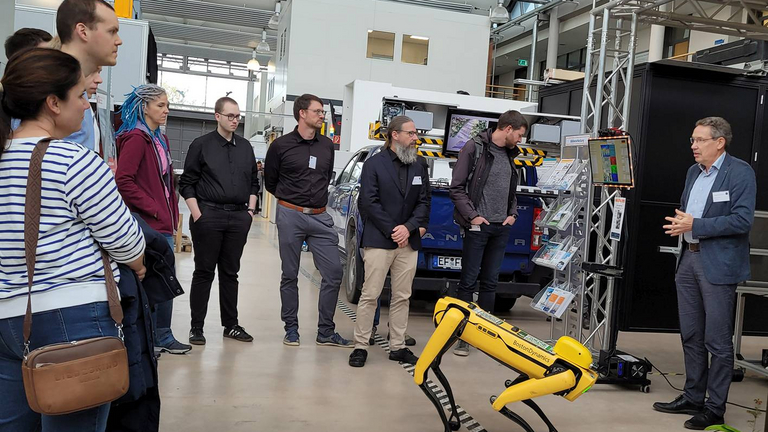
Whether in manufacturing, the food, wood, or construction industries, or in medical and security technology: Sensor technology and image processing are essential parts of quality assurance in many fields. Camera systems can inspect components, detect defects, or monitor production processes. The increasing use of machine learning is opening up new possibilities: systems can learn from data and recognize even complex patterns that are difficult to capture using traditional inspection rules.
At the same time, this gives rise to new requirements. After all, if a computer vision system’s decisions are based on trained models, the reliability of those models must also be verifiable. Questions regarding the availability and quality of training data, the robustness of the models, and the traceability of results are thus becoming increasingly important.
“Furthermore, inspection decisions must be auditable. This presents us with regulatory and normative requirements,” said the host of the Image Processing Forum, Prof. Gunther Notni, Head of Quality Assurance and Industrial Image Processing at the TU Ilmenau, who is also member of the Executive Board of Fraunhofer IOF Jena.
Overall, robust, trustworthy, and scalable systems, as well as ease of use, will determine whether image-based quality inspection can be successfully implemented in the future.

About 70 researchers and industry partners at the forum, including speakers from Robert Bosch GmbH, Opto GmbH, Ilmenauer TechnoTeam Bildverarbeitung GmbH, Fraunhofer IPA, and Darmstadt University of Applied Sciences, therefore not only addressed new lighting and imaging techniques, such as 3D measurement of transparent objects using thermal pattern projection. They also explored new evaluation methods and the question of where and how AI methods enable robust system solutions and process optimizations and where this is not yet possible.
Prof. Gunther Notni sees this as a key challenge for the future development of image processing in quality assurance:
In our field, we focus in particular on developing methods for data augmentation which can be used to generate training data as well as robust system solutions using multimodal image acquisition techniques.
Contact
Prof. Gunther Notni
Head of Quality Assurance and Industrial Image Processing