

Ilmenau has been a PEFC Forest Capital for ten years - a title awarded to cities and towns that are particularly committed to sustainable forest management. Together with partners from science, industry, and public administration, TU Ilmenau is also advancing innovations related to forest and wood through the Holz-21-regio” initiative. We spoke with Prof. Gunther Notni, head of Quality Assurance and Industrial Image Processing and deputy spokesperson of the initiative, about the university’s wide-ranging activities - and about whether Ilmenau could one day become not only a Forest Capital, but also a technology capital for smart and sustainable forestry.
Prof. Notni, although the Forest Condition Report 2024 showed that the health of the trees has improved slightly, the condition of our forests remains critical and they have not yet fully recovered from the extreme weather years from 2018 onwards. Only around 20 % of trees are still without visible crown damage. Is this also why so many partners quickly joined forces in the Holz-21-regio initiative, established in 2021, to drive innovations in the forest and wood sector?
We are in the midst of climate change—with serious consequences for our forests. Extreme weather events, such as prolonged droughts and heat waves, as well as pollutants, put stress on trees and make them more vulnerable to pests like bark beetles or fungal infections. This results in significant tree damage and high economic losses. This is particularly alarming because German forests—the trees, deadwood, and soils—are key carbon reservoirs and thus play a crucial role in climate protection.
Climate change affects our entire society, and we need to take action in key areas.
Wood products, for instance, extend carbon storage and can replace climate-damaging materials such as steel or cement in construction. Where wood is harvested, we can plant new trees that will absorb and store CO₂ as they grow.
It is therefore essential to adapt our forests to climate change, strengthen their resilience, and manage them sustainably. This also means finding new uses for damaged wood, transporting and storing wood properly to maintain its quality for as long as possible, and monitoring and managing wood flows and supply chains more efficiently.
Using wood regionally also reduces our dependence on global supply chains, which is particularly important in times of geopolitical crises.
How do all these topics tie in with what a technical university does? And what kind of momentum can research at TU Ilmenau generate to tackle them?
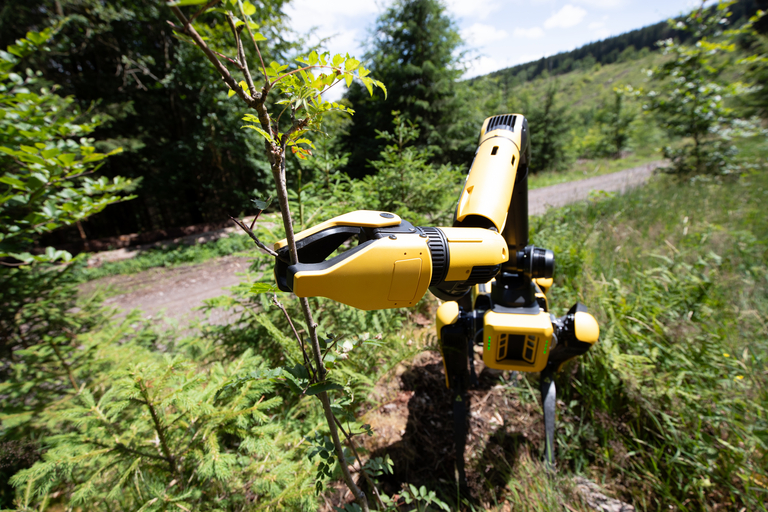
As engineers, we first need to understand the forest itself. That’s why we are not working on this initiative alone, but in close collaboration with Erfurt University of Applied Sciences. At the beginning, we had to gather a great deal of information in order to plan technical innovations for forestry: specialized camera systems, like the ones we are developing in our group, that allow us to look inside trees without damaging them, or to measure from a distance how fast and in which direction trees are growing. We are also working on automation technologies with robotic platforms that could support forestry tasks.
To control such platforms with a tablet, for example, communication between the platform and the tablet must function reliably—even under difficult forest conditions, where there are often signal dead zones. This means we also need suitable, energy-efficient radio technologies.
At TU Ilmenau, we can tackle all these aspects across different disciplines and departments. Even thermodynamics plays a role: if there are tall stumps that serve as vantage points for birds or as protection for young plants, we can determine the optimal planting spot by analyzing the airflow and temperature distribution around the stump. Where does moisture accumulate most? Where will the young plant be protected from wind or sun? Is it better to plant on the west side or the north side?
Here in Ilmenau, we can act as the technological hub of the initiative and provide a broad spectrum of expertise—from sensor and automation technologies, biomechatronics, production engineering, and lightweight construction to radio technologies and artificial intelligence (AI) applications.
But we can also contribute economic expertise to ensure that as much value creation from wood products as possible remains in Thuringia. And we can develop communication strategies: the “Walddoktor” project, for example, not only aims to automatically detect forest damage with the help of AI, but also to develop educational resources and communication tools to inform the public about the state of our forests. At our university and together with partners such as the Max Planck Institute for Biogeochemistry in Jena, we can approach all these questions in an integrated manner.
To what extent is the Thuringian Forest particularly suitable for this research?
The forest isn’t just practically on our doorstep - Ilmenau and the Thuringian Forest are ideal for this research for another reason:
We can simulate a variety of climatic conditions on our test sites.
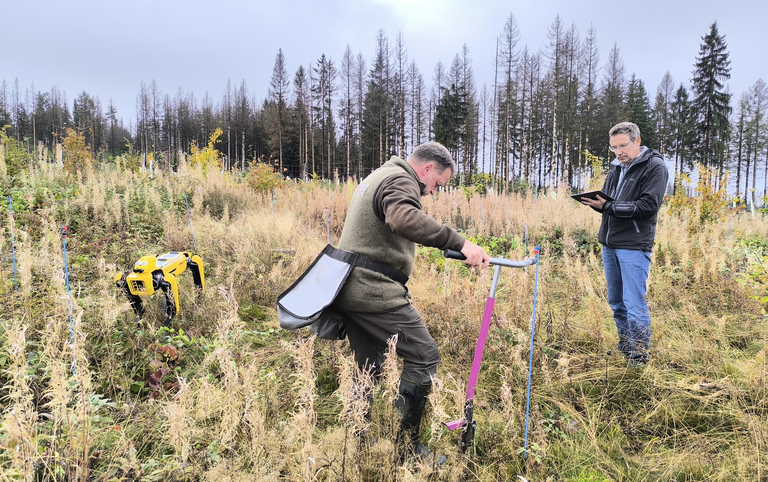
We have a practice area in Cursdorf, which, incidentally, does not require any external power supply, and where anyone can see what is happening via a webcam. In addition, Erfurt University of Applied Sciences manages six more test fields along the Rennsteig, where different tree species can be planted and a range of climatic and soil conditions can be simulated: north-facing slopes, south-facing slopes, and so on.
Many people might worry that machines and robots will “take over the forest.” But which forestry tasks can actually be automated—and which will still require human involvement in the future?
For years, forest workers have relied on established tools for maintenance—scythes, shears, and the like.
Our goal is not to develop new tools, but rather to provide platforms for handling these tools and to create a modular concept that allows parts of this work to be automated, supporting the monumental task of forest conversion.
Even small tasks—drilling a planting hole, placing a seedling, pressing down the soil—and later perhaps also tree care, such as pruning to ensure healthy growth—can be assisted. Even a robotic system that simply carries plants to the planting holes would already provide significant support for forest workers.
Which other tasks could be automated?
At the moment, we don’t yet know which steps can be automated in a meaningful way, or how time-consuming it would be. Many of the processes are familiar from industry. The major challenge, however, is adapting them to nature. Industrial parts are relatively easy to handle. Gripping a plant is entirely different—every plant is unique, flexible, and delicate. We have a vision, but it has to be efficient, of course.
One thing is already clear: people remain central to everything we research and develop, at least for planning the necessary work.
What needs to be done, where, and when? Digital technologies are needed to pass on this information. Surfaces must be captured in three dimensions, 3D maps generated, and loaded into the robotic platform so that the robot can plan its route and know exactly what tasks it needs to carry out, when, and how.
What are the particular challenges for using such technologies in forests?
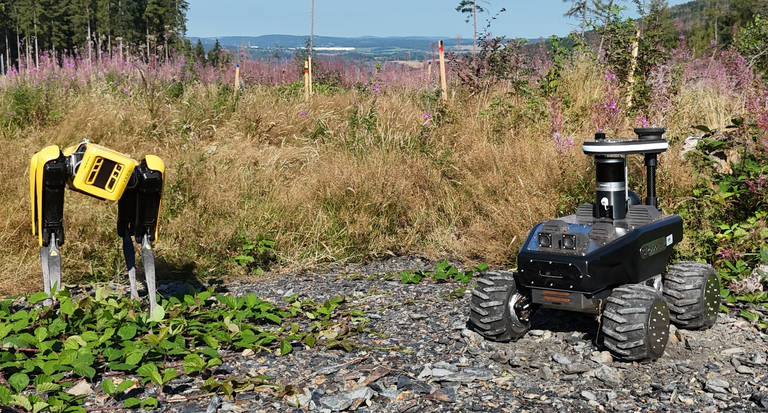
First, there are the slopes mentioned earlier, as robots must of course be able to handle steep gradients. For example, robotic mowers typically have a maximum slope limit of around 35 degrees. But other factors also come into play: the sensitive areas around plants and changing ground conditions—roots, rocks, small ditches, or branches—can easily obstruct a purely wheeled vehicle. Robots with legs can climb, but they consume a lot of energy. This isn’t just inconvenient for forest workers, who would then have to replace batteries constantly, but it also impacts the environment.
This is where our colleagues from the Biomechatronics department, led by Prof. Hartmut Witte, come in with their “Wheg” robots, which combine wheels and leg-like structures. At the same time, the sensor technology itself must be highly robust, as it needs to withstand sun, wind, and rain in the forest.
Beyond energy consumption, how are other ecological aspects considered in these projects?
In the long term, we also want to monitor whether invasive species are spreading in the areas we are planting. These would then need to be specifically removed during maintenance. Our goal is to use camera systems to “see into” the forest from forestry vehicles and apply AI to identify any new species or changes automatically—so that foresters don’t have to manually inspect every area. This is where our colleagues from the Data-intensive Systems and Visualization department, led by Prof. Patrick Mäder, contribute.
You and your colleagues are also developing technologies to make hidden conditions of timber construction elements visible, since wood can replace CO₂-intensive materials like concrete and steel in building construction.
Exactly. If I were to build a house today, I would definitely build it out of wood!
Wood is a renewable resource, and the key when using it is to ensure it stays in use as long as possible before being burned.
That’s also why I’m not a fan of pellet heating systems. Construction should focus on creating durable timber buildings, for example using cross-laminated timber, which can withstand regional climatic conditions—heavy rain, snow, and sun.
In a new project, we are developing sensors integrated directly into timber construction elements to determine optimal operating parameters and ensure maximum performance of the materials. Of course, the sensors themselves must be extremely energy-efficient, compact, and small.
Students and young people on voluntary sustainability years are also involved in many of these projects—working, in other words, at the interface of basic research, high-tech, and sustainability.
In fact, we receive inquiries for Master’s and Bachelor’s theses almost every day. The students are clearly very interested in the topic and have already tackled a wide variety of issues: experimental series with our multispectral cameras, investigating how steep a robot can climb, how to control it, and much more.
To what extent can your projects and the Holz-21-regio initiative serve as a model for other densely forested regions in Germany or Europe?
That is exactly our goal:
We aim to become a model region for sustainable and resilient value chains based on our domestic raw material - wood - for all of Europe.
At the same time, we can also learn a lot from other European countries, such as Austria or Slovenia.
Looking ahead ten years: What might the Thuringian Forest look like then, and what contribution will your systems have made?
I imagine that in ten years, humanoid robots will be assisting with certain forestry tasks for sustainable forest management, so that forest workers no longer have to do everything themselves. By that time, we hope to have expanded our technologies to include additional sensor systems, in collaboration with other research institutions such as the Fraunhofer IDMT, for example, to halt the spread of bark beetles using acoustic sensors.
Could Ilmenau then not only become a Forest Capital in the future, but also a kind of technology capital for forest robotics?
Yes - why not?
Contact
Prof. Gunther Notni
Leiter Fachgebiet Qualitätssicherung und industrielle Bildverarbeitung (QBV)