

Artificial intelligence can perform impressive tasks today: AI is capable of recognizing language, processing complex traffic situations, or analyzing turbulent flows for weather and climate forecasts. But the power of modern AI comes at a price: Training large neural networks – which learn from data and can recognize complex patterns within it – requires enormous computing power and, consequently, a great deal of energy. A research team at the Ilmenau School of Green Electronics (ISGE), led by doctoral student Anja Bartelmei, is therefore searching for new ways to implement neural networks more efficiently. Their approach: computing with light.
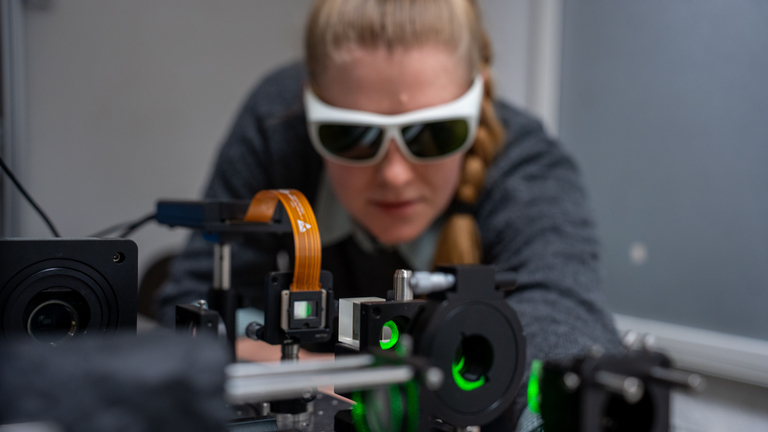
“I’ve been fascinated by machine learning for a long time,” says Anja Bartelmei. Even during her bachelor’s and master’s studies in Optical Systems Engineering at TU Ilmenau, the 27-year-old enjoyed programming: “To me, programming is like a puzzle: you have different tools and put everything together.” But it was during her master’s thesis, at the latest, that she also discovered the fascination of lab work: “It’s often frustrating when you come up with an idea and run the calculations, but it still doesn’t work. But that makes it all the more amazing when it does work in the end.”
Anja Bartelmei will also need patience for her doctoral dissertation, which she has been working on since October 2024. She has four years to work with her two advisors at TU Ilmenau – Prof. Stefan Sinzinger, head of Technical Optics, and Prof. Jörg Schumacher, head of Fluid Mechanics, to figure out how to implement artificial neural networks that can recognize complex patterns as efficiently as possible in large amounts of data and learn to make predictions based on them.
To do this, she is using a machine learning method that is particularly well-suited for time-dependent processes and in which a dynamic physical system serves as a kind of “memory”: reservoir computing.
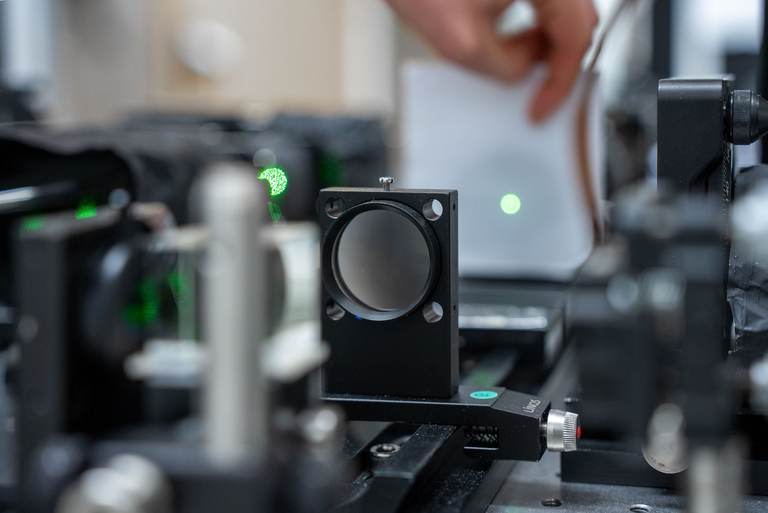
“In our project, we want to implement this reservoir using light,” explains Anja Bartelmei. The vision behind this is to directly harness the unique properties of light – its speed and its ability to process information in parallel – for neural computing processes.
Detecting and Predicting Strong Vortices in Turbulent Flows
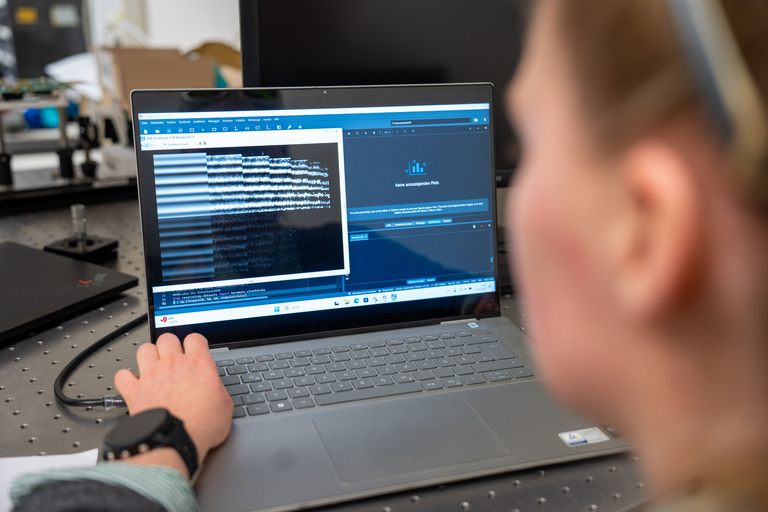
To be able to make predictions, the optical network must learn to recognize temporal patterns as well – such as the development of strong vortices in turbulent flows, says Anja Bartelmei.
I had already been working on the setup in my master’s thesis and conducting research on optical reservoir computing. Because I really enjoyed it and feel very at home in Ilmenau, I decided to pursue a PhD at the Ilmenau School of Electronics. The conditions here are very, very good for me as a doctoral student. And what’s exciting is how interdisciplinary the topic is: I can exchange ideas with many people and look at the topic from different perspectives.
Prof. Stefan Sinzinger, who serves as Vice President for Research and Young Scientists and is also the project director of the ISGE, sees the appeal of the project, but also its particular challenge in this interdisciplinary approach:
“What’s exciting is that we’re now trying to combine what Ms. Bartelmei explored theoretically in her master’s thesis with an application that actually requires significant computational resources.”
The interdisciplinary nature of the Ilmenau School of Green Electronics provides plenty of leeway for this.
However, interdisciplinary supervision is also a challenge, as the approaches of fluid mechanics and optics are quite different. At TU Ilmenau, we naturally have the advantage that our departments are located just two floors apart, so communication is quick and easy.
Modeled after the human brain
The idea behind this joint research topic is closely linked to the concept of so-called neuromorphic computing, as the technical architecture of Anja Bartelmei’s system is also based on fundamental principles of the brain: Instead of processing information exclusively as electrical signals in digital circuits in a serial manner, her system utilizes the unique properties of light and processes incoming information in a highly parallel manner, much like the human brain. This is because light waves can simultaneously carry information via various properties such as their intensity, phase, or polarization, as well as their spatial and temporal structure. Optical systems can therefore perform many computational operations in parallel.
“You could say that the reservoir Ms. Bartelmei uses to process data is a stack of many holograms that are interconnected and processed together within this component,” explains Prof. Sinzinger. “That’s incredibly exciting.”
A particularly challenging test case: turbulent flows
As a challenging application, Anja Bartelmei is investigating so-called turbulent thermal convective flows. These are characterized by complex structures that are constantly changing and interacting with one another. For example, particularly strong vortical events such as thunderclouds can form and disappear again within a short period of time.
The network Anja Bartelmei is working on is therefore designed not only to analyze individual images but also to understand the temporal evolution of the flow. To achieve this, she relies on so-called recurrent neural networks. These networks also take into account information from previous states and can thus model dynamic processes.
A Memory for the Optical Network
Anja Bartelmei has already investigated how temporal information can be processed in an optical neural network in an initial study conducted with her colleague Maximilian Zier. Zier is also a doctoral student at the Ilmenau School of Green Electronics and conducts research in the field of optical reservoir computing. Together, the two are using a method known as delay embedding.
Put simply, this method does not just consider the current state of a signal; it also incorporates past states into the representation. In a sense, this gives the optical network a memory of the recent past.
Anja Bartelmei explains:
This means we use the high degree of parallelism to create a kind of inherent memory effect, because the image we want to analyze may not be that complex, and we can sacrifice a certain part of the image to achieve this memory effect.This method thus further capitalizes on the high degree of parallelism in optics, because – especially with chaotic time series – it allows us to map the dynamics of the entire system in a single time step.
How does a network learn from light?
Currently, several additional questions remain to be answered in order to address the project’s central research question: What architecture must an optical neural network have in order to learn as effectively as possible?
Among other things, Anja Bartelmei intends to investigate how the network’s interconnections and its spatio-temporal activity patterns influence learning performance. She also wants to explore whether information is best modulated via the intensity, phase, or polarization of light.
“Our goal is not only to detect structures in flows more efficiently than before, but also to use these systems for predictions – and, if possible, ‘on the fly,’” explains Prof. Jörg Schumacher:
Ideally, this means that during the experiment, the optical reservoir computer will directly and immediately detect and analyze a particularly strong vortex event within a continuous stream of pixel data, allowing for targeted adjustments during the evaluation. This is particularly exciting for more precise weather or climate forecasts, but also for flow control in many other areas such as automobiles, aircraft wings, wind turbines, or heat transfer.
And yet Stefan Sinzinger also acknowledges: “With problems of this complexity, you naturally have to let go of the idea that there’s a single system that solves everything. But we can imagine that, thanks to Anja Bartelmei’s research, we might be able to develop partial solutions or functionalities that help us model and understand complex flow patterns more quickly, efficiently, or accurately.”
Perhaps, in the end, the solution to the energy problem posed by the increasing use of AI lies not in ever more powerful electronic processors – but in the nature of light.
Original publication
Anja Bartelmei, Maximilian Zier, Jörg Schumacher, and Stefan Sinzinger, "Delay-embedding for recurrence in optical reservoir computing," Opt. Express 34, 28496–28508 (2026). https://doi.org/10.1364/OE.595960
Contact
Anja Bartelmei
Institute of Micro- und Nanotechnologies