

How can light be used to measure the smallest distances, lengths or path changes that are invisible to the naked eye with even greater precision and stability? Scientists at the Group of Nanofabrication and Nanomeasurement Technology are working on this question in the project "MELI - Research on methods for external referencing for diode laser interferometry". We spoke to Prof. Thomas Kissinger and doctoral researcher Jasmin Ruprecht about their research.
Prof. Kissinger, Ms. Ruprecht - what exactly are you working on in the MELI project, and what problem in precision measurement technology do you want to solve with it?
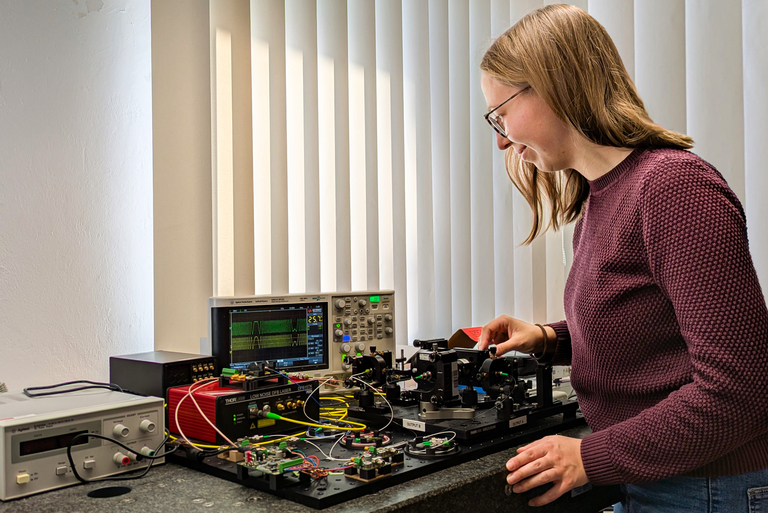
In the MELI project, we are researching new methods to make laser sources in so-called interferometric measuring systems even more precise and stable. Such systems measure lengths, distances or movements with extremely high accuracy - they are therefore a central component of modern measurement technology. The laser source is of fundamental importance here, as in an interferometer the length to be measured is "compared", so to speak, with the frequency or vacuum wavelength of the laser light; it therefore acts as a measuring scale, meaning that its absolute value must be known very precisely and be sufficiently stable. Our approach is to couple one or more lasers via an electronic phase-locked loop (PLL) and use a flexible, digital control concept. This allows us not only to keep laser frequencies very stable, but also to trace them back externally to highly accurate references - such as national frequency standards.
Close cooperation with industry is crucial for research of this kind. Which partners are involved in the project in this case?
We at TU Ilmenau, more precisely our institute, the Institute of Process Measurement and Sensor Technology (IPMS), and our partner SIOS Meßtechnik GmbH, a leading Ilmenau-based technology company in the field of interferometric precision measurement technology.
Why are even more precise and stable length measurements so important - and where are such systems used in everyday life in industry and research?
High-precision length measurements are the basis of many technologies - from semiconductor production and mechanical engineering to the calibration of scientific instruments. Ever higher demands on measuring accuracy and the increasing complexity of the corresponding measuring systems also increase the requirements on the output power and stability of the underlying laser sources. With the developments in MELI, we not only want to make existing laser interferometers, which are based on the proven 633 nm technology, more accurate and more flexible. We also want to pave the way for future measurement systems based on the already very mature, reliable and eye-safe 1.5 um technology from the telecommunications sector. This is becoming increasingly important due to the growing use of fiber-distributed metrology systems. A trend that is expected to intensify in the coming years due to new developments in the direct traceability of length measurement systems to the SI second. In this way, we are making a contribution to the next generation of precision measurement technology - and at the same time strengthening our technological sovereignty in this key area.

The project, which is funded by the Free State of Thuringia, is co-financed by the European Union as part of the European Regional Development Fund (ERDF).
Contact
Prof. Thomas Kissinger
Leiter des Fachgebietes Nanofabrikations- und Nanomesstechnik