

Sparks, spatter, scrap: When welding with high-power lasers, not only is material lost, but often a great deal of time and money as well. A research team led by Prof. Jean Pierre Bergmann and Dr. Leander Schmidt from the Ilmenau Production Technology Group sought to gain a deeper understanding of what causes these unwanted spatter formations and has identified the key mechanisms involved. The result: Material loss can be reduced by more than 90 percent. For this achievement, the team has now been honored with the 2026 Thuringian Research Award in the “Applied Research” category.
Research
Thuringian Research Award Winner: “We took on a practical challenge and brought it back into the academic world”
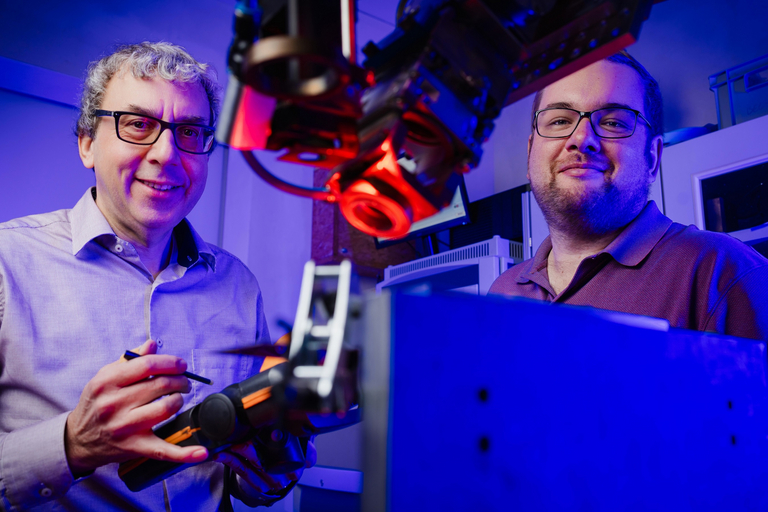
In an interview with UNIonline, Professor Bergmann explains why this success is based on many years of “application-driven basic research,” what role cutting-edge international technologies played in this, and why this research is of particular importance to Thuringia: for manufacturers of plant and systems engineering and the automotive industry, as well as for end-user applications, ranging from container construction and interior fittings to the Thuringian BBQ.
Professor Bergmann, congratulations on winning the 2026 Thuringian Research Award! What does this award mean to you and your team?
This award has several meanings. On the one hand, we recognize that manufacturing and welding are often perceived by the public as established technologies. The fact is, however, that a great deal of research still goes into them, since implementation in industry has often outpaced research. On the other hand, this award recognizes the achievements made over the past decade in Ilmenau. Members of the award-winning team were able to further their qualifications here and find their way into research and industry.

You were recognized for your research on high-power laser welding. For readers who aren’t familiar with manufacturing technology on a daily basis: What specific problem were you trying to solve?
We often recognize welding in videos or images on the evening news by the sparks flying. For the public, it has to glow and “sparkle.” In reality, however, this spatter is not what we want at all. On the one hand, it results in material loss; on the other hand, these particles adhere to the component surface and form what are known as “weld beads.”
Both of these are undesirable: on the one hand, material is lost, thereby reducing the component’s load-bearing capacity; on the other hand, these “weld beads” must be laboriously removed. Through our research, we were able to reduce the formation of spatter adhesion and, in particular, gain a deeper understanding of the process.
Your team has succeeded in reducing the mass loss caused by spatter by over 90 percent. What does this mean in practical terms for companies?
For companies, this means less rework and greater flexibility in implementing laser beam welding. The impetus for the research at the time was the observation that spatter formation increased disproportionately as welding speeds exceeded 10 m/min. As a result, high welding speeds were virtually impossible to achieve or only with a very high amount of post-welding work. With the insights gained, we have now succeeded in determining and understanding the conditions for higher welding speeds and reduced spatter formation.
“The engineer observes, listens, smells, and touches”
Your award falls into the “Applied Research” category. At the same time, your project clearly demonstrates that such an application would hardly be possible without a deep scientific understanding. How closely are basic research and application linked in your work?
The jury chair’s laudatory remarks were unequivocal on this point and essentially reflect our approach. We took on a practical challenge or problem and brought it back into the academic world.
In the first step, we pursued the solution, and in the second step, we went back to the fundamentals to understand the occurrence of this phenomenon so that we could also explain the solution.
Engineers – and manufacturing engineers in particular – typically work in a multidisciplinary and “multisensory” manner. They observe, they listen, they smell – for example, emissions in the surrounding environment – and they touch. By combining these perceptions with their physical and mathematical expertise, they formulate their working hypotheses. This is where creativity and scientific skill come into play.
The work is thus deeply rooted in the fundamentals. I would therefore often feel much more comfortable with the term “application-driven basic research.” To evaluate and interpret the experimental results, we conducted several experimental campaigns at the large-scale multinational research facility European Synchrotron Radiation Facility (ESRF) in Grenoble, tested new analysis methods, and were thus able to clearly explain the conditions under which spatter forms. However, spatter is merely the result of the flow patterns during laser beam welding; in other words, the solutions we have developed allow us to influence the melt flow conditions and the energy input.

So the real innovation began with the question: What actually happens physically inside the workpiece?
Definitely yes – with the question: What happens in the so-called “keyhole” within the material? The “keyhole” refers to a channel in the material formed by the high power of the laser beam, within which metal vapor interacts with the surrounding molten material.
Why was it so scientifically challenging to make these processes visible and understandable?
These processes take place within the thickness of the material in fractions of a millisecond and are confined to very small areas. Therefore, the sample must be irradiated during processing, and the images must be captured with high contrast at a high frequency. However, these conditions are only available at a few synchrotron facilities.
Once the experimental investigations have been carried out, the videos must be analyzed and processed in order, for example, to track the geometry of the “keyhole” – which changes in the kilohertz range, that is, at a frequency of several thousand changes per second – and to correlate it with the respective process conditions. The analysis took us a long time. We started with high-speed recordings from the outside, i.e. the surrounding (sample) atmosphere, and were already able to identify effects and, for example, describe the change in the “keyhole” opening. But we realized that this wasn’t enough, so we took the next step.
What was the moment when you realized: “Now we truly understand the mechanism of spatter formation”?
Based on our intuition and engineering insight, we already had an approach and an idea from the very beginning about how the relationship might work. But we couldn’t prove it yet. Our gut feeling was indirectly confirmed toward the end of the first publicly funded project. The investigations at the synchrotron made everything clearer and thus completed our understanding.
“Outstanding students and a scientific and industrial network”
To achieve this, you worked with high-speed cameras, image processing, simulations, and even synchrotron radiation in Grenoble. What made this combination of methods possible?
The combination arose from the various facets of the problem and presented us with the challenge of examining the ongoing process from multiple perspectives. To do this, we employed several methods. This was made possible by the existing laboratory facilities at the TU Ilmenau, by the excellent training of our students who were then part of the team and by our scientific and, in particular, industrial network. Companies – including those that compete with one another – supported the work throughout the entire process. Individual companies accompanied us in Grenoble, conducted experiments with us, and occasionally provided equipment systems.
What were you able to observe or model as a result that was previously inaccessible?
While it is possible to penetrate the sample and visualize the “keyhole” in isolated cases, the high contrast and high temporal resolution in our investigations were unique to laser beam welding. We were able to clearly identify the interaction points between the metal vapor and the molten pool, as well as changes within them.
What measures or technical solutions were you able to derive from this?
Initially, we pursued the approach of laser beam welding using adjusted laser intensities. In this case, that meant we wanted to work with multiple beams. One beam was intended to have a high-power density to form the “keyhole” and thus ensure the penetration depth. The second beam was intended to slightly melt the material in a ring around the “keyhole,” thereby stabilizing the process overall. This approach has been implemented in various ways in industrial settings, and we were now able to understand it.
This success serves as a prime example of how innovation often arises from long-term, cross-generational research.
In this case, I can unequivocally answer this question with a yes. We were successful in various competitions and were able to secure funding almost continuously from the BMWi (Federal Ministry for Economic Affairs and Energy), the Carl Zeiss Foundation, the former Thuringian Ministry of Science (TMWWDG), and the DFG. That was a very fortunate situation that allowed us to stay on track without interruption. The transfer of expertise across generations worked very well. Despite minor setbacks, the team has consistently managed to rekindle its enthusiasm and has not shied away from breaking new ground.
What role do doctoral students, postdocs, and young scientists play in carrying on such lines of research over the years?
The award is intentionally given to a team rather than to a single individual. Each person’s contribution at different points in their career is equally valuable and indispensable. Doctoral students and young scientists bring fresh perspectives and their own scientific creativity to the table. Their work is not only important – it is crucial.
Thuringia is a major hub for photonics, laser technology, and precision technologies. Why is your research particularly relevant to Thuringia’s industry and the region?
We have incorporated and taken into account regional factors in our considerations and activities. Our research primarily impacts the metalworking industry, particularly in the manufacture of high-quality goods made from stainless steel for the chemical and food industries as well as equipment manufacturing. Furthermore, these developments are very closely linked to photonics and optics – for example, to design and implement intensity distributions. Such expertise is available in Thuringia.
Your research results have also led to a patent “made in Thuringia.” What does this step from the lab toward industrial application mean to you?
This step is a natural one for us, especially when collaborating with industry. It’s proof of the transfer and application of an idea.
Looking ahead to the coming years: What scientific questions remain unanswered and what would you like to work on next?
Phew… I still have many unanswered questions that I’d love to find answers to. Just this year, we’ve begun new investigations focusing on droplet transition during metal gas-shielded welding. Although this process is well established and is currently also being used in the field of additive manufacturing, However, droplet transition and its effect on the molten pool are still not entirely clear to us and have hardly been described under practical conditions.
More than 60 years of research and teaching
As one of the larger departments at TU Ilmenau, the Ilmenau Production Technology Group looks back on a long tradition and has scientifically accompanied and helped shape the transformation of production over decades.
Today, the research focuses on the areas of press welding, laser material processing, arc technology, and machining.
As part of the Thuringian Center for Mechanical Engineering, the scientists work closely with partners from academia and industry. The group is also integrated into the Institute for Micro- and Nanotechnology and the Institute for Mobility Research, and is a member of the Research Association of the German Society for Welding and Related Processes (DVS) as well as the Research Association for Steel Applications (FOSTA).
Contact
Prof. Jean Pierre Bergmann
Head of Ilmenau Production Technology