

How can we get children excited about math, science, computer science, and technology? Not with long explanations, but by letting them try things out, tinker, and discover for themselves. This is exactly where the new pilot project “MI(N)Tmachen!,” funded by the eTeach Network Thuringia, comes in. It brings together students pursuing a teaching degree from the University of Erfurt and engineering students from TU Ilmenau to jointly develop child-friendly STEM learning programs and test them with elementary school students.
Study
“Get Involved in STEM!”
How University Students Get Elementary School Children Excited About Science
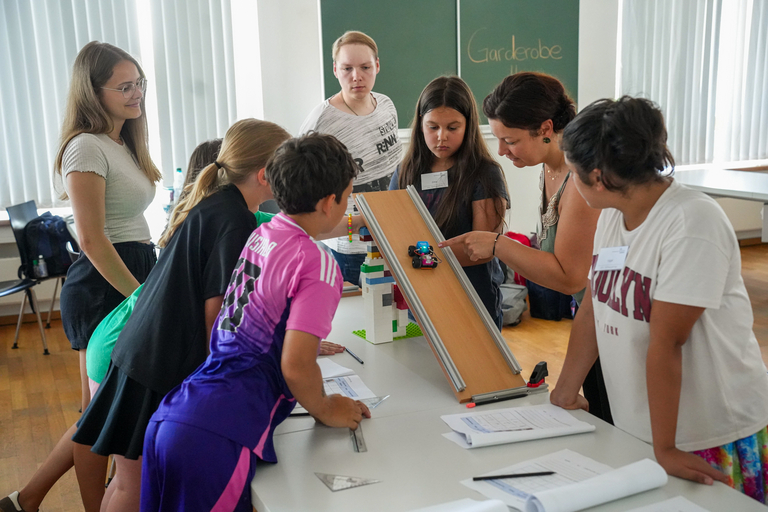
The first day of experimentation at TU Ilmenau at the end of June demonstrated how this concept works in practice. The guests were a fourth-grade class from the Geschwister-Scholl-Schule in Arnstadt. Together with students from the two Thuringian universities, they transformed the Humboldtbau into a discovery workshop.
At various stations, the children built walking robots out of LEGO and electronic building blocks – so-called Circuit Cubes – conducted experiments, and playfully explored engineering questions: Why do the robots move at different speeds? Which robot can handle the steepest incline, and why? And why do the robots perform differently during obstacle courses and cross-country runs?
The foundation for the project was laid by the first open house days for elementary school classes at TU Ilmenau, which were initiated by a request from an elementary school teacher for activities for elementary school children. At the “Im Dialog” conference organized by the eTeach Network Thuringia, Dr. Dagmar Brand from the Department of Elementary Education and Childhood Research at the University of Erfurt and Dr. Stefan Griebel from the Mechanics of Compliant Systems Group at TU Ilmenau met.
Together, they further developed the idea. Building on preliminary work from two “Freiraum” projects and the experiences gained from the open house days, they launched the collaborative pilot project “MI(N)Tmachen!”, which they now co-lead. Dr. Dagmar Brand describes the goal of the collaboration as follows:
Our goal is to bring students from both universities together to create a space for collaborative work. Not all of our students are taking the minor in technology. But through their interaction with students from TU Ilmenau, they must now consider how to work with children on these topics in a way that is appropriate for their developmental stage. In this way, they learn to explain complex content in an understandable way and to stimulate learning processes.
Looking ahead, the project is intended to be permanently established at both universities. At TU Ilmenau, plans are in place to develop a course offering within the Studium Generale program so that students from various disciplines can regularly participate in the development and testing of new STEM learning opportunities.
Making Science Accessible
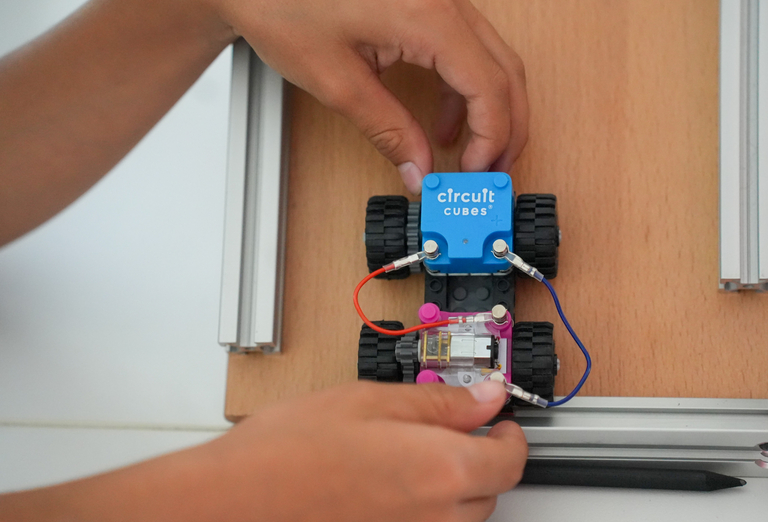
For the kids, the focus was initially on experimenting – and that went for Elma, too:
First, we built the robots in teams of two, and then we tested which robot was the strongest and could climb the ramp the best. Whenever we ran into trouble, the students helped us. It was fun.
For the students, the experiment day was also part of their own learning process. Six bachelor’s students in the “Primary and Elementary Education” program at the University of Erfurt facilitated the stations as part of their “Research in Primary Education” module, gaining valuable experience in planning, conducting, and reflecting on lessons.
One of them is Hanna. As a sixth-semester student in the elementary school teaching program, she deliberately chose to specialize in technology:
“I like being creative. But the class here is great, too, and the kids are really engaged.”
Mechanical engineering student Erik Schubert also participated in the experiment day as a technology expert and quiet observer.
I think the training in mechanical engineering here at the university is pretty cool. But I’ve noticed that the preparation for it in school isn’t that great. That’s why I find this project interesting. It gives the kids an early exposure to mechanical as well as electrical engineering, and programming, and prepares them well for the future.
As a sixth-semester bachelor’s student, he’s writing his thesis and is also contributing to the project. His goal is to expand the range of experiments offered to elementary school children. Even though he isn’t currently thinking about pursuing a master’s degree, he can definitely see himself moving into teaching later on.
I’ve always enjoyed working with children and am passionate about education. Even during my training as a machining technician, I thought: It might be a good idea to become a vocational school teacher.
Strengthening problem-solving skills and interest in technology
This benefits both sides: The children discover science and technology through play, while the students gain valuable experience in interdisciplinary collaboration and the design of educational programs.
The interdisciplinary teams combine different areas of expertise: While the students from Erfurt contribute their subject-specific teaching and pedagogical expertise, the students from Ilmenau supplement this with technical know-how and programming skills. Together, they aim to create innovative teaching and learning units that convey technical content in an age-appropriate and engaging way and inspire children to explore and conduct research on their own.
With visible enthusiasm, the students tested the robots they had built themselves during the first experiment day, discussed their observations, and asked questions. It is precisely this curiosity that the project aims to foster: The goal is to strengthen problem-solving skills, systems thinking, and an interest in technology as early as elementary school. Children should not just have scientific concepts explained to them, but should discover, try out, and understand them for themselves.
Working Together to Advance STEM Education
The project takes a long-term approach. In a multi-stage development process, students not only design lesson plans on STEM topics and test them with elementary school students, but also reflect on their experiences and continuously refine the materials. The resulting digital learning modules and lesson plans are then made freely available to teachers as open educational resources via the Thuringian School Cloud and the Virtual Campus Thuringia.
The first day of experimentation has already demonstrated the potential of this approach: children experience science as an exciting adventure. Students learn to explain scientific content in an understandable way, to guide learning processes, and to refine their concepts based on immediate feedback from the children. This also sets the stage for long-term collaboration, according to Dr. Griebel:
“Our goal is to establish a lasting collaboration among our universities and to integrate subject-specific pedagogical and technical expertise even more closely.”
Contact
Dr. Stefan Griebel
Mechanics of Compliant Systems Group