

In a time when societal, socioeconomic and technological conditions are changing rapidly, higher education teaching must also adapt. Which concepts and methods have proven successful, where are new approaches needed, and which models demonstrably enhance student learning outcomes? Teaching staff of TU Ilmenau presented their ideas, experiences and insights on these questions at the 6th STEM Symposium of BayZiel – the Bavarian Center for Innovative Teaching. The exchange platform for STEM enthusiasts in higher education, held every two years, took place from 17 to 19 September 2025 at Nuremberg Tech (Technische Hochschule Nürnberg Georg Simon Ohm). The contributions have now also been published in the digital conference proceedings: www.mint-symposium.de/tagungsband.
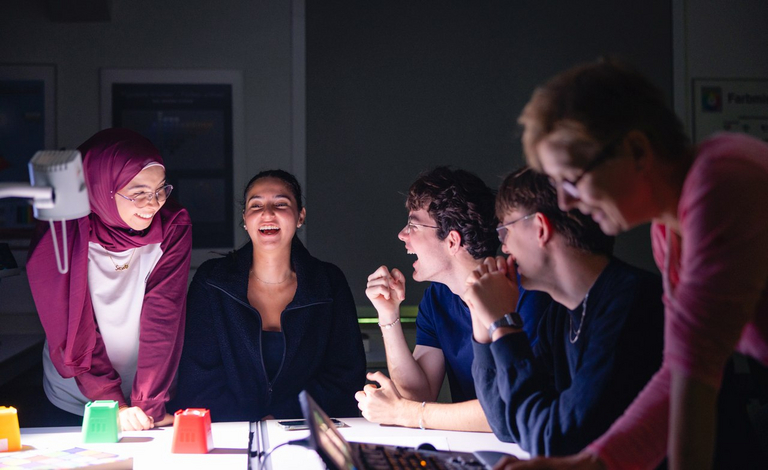
Student STEM tutors as a bridge between school and university
The contribution “STEM Tutors for Thuringian Senior Research Projects” describes an innovative approach developed at TU Ilmenau, in which student STEM mentors support school students in Thuringia during the preparation of their senior research papers. Using a selected project as an example, the authors show how students draw on their experiences from practice-oriented teaching formats such as practicING and the Basic Engineering School and take on a well-founded peer-to-peer mentoring role.
Through the principle of “knowledge on demand,” school students receive relevant information precisely when they need it during their research and writing processes. This collaboration provides authentic insights into academic work, access to laboratories, and the opportunity to apply engineering methods outside the school setting. For the students, this creates a motivating learning environment that strengthens scientific thinking and working skills.
At the same time, the mentors deepen their subject knowledge, expand their didactic and communication competencies, and gain valuable project experience. The multi-year support model fosters trust, continuity, and the sustainable development of personal and professional skills for everyone involved.
Looking ahead, the supervision of senior seminar papers by staff members of TU Ilmenau is to be further improved by strengthening their role, systematically involving students, and better leveraging existing structures and expertise. This will give rise to new forms of cooperation and networks within the university as well as with external partners. Overall, the approach supports STEM education for school students, promotes study orientation, and strengthens the long-term transition from school to university.
Innovative Curriculum Design in the Master’s Program "Electric Power Systems"
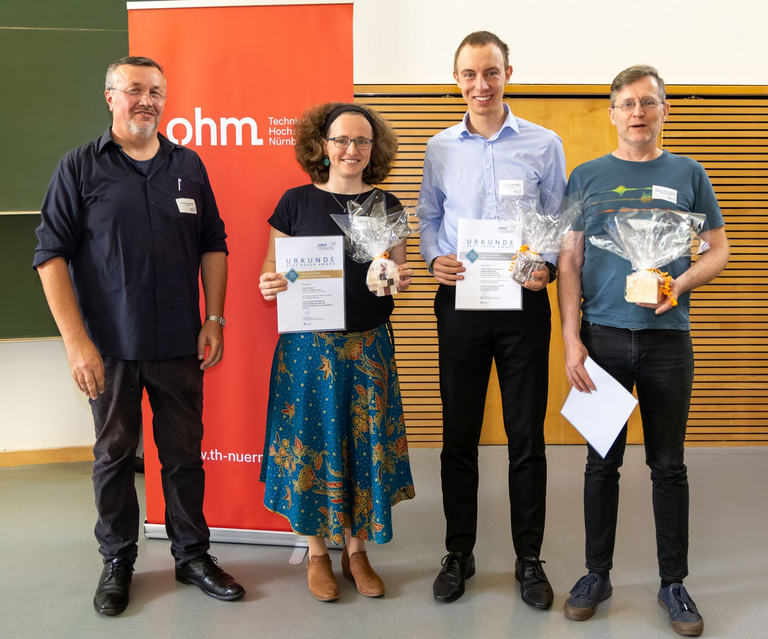
The contribution “Curriculum Design for a Research-Oriented Master’s in Electric Power Systems” outlines the concept of the innovative Master’s program Electric Power Systems, offered by the Department of Electrical Engineering and Information Technology. This program integrates technical elective modules, scientific project work and innovation projects into a holistic concept.
The combination of modules and the coherent structure convinced the jury of the STEM Symposium, earning the contribution the Best Paper Award in Silver.
Science camps as a driver for academic success and career preparation
In the contribution “From Study Orientation to Career Entry: Potentials of the Science Camps of the ThürING Alliance,” the authors show how STEM Science Camps support students during different phases of their studies and contribute to academic success. The focus is especially on the Science Camps for Bachelor’s and Master’s students, organized by the ThürING Alliance.
The camps not only promote subject-related skills but also strengthen teamwork, communication and project management by engaging participants in interdisciplinary, practice-oriented projects. At the same time, the cross-university approach enables students to collaborate across institutional boundaries and learn from one another. Excursions to regional companies and research institutions offer additional valuable insights into applied research and various professional fields. A key factor is the active involvement of student mentors, who support the project teams both organizationally and academically and who significantly shape the learning environment.
“The positive feedback from participants confirms the high added value of the format and its significance for practice-oriented engineering education,” says author Jenny Gramsch, staff member of the Central Student Advisory Service and head of the Student Research Center.
Carsten Gatermann, Diplom-Ingenieur and research associate in the Group for Electrical Power Supply, contributed his experiences from two initiatives at the STEM Symposium and concludes:
“The STEM Symposium offered a great opportunity for networking and generating new impulses for student-centered higher education teaching. We are already looking forward to the STEM Symposium 2027.”
All contributions can also be found in the digital conference proceedings of the STEM Symposium at www.mint-symposium.de/tagungsband.
The camps not only promote subject-related skills but also strengthen teamwork, communication and project management by engaging participants in interdisciplinary, practice-oriented projects. At the same time, the cross-university approach enables students to collaborate across institutional boundaries and learn from one another. Excursions to regional companies and research institutions offer additional valuable insights into applied research and various professional fields. A key factor is the active involvement of student mentors, who support the project teams both organizationally and academically and who significantly shape the learning environment.
“The positive feedback from participants confirms the high added value of the format and its significance for practice-oriented engineering education,” says author Jenny Gramsch, staff member of the Central Student Advisory Service and head of the Student Research Center.
Carsten Gatermann, Diplom-Ingenieur and research associate in the Group for Electrical Power Supply, contributed his experiences from two initiatives at the STEM Symposium and concludes:
“The STEM Symposium offered a great opportunity for networking and generating new impulses for student-centered higher education teaching. We are already looking forward to the STEM Symposium 2027.”
All contributions can also be found in the digital conference proceedings of the STEM Symposium at www.mint-symposium.de/tagungsband.
All contributions can also be found in the digital proceedings of the MINT Symposium at www.mint-symposium.de/tagungsband:
- C. Gatermann, N. Weißinger, J. Gramsch, S. Fincke: "MINT tutors for Thuringian technical work projects" (conference proceedings pages 24-30 + poster)
- C. Gatermann, N. Belz, R. Pabst, D. Westermann: "Curriculum design for a research-oriented master's degree in energy systems" (conference proceedings pages 161-169 + poster)
- J. Gramsch, S. Fincke, M. Testa, F. Meier, L. Abrahamczyk: "From study orientation to career entry: Potentials of the Science Camps of the ThürING Alliance" (conference proceedings pages 186-193 + presentation)
The fifth IEEE German Education Conference (GECon) from July 20 to 22, 2026 at TU Ilmenau offers another opportunity to immerse yourself in the world of innovative university teaching. Some parts of the program will also be open to the university public.
Further information and call for papers: www.ieee.de/gecon
Contact
Prof. Anja Geigenmüller
Vice President for Teaching and Learning