

Gold for an Invention from Ilmenau: “VolumeControl 2.0” is designed to keep injection-molding processes stable even when the properties of recycled plastics change.
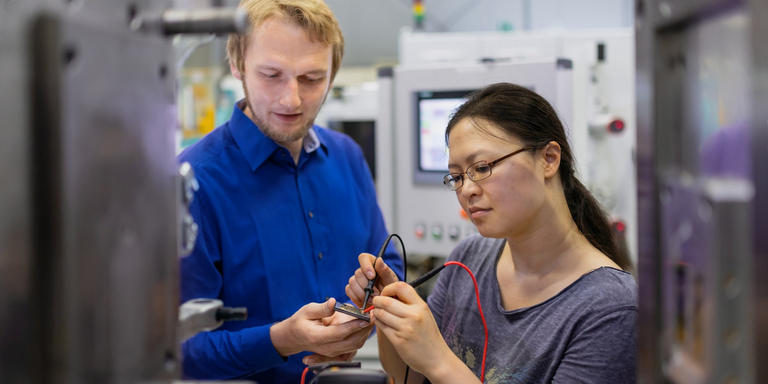
Recycled plastics are in demand, but their properties can vary from one molded part to the next. This makes them challenging to process on an industrial scale: changes in viscosity, the material’s resistance to flow, as well as in filler content or material composition can alter how the plastic fills the mold during injection molding. As a result, a component may not be completely filled even though the machine settings remain unchanged, parts may vary in weight, or the mold may be overfilled, resulting in rejects.
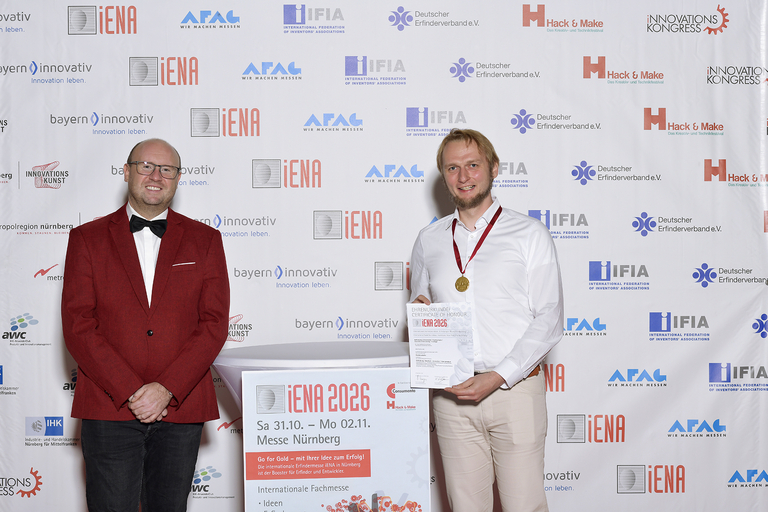
This is exactly where “VolumeControl 2.0” comes in. The invention by Dr. Matthias Bruchmüller from the Plastics Engineering Group at the TU Ilmenau was awarded a gold medal at iENA 2026 – the International Trade Fair for Ideas, Inventions, and Innovations in Nuremberg.
The control method developed by Matthias Bruchmüller determines, during the ongoing injection molding process, how much plastic actually enters the mold. This allows for a more precise determination of the timing for the transition from injection to holding pressure.
To do this, “VolumeControl 2.0” uses existing machine data, particularly pressure and position information. A physically informed soft sensor evaluates this data in real time. Additional sensors directly in the mold are not necessary. Dr. Matthias Bruchmüller explains:
This development is particularly interesting for applications in which companies use recycled materials – such as plastic pellets from old plastic bottles – or varying material batches; for example, for housings of electrical appliances, technical plastic components, or automotive parts.
Different filler content or frequently changing materials could also influence the process.
The development is intended to help produce components more consistently, make the process more stable, and prevent scrap. At the same time, it can reduce the effort companies have previously had to expend to adapt injection molding processes to new materials.
In this way, “VolumeControl 2.0” could help ensure that recycled materials are used more reliably in industrial plastics production.
The invention was patented under patent number DE 10 2025 115 214 B3. The process has already been tested on laboratory and industrial equipment.
The following inventions by the TU Ilmenau and its affiliated institute were also honored at iENA:
SPAD-based sensors for in vitro diagnostics. Photodiodes replace complex and costly optics
IMMS, Inventors: M.Sc. Benjamin Saft, M.Sc. Maximilian Wiener, M.Sc. Eric Schäfer
The invention enables precise medical tests in which, for example, DNA or proteins can be analyzed simultaneously across many small test fields. Instead of relying on complex optics, the system mathematically compensates for differences in illumination using additional photodiodes. This paves the way for compact and more cost-effective diagnostic systems.
Passive exoskeleton to assist with lifting tasks
Inventors: Dipl.-Ing. Felix Poppel, Dr.-Ing. Lukas Merker, Dr.-Ing. Stefan Griebel, Prof. Dr.-Ing. habil. Lena Zentner
The exoskeleton developed at the Technical University of Ilmenau assists people with lifting without requiring motors or batteries. It stores kinetic energy while the user bends over and releases it during the subsequent lifting motion, thereby relieving strain on the weaker muscles in particular and making lifting physically easier.
Seeding Unit and Mobile Seeding Device
Inventors: M.Sc. Konrad Scheller, M.Sc. Martin Richter, Dr.-Ing. Maik Rosenberger, M.Sc. Lukas Petrich
A lightweight robot is designed to automatically sow seeds or specially coated seed pellets even on steep or hard-to-reach terrain. The process begins by drilling a hole, depositing the seed, and then recording the position via RTK-GPS—that is, satellite-based positioning with real-time correction. This is intended to make reforestation more precise, gentler on the soil, and possible with less physical effort.
The inventions were presented at the iENA trade fair from October 31 to November 2, 2026, by PATON | Thuringia State Patent Center at the Technical University of Ilmenau.
In total, 580 inventions from 340 exhibitors representing 21 countries and regions in Europe, Asia, and the Middle East were presented at this year’s invention fair and evaluated by an international jury of experts.
Dipl.-Ing. Tino Rhein
Leiter PATON-PTH | Innovationsmanager