

Is the North Pole drunk? With this question, PhD student Andreu Queralt McBride opened the first Science Slam of the PhD Roundtable at TU Ilmenau on February 4, initiated by Kamila Costa: "We want to show that science must be very precise, careful and methodically correct in order to be reliable, comprehensible and verifiable, but at the same time it can also be very accessible and playful," says the PhD student.
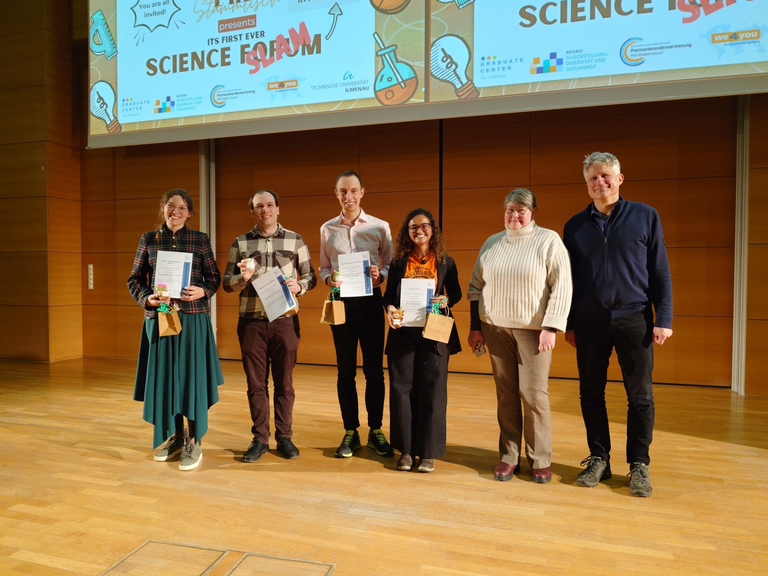
Under the motto "Science works much better when you share it", a total of four young researchers presented their work in an entertaining way as part of the internal science forum.
"Is the North Pole drunk?"
"Today I'm going to address a question that I'm sure you ask yourself every morning: Is the North Pole drunk?" With this - and with a wink - Andreu Queralt McBride opened the first Science Slam of the PhD roundtable in the Audimax. The PhD student came to Ilmenau from Barcelona in April 2025 and is conducting research in the field of magnetohydrodynamics at the Institute of Thermo and Fluid Dynamics. Specifically, he is working on the question of how magnetic fields influence the flow of electrically conductive liquids. In his presentation, the young scientist explained in a humorous way why the geographic and magnetic North Pole are in different places and why the North Pole is constantly changing its position - and, true to his motto, also answered questions from the audience:
For me, science is the best tool to satisfy human curiosity.
Paulina Marczakiewicz-Perera from Poland, who researches microfluidic platforms for plant cells at the Institute of Chemistry and Biotechnology, also aroused the curiosity of the audience. Her system makes it possible to operate and study plant farms "that are so small that you can only see them under a microscope". Her goal: to study early development processes of plant cells under different conditions and thus create important foundations for later optimization and selection strategies. For her, too, science means constant curiosity and answering new questions that arise during research - such as at the Science Slam in the Audimax following her presentation.
Under the motto "Science made easy", Carsten Gatermann, a graduate in Electrical Engineering and Information Technology and research assistant in the Group of Electrical Energy Supply, presented his research on electrical energy systems: "Black out in Spain and Portugal, integration of hydrogen and renewable energies into the energy system and conversion from alternating to direct current grids: The challenges in our energy system that we will have to overcome in the coming years are immense - and complex." In the Audimax, the young scientist outlined these challenges in a simple and entertaining way in just ten minutes. He also motivated the audience to play an active role in shaping these changes.
Finally, Kamila Costa, an electrical engineer from Brazil, presented her research into optimizing the lightning and surge protection of large photovoltaic and agrivoltaic systems. This is because the rapid expansion of solar energy brings with it new challenges: large solar systems require a lot of space and increasingly compete with agricultural land. Agri-photovoltaics offers a solution to this by allowing agriculture and electricity generation to be carried out on the same area at the same time. But how can the external lightning protection system of such systems be optimized to minimize the use of materials and protect personnel and livestock? Kamila Costa presented this research question humorously at the Science Slam. Her motto:
Science happens where curiosity meets responsibility and questions never stop being asked.
There were plenty of questions at the Science Slam - and at the end there were also certificates for the participants, presented by Prof. Stefan Sinzinger, Vice President for Research and Young Scientists, and Alexandra Dalek from the university's Graduate Center. She also received special thanks from Science Slam initiator Kamila Costa:
Without her support from the very beginning, this initiative would never have become so concrete.
With the first Science Slam, the doctoral students not only inspired the audience, but also created a relaxed space for networking, exchange and open discussion - just as is the aim of the PhD Stammtisch itself, an initiative by doctoral students for doctoral students at TU Ilmenau. Initiator Kamila Costa:
All PhD students, but also Master's students who are considering a PhD, are welcome to join our Stammtisch.
The initiative is supported by the Graduate Center, the Division for Equality, Diversity and Health, the we4you student service and the TU Ilmenau doctoral student representatives.