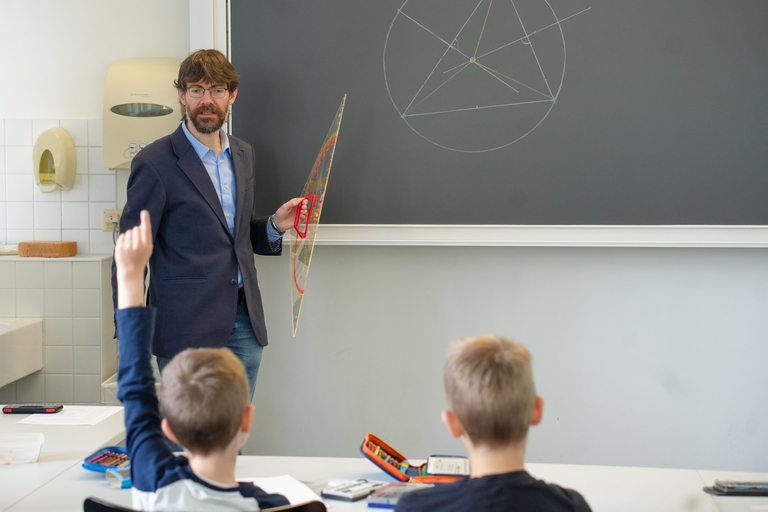
"Do you like math?" "Yay!" The answer of the 25 third-graders to the question posed by math professor Thomas Hotz was clear: math is fun! On May 19, 2026, primary school children from the region who are particularly interested and talented in mathematics and science learned all about what you can do with mathematics, physics and chemistry at Ilmenau University of Technology.
“Do you like math?” – “Yeeeeees!” The answer given by the 25 third-grade students to mathematics professor Thomas Hotz was loud and clear: math is fun! On May 19, 2026, the particularly talented and science-minded elementary school children learned at Technische Universität Ilmenau just how exciting mathematics, physics, and chemistry can be.
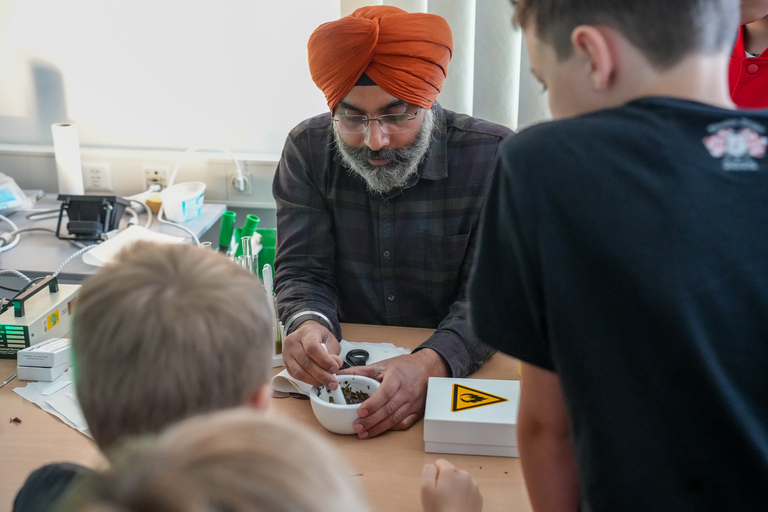
Together with Sukhdeep Singh, head of the research group Bioorganic Chemistry of Bioactive Surfaces, the children explored the hidden world of plants through hands-on activities at TU Ilmenau.
For the third time, the children had been invited as part of the Ilm district’s gifted education program, organized in cooperation with the university’s student research center, to tackle fascinating puzzles and STEM experiments. Throughout the morning, the students and their teachers, Hanni Hille and Marianna Schulz, gained exciting insights into chemistry, physics, and mathematics. They worked alongside professors and researchers from the university and, like real students, had the chance to bombard them with questions.
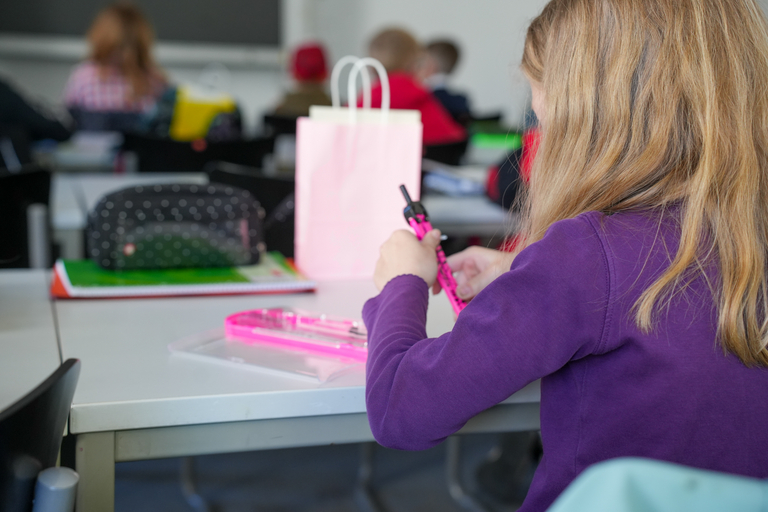
The day began with mathematics: What are even numbers, whole numbers, or even “in love” numbers? And how can simple formulas be recreated using colorful sticks? The children explored these questions together with Jan Heiland from the Optimization-based Control department. During a “lecture” by mathematics professor Thomas Hotz, the children also worked with compasses and rulers, constructing circumcircles of triangles while learning what a mathematical proof is.
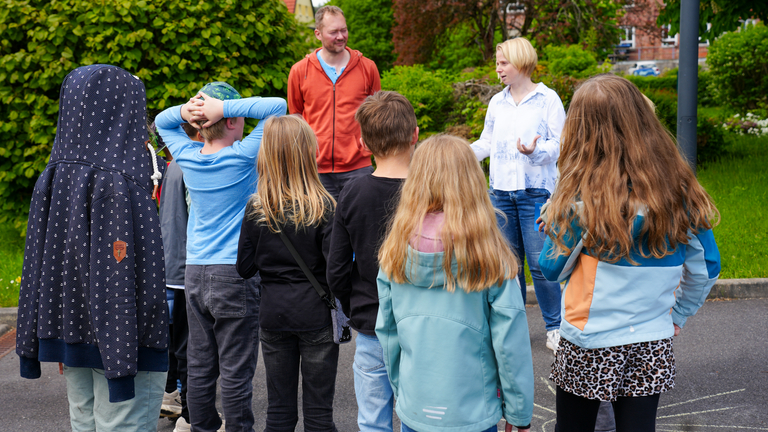
During the physics session with Anke Sander and Marcus Bose from the introductory physics lab, the children focused on renewable energy: How is electricity generated when wind turns turbines or water drives a waterwheel? What happens inside a solar cell when sunlight shines on it? They investigated these questions both experimentally and through playful activities – even turning themselves into “electrons.”
Finally, together with Sukhdeep Singh and his colleagues from the Nano-Biosystems Engineering Group, Merle Küster and Maren Klett, the curious students explored the chemical functions of biology and discovered the hidden world of plants through practical experiments: How do plants “breathe”? And what role do their tiny “mouths” – the so-called stomata on their leaves – play? To answer these questions, the children made leaf imprints and examined them under the microscope.
In a simple photosynthesis experiment, they also learned how plants use light to produce their own food. The enthusiasm of lecturer Sukhdeep Singh and his colleagues quickly spread to the children as well:
Together, we extracted chlorophyll from leaves and used simple chromatography to discover the different pigments found in plants. The children were able to observe for themselves how light interacts with chemical substances and how fascinating chemistry in nature – and science in everyday life – can be. Our goal is to spark curiosity, encourage a love of discovery, and introduce children to the fascinating world of plants and chemical processes.