

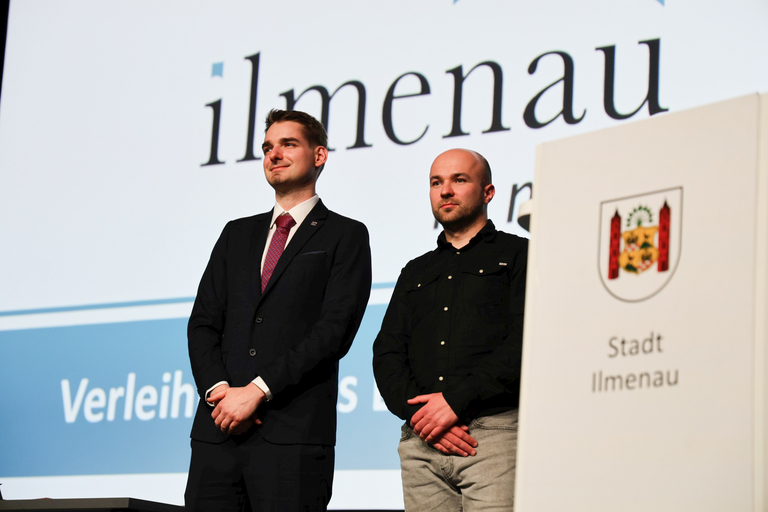
Johannes Belkner and Daniel Seichter have been honored with the Dagmar Schipanski Prize for their outstanding scientific work at the TU Ilmenau. Their award-winning dissertations show how research is being carried out at TU Ilmenau that pushes technological boundaries and enables concrete applications in industry and society.
Precision manufacturing rethought
His research on the integration of processing and measurement optics will make it possible in the future to accurately create ultra-fine structures—a hundred times thinner than a human hair—using a laser, even on uneven workpieces. Until now, this has been achieved with high precision primarily on flat workpieces, as even small deviations from the ideal laser focus lead to errors. Using the new system, the workpiece can be kept stably in focus down to a single nanometer.
To achieve this, he combined high-precision nanopositioning technology, new confocal measurement methods, and intelligent algorithms for error correction. An optimized laser beam guidance system additionally ensures more stable results. “This opens up new possibilities for the flexible production of highly specialized macroscopic components, for example in optics, medical technology, or sensor technology—especially where customized solutions are required, such as for individual prototypes or small product series,” explains Dr. Belkner.
Johannes Belkner studied mechatronics at TU Ilmenau, where he completed his Master of Science in 2019. In the meantime, he gained international experience during a research stay in Taiwan and as a research assistant at the Leibniz Institute of Photonic Technology in Jena. Since April 2020, Belkner has been working on his doctorate as part of the interdisciplinary research training group "Advanced and laser-based 3D nanofabrication in extended macroscopic working areas"(3D-NanoFab), which has been funded by the German Research Foundation (DFG) since 2017. Three generations of young scientists have already had the opportunity to carry out specialized cutting-edge research in a research and qualification program and to complete their doctorates at the highest level.
In June 2024, Johannes Belkner defended his dissertation with summa cum laude under the supervision of Prof. Eberhard Manske, Prof. Thomas Kissinger and Prof. Peter Lehmann from the University of Kassel. Since then, he has been working as a postdoctoral researcher at the Institute of Process Measurement and Sensor Technology at TU Ilmenau, focusing on precision measurement technology using confocal microscopy and nanopositioning in five spatial directions.
Robots that understand instead of just seeing
Daniel Seichter was also awarded the Dagmar Schipanski Award for his dissertation on AI-based environment analysis in mobile robotics, which he wrote at the Neuroinformatics and Cognitive Robotics Lab under the supervision of Prof. Horst-Michael Groß. Prof. Tamim Asfour from the Karlsruhe Institute of Technology (KIT) and Prof. Wolfram Burgard from the University of Nuremberg (UTN), two internationally recognized robotics experts, were also involved as reviewers.
His work focuses on the question of how robots can not only detect interiors, but really "understand" them. To this end, the scientist developed deep learning methods that recognize objects, interpret scenes and combine this information appropriately. The systems he developed not only analyze rooms in detail, but also particularly efficiently directly on the robot - a decisive advantage for practical use.
Daniel Seichter also linked these analyses with three-dimensional maps, which contain far more than just geometry. They also store meaning and contextual information and thus become a real knowledge base for the robot. This enables better navigation, predictive planning and safer interaction with humans. "The first successful applications in the field of domesticity as part of our MORPHIA and CO-HUMANICS research projects show that these approaches are already suitable for practical use," says Prof. Groß.
Daniel Seichter completed his Master's degree in Computer Engineering with distinction in 2017. In October 2024, he also completed his doctorate summa cum laude. He now works as a team leader for near-field perception at Spleenlab, where he works on AI software for autonomous systems with a focus on safety and reliability. He is still associated with TU Ilmenau as a research assistant at the Neuroinformatics and Cognitive Robotics Lab with teaching and research duties.
The Dagamar Schipanski Award was presented to Dr. Johannes Belkner and Dr. Daniel Seichter on 26 March 2026 at the reception of the city of Ilmenau by the Chairman of the Ilmenau University Society, Prof. Peter Scharff, and Ilmenau's Lord Mayor Dr. Daniel Schultheiß.
About the Dagmar Schipanski Award
The Dagmar Schipanski Award is awarded annually by the "Universitätsgesellschaft Ilmenau - Freunde, Förderer, Alumni e. V." and honors outstanding dissertations of particular scientific quality and social relevance. The award is named after the physicist and former President of the Thuringian State Parliament, Dagmar Schipanski, who has been committed to science and research for many years. The award specifically highlights work that is not only technically excellent, but also provides impetus for innovation and application - a requirement that both of this year's award winners fulfill in a special way.