

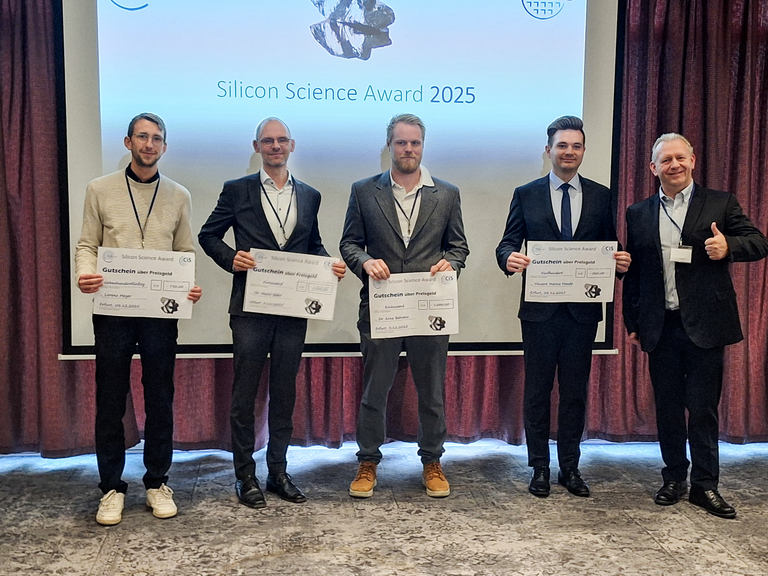
On December 3, three young scientists from TU Ilmenau were honored with the Silicon Science Award 2025 for the great knowledge gained from their scientific work on the smallest structures: Dr. Arne Behrens, Lorenz Meyer and Vincent Marius Haude. The prize, which was awarded on 3 December at the international conference "WaferBond '25" in Chemnitz, was presented by CiS e.V. and CiS Forschungsinstitut für Mikrosensorik GmbH in recognition of the high practical value of their challenging doctoral, master's and bachelor's theses on quantum physics, micro-optics and sensor technology.
Whispering galleries for light
In his dissertation at the Optical Engineering Group, Dr. Arne Behrens researched so-called whispering gallery mode resonators (WGMRs ) - microscopically small, ring-shaped structures in which light is guided in a circle similar to an acoustic whispering gallery. Such structures are the building blocks of many future technologies: they can serve as extremely sensitive sensors or stabilize lasers with particular precision. They also enable compact and energy-efficient solutions in photonic integrated circuits, i.e. tiny chips that control and process light signals in waveguides.
To ensure that the light signals remain stable, the side walls of these microstructures must be extremely smooth and precisely shaped. This is because even the smallest deviations lead to light losses and impair the resonator properties. This is still difficult to achieve today, which is why conventional methods usually require the side walls to be reworked and smoothed in a complex and technically demanding process.
Precision beyond classic production limits
This is precisely where Dr. Behrens' research at the Center for Micro and Nanotechnologies (ZMN) comes in: In his work, he further developed a plasma-based manufacturing process with which the sidewall inclination and roughness of microstructures in silicon, silicon nitride and silicon oxide can be controlled much more precisely. This so-called 2.5D+ microstructuring makes it possible for the first time to produce high-quality WGMRs directly from the lithographic process - without labor-intensive post-polishing. This also makes more complex resonator arrangements possible, such as those required for photonic systems and optical microchips.
At the same time, Dr. Behrens developed a new method for characterizing these resonators. During a research stay at the Okinawa Institute of Science and Technology in Japan, he worked with the sophisticated technique of optical coupling via so-called tapered fibers. Based on this experience, he then developed fluorescent resonators that can be examined particularly reliably using single photon correlation.
Scientifically visible and committed beyond research
Dr. Behrens published the results of his work in high-ranking international journals and presented them at scientific conferences and expert workshops. He was supervised by Prof. Stefan Sinzinger, Vice President for Research and Young Scientists and Head of the Optical Engineering Group at TU Ilmenau:
Dr. Behrens has further developed the topic of whispering gallery mode resonators with great scientific creativity in an almost ideal way and has thus earned himself a considerable reputation as a scientist and proven specialist in the field of reactive ion etching. In addition to the documented scientific quality of his work, he impressed me above all with his personal qualities as a long-standing member of staff and highly motivated and committed doctoral student in my research group. For example, he was involved for many years in the TU Ilmenau's doctoral student representative body, where he campaigned for better conditions and more exchange within the doctoral student body.
After completing his doctorate, Dr. Behrens continued his career at Zeiss Semiconductor Manufacturing Technology (SMT) in Oberkochen. He works there as a specialist in plasma-based manufacturing processes and applies his research findings directly to industrial microfabrication.
Molecules as switches for electric current
Lorenz Meyer dealt with quantum objects in his Master's thesis at the Experimental Physics Group at TU Ilmenau. Using a scanning tunneling microscope, he investigated how electric current flows through the interface between a normal conductor - a material with normal electrical resistance - and a superconductor, which conducts electricity without loss at low temperatures. Both were connected to each other by a single molecule.
The current in such arrangements is carried by what is known as Andreev reflection. Electrons in the normal conductor are converted into so-called Cooper pairs in the superconductor - and vice versa. Until now, it was generally assumed that this conversion was primarily dependent on the respective material combination at the interface.
Lorenz Meyer has succeeded in significantly expanding this view and thus advancing the physical understanding of Andreev reflection on an atomic scale. The molecule has a crucial task when it comes to controlling the efficiency of Andreev reflection: its bond to both electrodes is mediated by an electron orbital. If this orbital has the right energy, it increases the electrical conductance of the contact - and therefore also the rate of Andreev reflection.
Quantum effects at the atomic boundary
The crucial point here is that the energy of this orbital can be changed in a targeted manner. According to supervisor Prof. Jörg Kröger, Lorenz Meyer has not only uncovered new aspects of Andreev reflection with this finding, but has also taken an important step towards the active control of quantum physical processes from the macroscopic world.
According to the Thuringian research prize winner, these results could even find technological applications in the future - for example as active components in miniaturized superconducting circuits, which are becoming increasingly important in quantum and nanotechnology:
Mr. Meyer's study shows once again that experiments with a model-like character on the atomic scale lead to great gains in knowledge. First and foremost, it is not important to realize an application, but to recognize the physical mechanisms and principles underlying a phenomenon. In this sense, Mr. Meyer has looked into the nature of charge transport via quantum contacts.
Mr. Meyer's work was published in the leading journal of the American Physical Society, Physical Review Letters, one of the most important journals for physics research. Because it both advanced the fundamental understanding of physics and opened up new perspectives for quantum technological applications, the publication received two further awards. It was selected as an Editors' Suggestion and was also highlighted in the journal Physics under the title Superconductivity Traverses a Single Molecule Bridge. Now it has been honored with the Silicon Science Award as well.
Fast LEDS for in-vitro diagnostics
Vincent Haude, electrical engineer and researcher at the IMMS Institut für Mikroelektronik- und Mechatronik-Systeme gemeinnützige GmbH (IMMS GmbH) received the Silicon Science Award for his bachelor's thesis “Development and characterization of a circuit topology for the generation of short LED light pulses”. It was written in collaboration with IMMS and Ilmenau University of Technology and was supervised by Alexander Rolapp, specialist for the characterization and testing of integrated circuits at IMMS, and Prof. Hannes Töpfer at the Department of Theoretical Electrical Engineering.
In his thesis, the young scientist developed and tested a very compact circuit with which LEDs can be switched on and off significantly faster and more precisely. This makes the system particularly suitable for measurement methods that require short light pulses - such as time-resolved fluorescence measurement. With its help, even the smallest concentrations of pathogens can be detected, for example, which were previously relatively time-consuming and costly to measure using large analysis devices in central laboratories. The circuit developed by Vincent Haude is therefore suitable, among other things, for integrated sensor systems in point-of-care devices for in-vitro diagnostics, such as those being researched and developed at IMMS. They make it possible to analyze medical samples without a detour to the laboratory in order to make quick and reliable diagnoses directly on site or to monitor therapeutic measures.
"Vincent Haude has produced outstanding work on a very challenging topic that strengthens Thuringia's innovative power in the key sector of sensor technology," said Prof. Töpfer:
Increasingly sensitive sensor systems can be used to improve analysis processes in medicine and environmental analysis and are therefore of considerable interest to society.
About the Silicon Science Award
The Silicon Science Award is presented every two years by CiS e.V. and the CiS Research Institute for Microsensor Technology. Prizes are awarded for outstanding bachelor's and master's theses as well as dissertations related to silicon-based microsystems technology, optoelectronics and quantum technologies, which are fundamental to many scientific and economic innovations in order to solve social challenges such as climate protection or resource efficiency. A jury of experts from science and industry as well as members of the Scientific Advisory Board and the Executive Board of CiS e. V. assess the submitted work in terms of its degree of innovation and scientific significance, among other things.
Original publications
Arne Behrens, Stefan Sinzinger, "2.5D+ plasma etching for a continuously adjustable sidewall angle in SiO2," Opt. Mater. Express 13, 1780-1796 (2023).
Christoph Weigel, Ulrike Brokmann, Meike Hofmann, Arne Behrens, Edda Rädlein, Martin Hoffmann, Steffen Strehle, Stefan Sinzinger, "Perspectives of reactive ion etching of silicate glasses for optical microsystems," Journal of Optical Microsystems, Vol. 1, Issue 4, 040901 (December 2021). https://doi.org/10.1117/1.JOM.1.4.040901
Lorenz Meyer, Jose L. Lado, Nicolas Néel, Jörg Kröger, "Control of Andreev Reflection via a Single-Molecule Orbital", Phys. Rev. Lett. 134, 146201 (2025). https://doi.org/10.1103/PhysRevLett.134.146201