

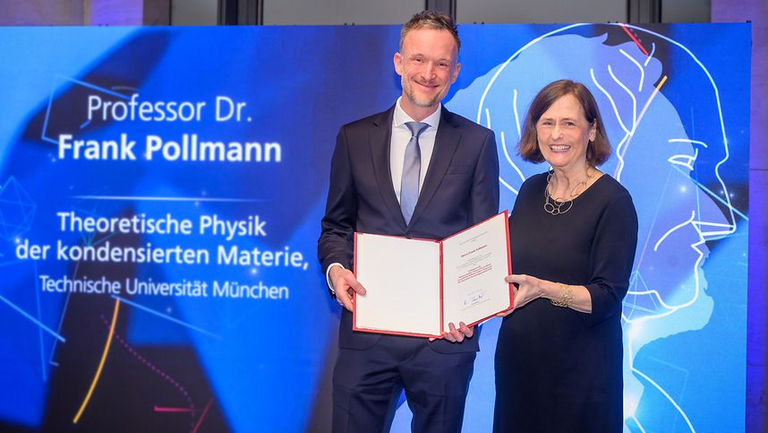
When Frank Pollmann defended his doctoral thesis at the Institute of Physics at the Technische Universität Ilmenau in 2006, he could never have imagined that almost exactly twenty years later he would be named one of the 2026 Gottfried Wilhelm Leibniz Prize winners by the German Research Foundation (DFG), receiving up to €2.5 million for his outstanding research in theoretical quantum physics. Now a professor of Theoretical Solid-State Physics at the Technical University of Munich (TUM), he looks back with gratitude: “Receiving the distinction summa cum laude from TU Ilmenau was an important first step on that path.”
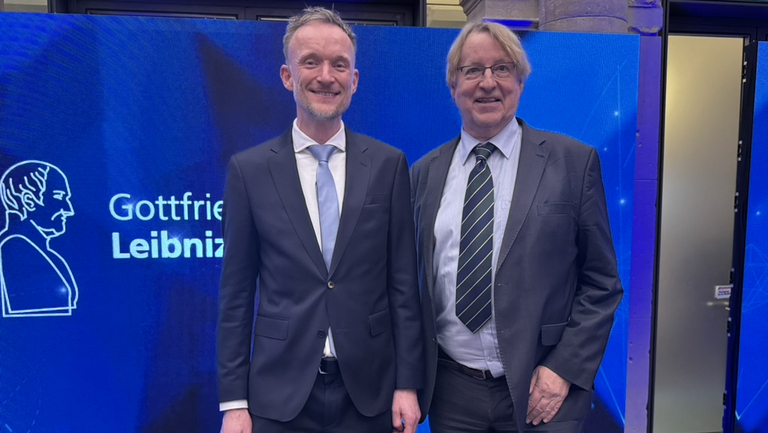
After studying physics at the Technical University of Braunschweig and the Royal Institute of Technology in Stockholm, Frank Pollmann came to the Max Planck Institute for the Physics of Complex Systems (MPIPKS) in Dresden, where in 2006 he met Erich Runge, now Professor of Theoretical Physics at TU Ilmenau, in the research group of Prof. Peter Fulde. “At the time, we were working together on so-called frustrated, highly correlated electronic systems. Today, these phenomena would be described as emergent behavior in topological quantum phases, which sounds a bit nicer than ‘frustrated systems,’” Erich Runge recalls.
After Runge was appointed head of the Theoretical Physics I group at TU Ilmenau, it was clear that Frank Pollmann would complete his doctorate there as his first doctoral student. “I don’t know which of the two of us was more nervous back then,” Runge says, remembering the dissertation defense.
Everything went extremely well, however, and Frank Pollmann received his first major honor with the Otto Hahn Medal, awarded for one of the best dissertations in the Max Planck Society.
Over the course of his academic career – from the University of California, Berkeley, in the United States, and Academia Sinica in Taipei, Taiwan, to TU Munich – Prof. Pollmann remained true to the study of complex and topological systems. He was also among the first to recognize their importance for quantum computing, and especially for topologically protected qubits.
He also continued to speak about his findings during visits and lectures at TU Ilmenau and with his doctoral advisor, memories that Prof. Erich Runge still cherishes – including one shared restaurant visit:
On his first visit to Ilmenau, Frank Pollmann ordered a small beer at the Nasse Post and, quite astonished, told me he had paid ‘six ninety.’ I was shocked – but then it turned out that the price of ninety-six cents seemed unbelievably cheap to him, coming from Dresden.
Runge says he could imagine a similar success story for a handful of younger Ilmenau graduates as well, but he also knows:
In academia, there are only a few people who are as kind and at the same time as successful as Frank.
Contact
Prof. Dr. Erich Runge
Head of Theoretical Physics 1