

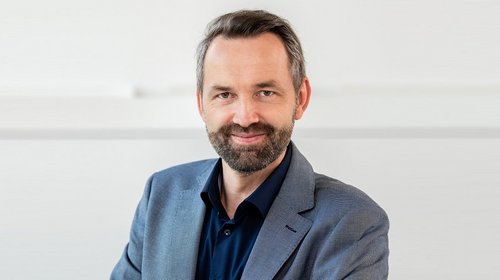
Since December 1, 2025, Professor Dr. Sascha Klee has headed the Computational Medicine Group at the Institute of Biomedical Engineering and Informatics at TU Ilmenau.
Prof. Klee completed his studies in electrical engineering in Ilmenau and then earned his doctorate in the field of neuroscience, i.e. research into the nervous system and the brain. During his time as a post-doctoral researcher, he conducted research into opto-neurological rehabilitation, among other things. This involves using special optical imaging principles to support neurological functions in patients with age-related macular degeneration (AMD), a common disease of the retina. Another focus of his work was the evaluation of multimodal medical data, in which information from different information domains such as image, measurement and clinical data are analyzed together.
From 2016, Prof. Klee established new methods for processing sensor data as a junior professor of optoelectrophysiological medical technology. These sensor systems record electrical and optical signals from the body and are used in particular to study the human visual system, i.e. vision.
In 2021, Prof. Klee accepted a professorship in biostatistics and data science at the Karl Landsteiner University of Health Sciences in Austria. There, he developed models for the further use of complex, multidimensional clinical data in order to tailor medical decisions more closely to individual patients - a central approach to personalized medicine.
Prof. Klee now wants to continue this research in Ilmenau and specifically expand it to include new issues in which medical data is used proactively, for example for more efficient diagnostics or better planning of therapies:
The subsequent use of existing clinical data to gain new insights into disease progression or the effectiveness of therapies has been insufficiently researched to date. The methods often do not go beyond the calculation of simple quality assurance measures. I am very much looking forward to making a contribution to more efficient medicine by developing complex models.