What does it take to combine academic research with raising a family? This was a topic of discussion at this year’s PhD Day at TU Ilmenau. And that's a question that's also on Philibert's mind who is pursuing his PhD at TU Ilmenau as part of the EU Horizon-funded Marie Skłodowska-Curie Actions (MSCA) doctoral network LASERS4NETZERO. His research focuses on how thin stainless-steel sheets can be reliably laser-welded for use in fuel cells. In his interview with UNIonline, he talks about the challenges of balancing research and family life – and about his enthusiasm for technologies that can contribute to more climate-friendly energy and mobility.
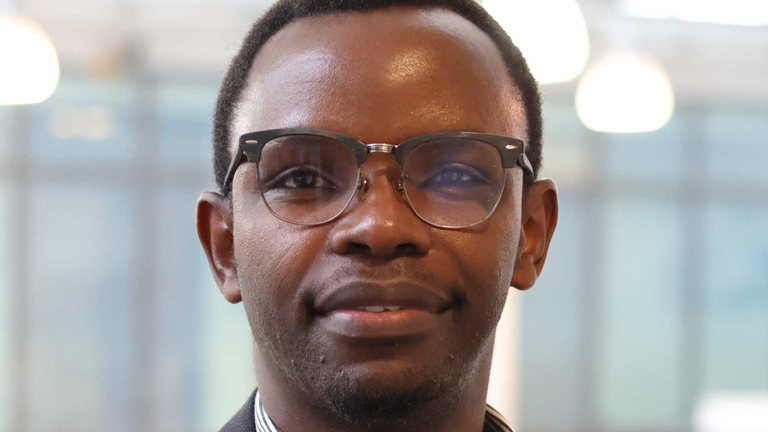
Mr. Muhayimana, what motivated you to pursue a PhD at our university?
I was born and raised in Rwanda, a country well known for its thousand hills in Eastern Africa. My journey towards a PhD started in 2013 after completing my bachelor’s degree in Rwanda and led me to a a master’s degree in mechanical engineering in Kenya. Then COVID came, and many things became uncertain. So I initially focused on my family. After my first child was born in December 2020 I wanted to work and provide a stable financial foundation for my family.
So when I came across the LASERS4NETZERO position on LinkedIn, I applied and was selected as one of twelve doctoral researchers for the European Marie Skłodowska-Curie Doctoral Network at TU Ilmenau.
Meanwhile, you are raising two young children. What does a typical day look like for you, and how do you balance research and family life?
Most of the time, I wake up at 4 am and I start my day with a devotional, after which I check my calendar for the day. That is when I read papers that I failed to understand during the day. After taking my kids to kindergarden by bus I go to the office.
What does your research day look like?
A large part of my work involves reading scientific papers, conducting experiments and using numerical simulations. Sometimes we have to redo the experiments. Sometimes our papers are rejected by different journals. Then we need to rework or rewrite. All of these uncertainties define my office work. Sometimes we have meetings or business trips that overlap with my everyday schedule; that is when it becomes a challenge.
My evening belongs to my children. After putting them to bed I sometings have to work for another one or two hours, depending on the urgency.
What are the biggest challenges for you in all of this?
The biggest challenge is when things are falling apart, and I still have to put on a smile for my kids. Many times, things do not go as I had hoped, and this affects my morale. When I go home, I do not want to present myself as a researcher whose paper has been rejected, whose simulations are not working, or whose data do not make sense. I want to go home simply as a father, a man who inspires his children and a strong and caring husband to his wife.
Separating these two parts of myself is not always easy. Trying to hide the frustration and disappointment can be emotionally exhausting.
My children also want me to spend time with them, especially at the weekend. When important deadlines are approaching, this is not always possible. On the other hand, parenting is helping me a lot because spending time with them is a form of stress relief.
Has becoming a parent also changed you as a researcher?
Definitely. As a father, I have to plan my working hours, priorities and deadlines carefully. During my PhD, for example, I have learned to organise appointments so that they do not overlap.
I have also become more resilient. A PhD is demanding and requires resilience and persistence at every step. Life itself is also full of uncertainties. As a father, I have to learn to stay strong enough to deal with these challenges.
Parenthood has also made me more patient and understanding. As a father, you learn that not everything goes according to plan. Children do not always understand instructions in the way you expect. You have to adapt your approach and find another way.
I also take this experience into my research and collaboration with others. People can understand the same problem differently. Sometimes you have to listen, change your approach or explain an idea in a different way.
In research, too, I try to remain patient when something does not work as expected. Instead of immediately considering it a failure, I want to understand why it happened, adapt and find a new way forward.
What kind of support at TU Ilmenau has been particularly helpful to you?
I would divide the support into three areas: social integration, academic supervision and support with family-related matters.
For social integration, We4You and the International Office helped me a lot. Through them, I was initially able to find accommodation at the CJD apartment. Colleagues also supported me with city registration and the necessary formalities. After about a month, I was able to open a bank account, get health insurance and apply for the Deutschlandticket, among other things.
I also feel very well supported academically. My supervisor's office is open to me when I have questions about my research, challenges or new ideas. My colleagues and our group leader are also very helpful. In the Laser Material Processing group, we meet regularly, discuss research ideas and talk about which experiments we would like to conduct next.
After my wife and children came to Germany, colleagues who also have children helped me with questions about kindergarten, paediatricians and administrative matters. Now that my older daughter will start school next year, my colleagues have also helped me understand the registration process.
Overall, I have received support in many areas, and I am very grateful for that.
What could universities do beyond this to make it easier for doctoral researchers with families to combine the two?
One of the biggest challenges is the uncertainty about how long a PhD will take and which requirements actually need to be fulfilled to complete it. Many doctoral researchers have fixed-term contracts that do not necessarily match the actual duration of their PhD.
When a contract ends and no further funding is available, researchers may have to look for a new source of income outside academia. Combining a new job with completing a PhD can significantly slow down progress.
For international doctoral researchers with families, this uncertainty can have even greater consequences because residence permits may depend on their employment situation. The end of an employment contract can therefore affect not only the PhD but the situation of the whole family.
Universities could help by communicating expectations and realistic timelines for the PhD more clearly, aligning employment and funding periods more closely with them, and providing support when funding ends before the PhD is completed. For international researchers with families, early and reliable information about residence permits, alternative funding opportunities and possible contract extensions would also be very helpful.
What makes your research particularly exciting for you?
Two things fascinate me most. First, I am working on a fundamental scientific problem that also has a clear connection to real industrial challenges. With modern imaging techniques, we can observe what happens inside the material during laser welding – something that cannot be seen from the outside.
Second, understanding how molten material moves between very thin sheets and why a connection sometimes fails can help make these welding processes more reliable.
This is also important in the context of Lasers4NetZero: reliable and efficient manufacturing processes are a prerequisite for technologies that support the transition towards sustainable mobility. The project combines experimental research with advanced process simulation and monitoring.
For me, it is particularly exciting to see how fundamental knowledge at the microscopic level can ultimately contribute to improving real manufacturing processes.
Your research is closely connected to mobility and sustainability. What does this mean to you as a father?
We live in a changing world where climate change and air pollution are strongly influenced by human activities, including industry and transport. We have only one planet, and I believe we all have a responsibility to protect it for future generations.
The journey towards net-zero emissions is a long one, but every journey starts with the first step. That is why I am proud and happy to be part of Lasers4NetZero.
As a researcher, I want to contribute to improving scientific understanding, identifying challenges in electric-vehicle manufacturing and developing solutions that can be transferred to industry. I believe that through the contributions of many people, we can shape a more sustainable future for the generations to come.
Looking back on your journey so far, what are you most proud of?
When I look back at my journey – the ups and downs, the successes and where I come from – I am most proud that I did not give up.
I have learned that life is about taking small steps and understanding that difficult and unexpected situations will arise.
Being a researcher and a father requires patience and resilience. Combining these two roles has taught me a lot about myself and my abilities.
What would you say to other doctoral researchers who are thinking about having children – or to parents wondering whether a PhD is compatible with family life?
I believe children are a gift. Family and a PhD are compatible, but it requires patience, careful planning and support.
There will never be a perfect time to have children, and a PhD is also a journey full of uncertainties. The important thing is to learn how to balance both responsibilities and accept that sometimes one will need more attention than the other.
What I would like more people to understand is that, for parents, the working day does not really end when they leave the university. You may have had a difficult day with experiments, publications or deadlines – but at home, your children still need their father.
Sometimes you have to put your own stress aside and simply be there for them. This is challenging, but it has also taught me resilience, a sense of responsibility and what really matters in life.
This year's PhD Day motto is “Growing together. Researching for tomorrow.” What does this idea mean to you personally?
For me, “Growing together. Researching for tomorrow” means that research is not only about the scientific results we achieve in the laboratory. It is also about growing as a person and contributing to something bigger than yourself.
During my PhD, I have learned from challenges, from other researchers, from mistakes and also from my role as a father. At the same time, the research we conduct today should help solve the challenges of tomorrow.
Every individual contribution may seem small. But if we grow together, collaborate and make our contribution, these small steps can lead to important changes for future generations.
What kind of support at TU Ilmenau has been particularly helpful to you?
I would divide the support into three areas: social integration, academic supervision and support with family-related matters.
For social integration, We4You and the International Office helped me a lot. Through them, I was initially able to find accommodation at the CJD apartment. Colleagues also supported me with city registration and the necessary formalities. After about a month, I was able to open a bank account, get health insurance and apply for the Deutschlandticket, among other things.
I also feel very well supported academically. My supervisor's office is open to me when I have questions about my research, challenges or new ideas. My colleagues and our group leader are also very helpful. In the Laser Material Processing group, we meet regularly, discuss research ideas and talk about which experiments we would like to conduct next.
After my wife and children came to Germany, colleagues who also have children helped me with questions about kindergarten, paediatricians and administrative matters. Now that my older daughter will start school next year, my colleagues have also helped me understand the registration process.
Overall, I have received support in many areas, and I am very grateful for that.
What could universities do beyond this to make it easier for doctoral researchers with families to combine the two?
One of the biggest challenges is the uncertainty about how long a PhD will take and which requirements actually need to be fulfilled to complete it. Many doctoral researchers have fixed-term contracts that do not necessarily match the actual duration of their PhD.
When a contract ends and no further funding is available, researchers may have to look for a new source of income outside academia. Combining a new job with completing a PhD can significantly slow down progress.
For international doctoral researchers with families, this uncertainty can have even greater consequences because residence permits may depend on their employment situation. The end of an employment contract can therefore affect not only the PhD but the situation of the whole family.
Universities could help by communicating expectations and realistic timelines for the PhD more clearly, aligning employment and funding periods more closely with them, and providing support when funding ends before the PhD is completed. For international researchers with families, early and reliable information about residence permits, alternative funding opportunities and possible contract extensions would also be very helpful.
What makes your research particularly exciting for you?
Two things fascinate me most. First, I am working on a fundamental scientific problem that also has a clear connection to real industrial challenges. With modern imaging techniques, we can observe what happens inside the material during laser welding – something that cannot be seen from the outside.
Second, understanding how molten material moves between very thin sheets and why a connection sometimes fails can help make these welding processes more reliable.
This is also important in the context of Lasers4NetZero: reliable and efficient manufacturing processes are a prerequisite for technologies that support the transition towards sustainable mobility. The project combines experimental research with advanced process simulation and monitoring.
For me, it is particularly exciting to see how fundamental knowledge at the microscopic level can ultimately contribute to improving real manufacturing processes.
Your research is closely connected to mobility and sustainability. What does this mean to you as a father?
We live in a changing world where climate change and air pollution are strongly influenced by human activities, including industry and transport. We have only one planet, and I believe we all have a responsibility to protect it for future generations.
The journey towards net-zero emissions is a long one, but every journey starts with the first step. That is why I am proud and happy to be part of Lasers4NetZero.
As a researcher, I want to contribute to improving scientific understanding, identifying challenges in electric-vehicle manufacturing and developing solutions that can be transferred to industry. I believe that through the contributions of many people, we can shape a more sustainable future for the generations to come.
Looking back on your journey so far, what are you most proud of?
When I look back at my journey – the ups and downs, the successes and where I come from – I am most proud that I did not give up.
I have learned that life is about taking small steps and understanding that difficult and unexpected situations will arise.
Being a researcher and a father requires patience and resilience. Combining these two roles has taught me a lot about myself and my abilities.
What would you say to other doctoral researchers who are thinking about having children – or to parents wondering whether a PhD is compatible with family life?
I believe children are a gift. Family and a PhD are compatible, but it requires patience, careful planning and support.
There will never be a perfect time to have children, and a PhD is also a journey full of uncertainties. The important thing is to learn how to balance both responsibilities and accept that sometimes one will need more attention than the other.
What I would like more people to understand is that, for parents, the working day does not really end when they leave the university. You may have had a difficult day with experiments, publications or deadlines – but at home, your children still need their father.
Sometimes you have to put your own stress aside and simply be there for them. This is challenging, but it has also taught me resilience, a sense of responsibility and what really matters in life.
This year's PhD Day motto was “Growing together. Researching for tomorrow.” What does this idea mean to you personally?
For me, “Growing together. Researching for tomorrow” means that research is not only about the scientific results we achieve in the laboratory. It is also about growing as a person and contributing to something bigger than yourself.
During my PhD, I have learned from challenges, from other researchers, from mistakes and also from my role as a father. At the same time, the research we conduct today should help solve the challenges of tomorrow.
Every individual contribution may seem small. But if we grow together, collaborate and make our contribution, these small steps can lead to important changes for future generations.
Lasers4NetZero – working together for more sustainable e-mobility

Approximately 30% of the emissions from electric vehicles come from manufacturing processes, due to unoptimised material utilisation, low process efficiency, product defects and waste.
The EU Horizon-funded Marie Skłodowska-Curie Actions (MSCA) doctoral network focuses on laser material processing technologies as a key technology in the manufacturing of electric vehicles. Advances in laser technologies and new-generation scanning optics for fuel cell and battery manufacturing have the potential to improve material utilisation, process efficiency and product quality, while significantly reducing CO₂-equivalent emissions.
The network brings together six academic partners and ten industrial partners. Together, they will establish an innovative training programme for 12 doctoral candidates (PhDs), focusing on laser material processing, artificial intelligence for quality control, advanced process simulation, and predictive lifecycle and sustainability analysis for e-vehicle manufacturing.
The individual PhD projects will develop novel methods for laser material processing, including cutting and welding, supported by laser beam shaping and ultra-fast scanning technologies. The overall goal is to improve material utilisation, process efficiency and product quality while reducing defects and waste.
Close cooperation across the multidisciplinary network will support knowledge transfer from research to industrial implementation. Two demonstrators – for fuel cells and battery systems – will be developed together with the industrial partners to demonstrate the potential of the research for market-oriented applications.