

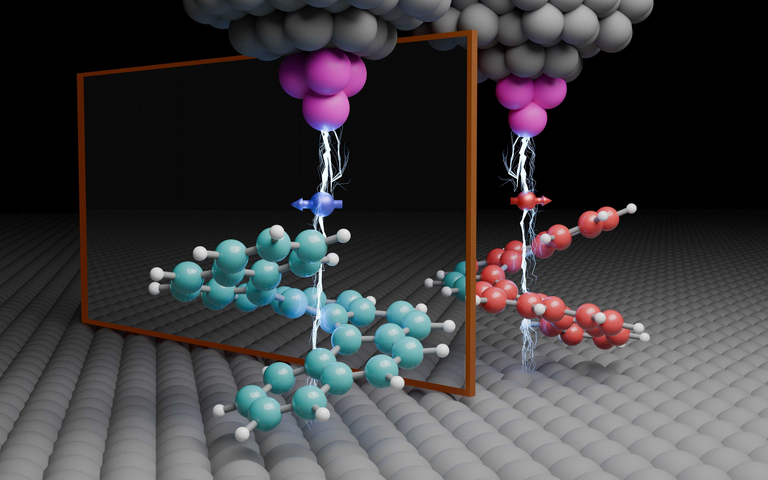
Molecules that cannot be superimposed on their mirror images possess remarkable properties: they can selectively orient the spin of electrons and are therefore considered promising building blocks for future miniaturized circuitry. These so-called chiral molecules are currently the focus of intensive research. Scientists from Technische Universität Ilmenau have now demonstrated for the first time in an unambiguous manner the phenomenon known as chirality-induced spin selection (CISS) at the level of single-molecule junctions – a breakthrough published in the prestigious journal Physical Review Letters: doi.org/10.1103/pgs4-4nds
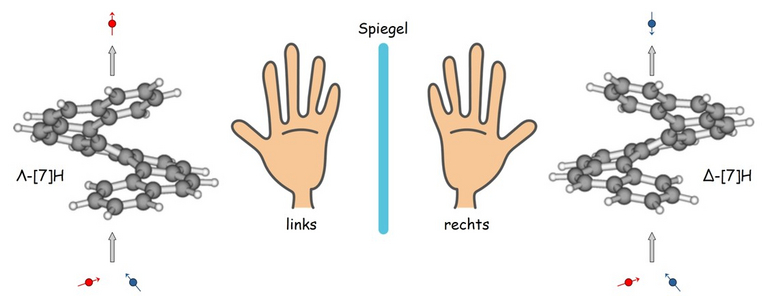
The left and right hand look similar – however, whatever you do, you will not succeed in converting left to right or vice versa. Such mirror-symmetric, yet not identical shapes are referred to as chiral. An interesting side note concerns homochirality in living organisms, that is, only one handedness prevails. A prominent example is the DNA double helix, which only occurs with right-handed chirality. In physics, chiral effects are reflected by different findings in mirror-inverted experiments. The associated chirality-induced spin selectivity (CISS) has been subject to a longstanding and intense dispute in the condensed-matter community. What is this debate all about?
Electrons carry electrical charge as well as spin. The spin is a purely quantum-mechanical property, which may be conceived as an inner angular momentum that can show up in experiments via its magnetic moment. The electron spin can technologically be utilized to store and transfer information. Therefore, modern spintronic devices make use of both electron properties, namely its charge (current on or off) and its spin (pointing up or down). The promising opportunity of the vivid research activities in spintronics is the development of devices for miniaturized circuitry with fast and energy-efficient operation.
To exploit the spin, it must be generated before, that is, electrons with the preferred spin direction must be selected. An intensely explored possibility for electron polarization, i.e., for imparting the desired spin direction, is the use of chiral molecules whose handedness together with the current direction determines the electron spin. Originally, CISS was observed for the photoelectric effect of chiral molecules. The helical structure of the molecules exhibited handedness, that is, clockwise and counter-clockwise windings. The spin of photoemitted electrons depended on the actual mirror-inverted variant of the molecule that had been traversed by the electrons on their way to the vacuum.
“Condensed-matter physicists tend to apply such effects to miniaturized circuitry”, says Prof. Jörg Kröger, head of the Experimental Physics 1 Group at the TU Ilmenau. However, CISS at the level of single-molecule junctions has not unambiguously been demonstrated so far. Jörg Kröger explains:
It is here where the controversy starts because so far experimental data extracted from molecular circuits have not provided unambiguous evidence for CISS. External magnetic fields as well as elevated voltages yielded results that only feigned CISS.
The key challenge for worldwide physical research was therefore the identification of a suitable experiment that avoids such ambiguities.
Lorenz Meyer (PhD student of the Experimental Physics 1 group) has indeed developed an elegant method that circumvents external magnetic field and elevated voltages. To this end, he made use of the fascinating interplay between superconductivity and magnetism for crafting appropriate probes for scanning tunneling microscopy. Decorating the superconducting lead tip of the microscope with a nanometer-scaled magnet of manganese atoms induced low-energy spin-polarized electronic states, that is, states with a unique spin direction (either up or down).
“These states kill two birds with one stone”, says Lorent Meyer:
First, an external magnetic field for changing the spin is not required because both spins are already available and, second, owing to the low energy of the states, only small voltages across the tunneling barrier are necessary to reach them.
On the other side of the tunneling barrier heptahelicene molecules were adsorbed on a superconducting lead substrate. The clou according to Lorenz Meyer is:
The racemic mixture of left-handed (Λ) and right-handed (Δ) molecules self-organized into domains of pure chirality, mimicking the famous Pasteur experiment of chiral recognition and separation.
First unambiguous evidence for the CISS effect

In the main part of the experiments, Lorenz Meyer acquired current-voltage characteristics of the Λ and Δ variants with the specifically prepared probe. As the key finding for a given current direction, Λ-heptahelicene produces spin-up electrons while Δ-heptahelicene generates spin-down electrons; upon reversing the current direction by changing the voltage polarity, the spin output of the chiral molecules changes, too. Lorenz Meyer:
The CISS effect at the single-molecule level has thus been experimentally demonstrated for the first time in an unambiguous manner. This result in its own represents a substantial progress in the understanding of spin-polarized charge transport across chiral molecules because the future uncovering of the mechanism underlying CISS can rely on clear-cut experimental observations.
The findings of Meyer’s experiments moreover touch upon a fundamental symmetry, which is described via the Onsager-Casimir reciprocity:
The latter appears to be inapplicable for single-molecule contacts. Our group is being involved in vivid discussions on this issue with high-ranking theory groups.
The supply of the low-temperature (− 269 °C) experiments with liquefied helium was essential and steadily guaranteed by the recycling instrumentation in the cryo-laboratory of the TU Ilmenau Center of Micro- and Nanotechnology.
The studies were funded within the framework of a joint project by the Agence Nationale de la Recherche and the German Science Foundation as well as by the Federal Ministry of Education and Research. The work will soon be available at Physical Review Letters, the most important journal for physical research. It is labeled as an Editors’ suggestion and featured as a Synopsis in the Physics Magazine.
Original publication
L. Meyer, N. Néel, J. Kröger, Single-enantiomer spin polarizers in superconducting junctions, Phys. Rev. Lett. (2026). DOI: doi.org/10.1103/pgs4-4nds