

Using a state-of-the-art full-body scanner, the Department of Economics and Media and the Ilmenau Immersive Interactive Technologies Center (I3TC) at TU Ilmenau are further expanding their research infrastructure in the field of immersive technologies. For the first time, visitors were able to experience the scanner live at the Ilmenau Science Night and have themselves captured as photorealistic 3D reconstructions. In the future, the system will be available for research, teaching, and technology transfer, opening up a wide range of possibilities for the development of virtual representations and innovative applications in virtual and augmented reality.
Research
Remarkably lifelike and highly precise: New full-body scanner expands TU Ilmenau's research infrastructure
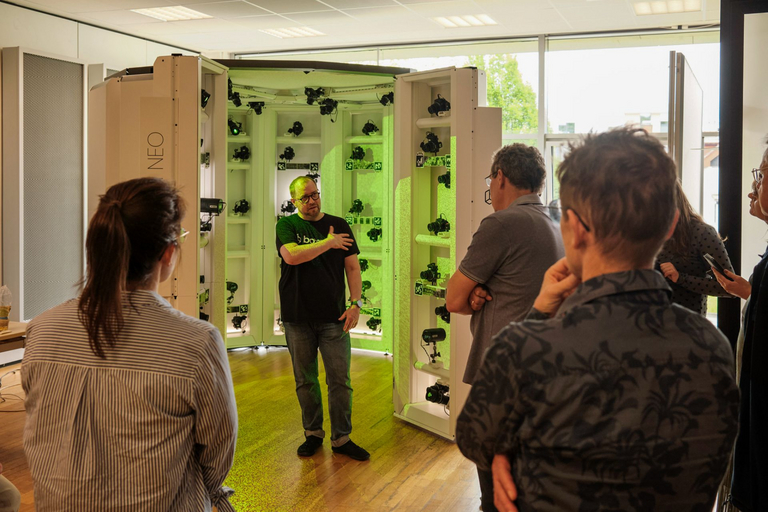
The scanner reconstructs people and objects in three dimensions with high precision and rich detail. To do this, 88 synchronized cameras capture the subject simultaneously from nearly every angle and take two shots. The actual scan takes only 0.01 seconds. This results in exceptionally reliable images with fewer image errors, as well as photorealistic 3D models with a measurement accuracy of up to one millimeter and a surface resolution of up to 0.06 millimeters per pixel. This high precision forms the basis for realistic digital representations that can be used in a wide range of applications in research and development.
The capture process is based on photogrammetry. Using the images captured simultaneously, the software calculates precise three-dimensional geometries and high-resolution textures. This process is complemented by modern reconstruction methods such as 3D Gaussian splatting, which can be used to generate particularly realistic and efficiently renderable 3D scenes. The generated models can be integrated into common development environments for virtual and augmented reality, thereby serving as the foundation for a wide variety of research and development projects.
Use in Research and Teaching
The potential applications are diverse. They range from virtual communication between real people and their digital representations, to the transfer of movement patterns, facial expressions, and gestures to photorealistic 3D avatars, to the development of AI-powered virtual assistant systems. Objects can also be digitized with high precision and used for simulations, visualizations, or interactive applications. In combination with motion capture, artificial intelligence, and other sensor data, these 3D reconstructions can also be used to create digital twins in the future. In this way, the new technology creates ideal conditions for further developing the interaction between humans, artificial intelligence, and immersive media.
The full-body scanner also opens up new possibilities in teaching. It is being integrated into both existing courses and new teaching formats. This allows students at TU Ilmenau to gain hands-on experience with state-of-the-art 3D capture and digital reconstruction methods.
Interaction Lab focusing on human-technology and (remote) human-human interaction
“The presentation of the new body scanner and the positive response at the Ilmenau Science Night were a great start to the technology’s implementation at TU Ilmenau,” says Thomas Helbig, Technology and Research Officer at I3TC. “While the focus at the Ilmenau Science Night was initially on introducing the technology—allowing visitors to directly experience the creation of their own photorealistic 3D reconstructions – the system is now being put to use in research and teaching.”
The state-of-the-art full-body scanner is a key component of the I3TC’s Interaction Lab, currently under development, which focuses on human-technology and (remote) human-human interaction. Thomas Helbig is convinced:
“With this system, we are strengthening our position as a research and development hub for interactive and immersive media and technologies, and creating ideal conditions for interdisciplinary research at the intersection of digitalization, extended reality, and all aspects of human-technology interaction.”
Contact
Thomas Helbig
Technology and Research Officer I3TC