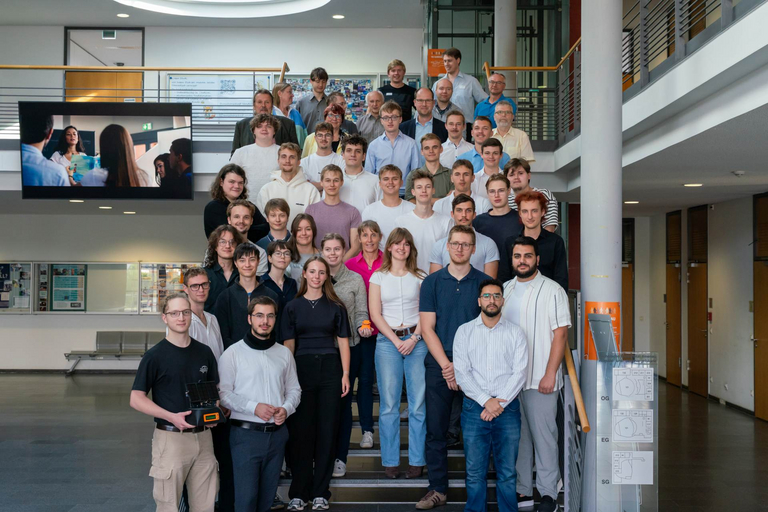
From idea to prototype: During the final presentation of the orientation program at TU Ilmenau, students presented their interdisciplinary projects: a solar tracking system, an autonomous miniature transporter, and a wind turbine. In doing so, they demonstrated what they had learned during their first year of study and how they had collaborated across disciplinary boundaries to bring their ideas to life.
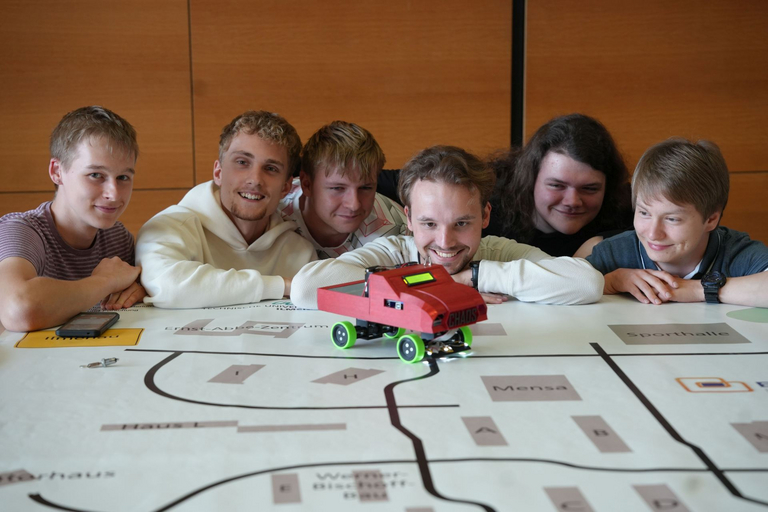
The atmosphere at the final presentation in the Audimax at TU Ilmenau was marked by visible pride and enthusiasm. The students explained how their projects worked, presented models and prototypes, and described the challenges they had overcome during the course of their year-long project work. What had started as an open-ended task now stood before them as a solution they had developed themselves.
For project coordinator Sabine Fincke, these hands-on projects are therefore a central component of the program:
The hands-on projects are a very essential part of these orientation programs and serve as the common thread running through the entire program. The students have been working on these projects in their project groups for a year. Today they are reaping the rewards, and we are delighted with their results.
Six students, one solar project
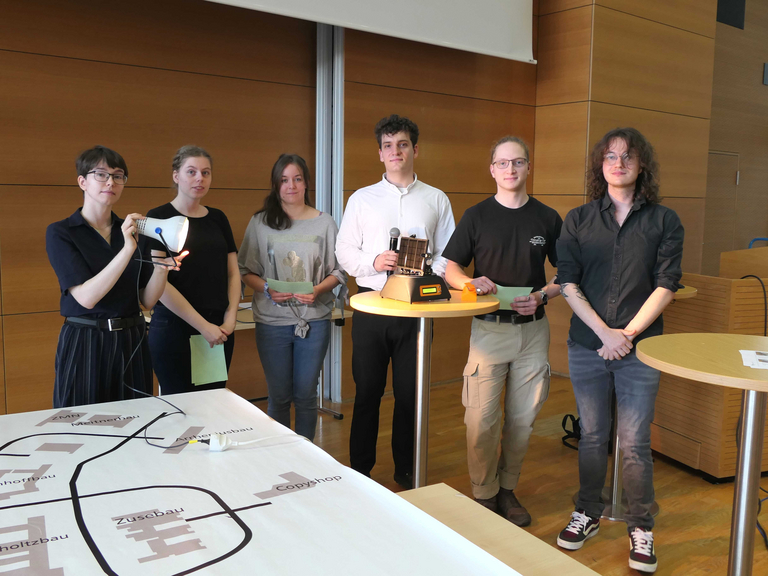
The “Ars Orions” project group demonstrated just how different the paths to a common goal can be. Students majoring in Biomedical Engineering, Electrical Engineering and Information Technology, Mechanical Engineering, and Mechatronics developed a solar tracking system. The solar modules automatically align themselves with the sun and can thus generate significantly more energy than fixed structures.
“Our task was to convert the rays from a light source into electrical energy and to automatically align themselves with that source,” explains Liv, who is studying Electrical Engineering.
In doing so, she and her fellow students also gave careful consideration to sustainability and the costs of the materials used. They deliberately manufactured a large part of the model from PLA, a plastic made from renewable raw materials, and largely fastened the components with screws to make them interchangeable.
The real challenge, however, wasn’t just technical. “The biggest challenge for us was that there were six of us: That’s quite a few cooks in the kitchen,” says Liv. Collaborating in such a large and interdisciplinary group wasn’t easy at first. At the same time, it was one of the most valuable experiences for her, she says:
For me, this collaboration was also the coolest part.
In addition to the project work, the engineering students acquired other skills: They gained hands-on experience with key steps in the development process, from manufacturing and testing electronic components to controlling the exhibits, as well as CAD design and technical product documentation. Company tours also provided insights into potential career paths.
Experiencing technology firsthand
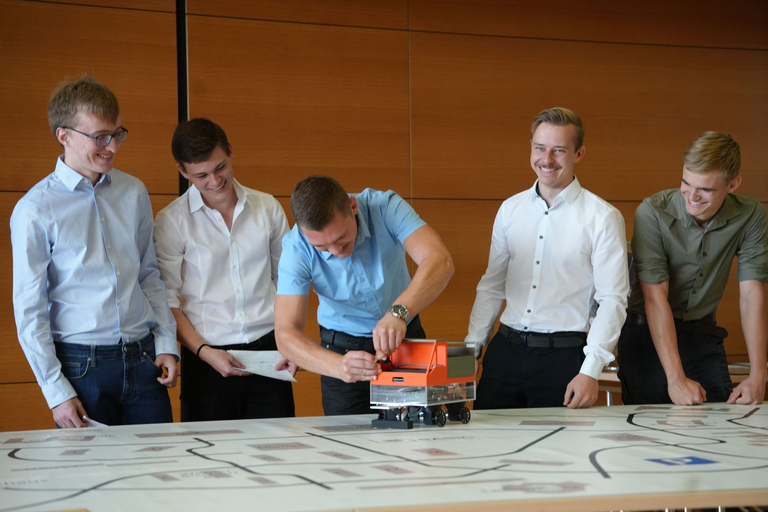
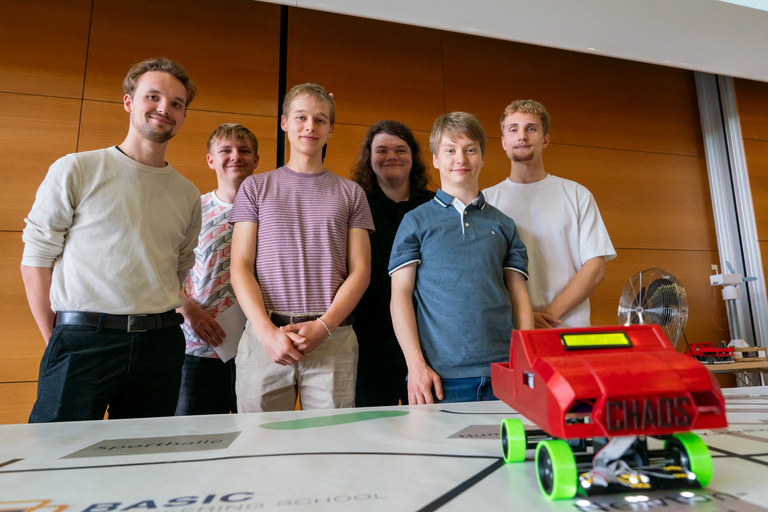
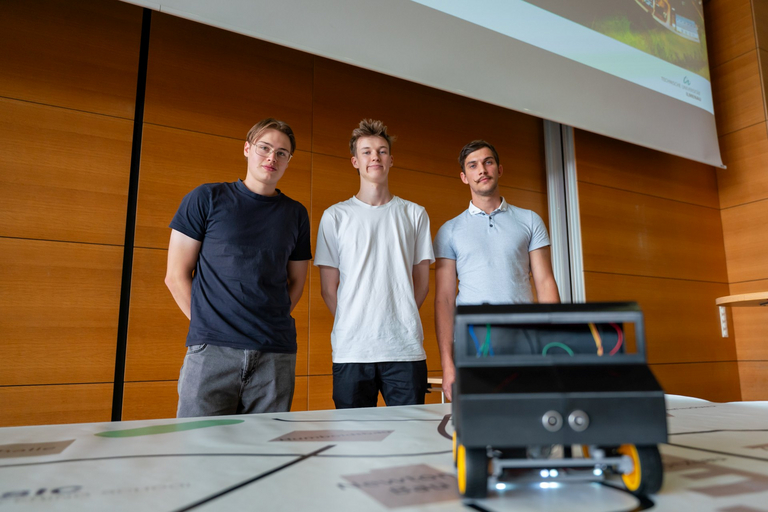
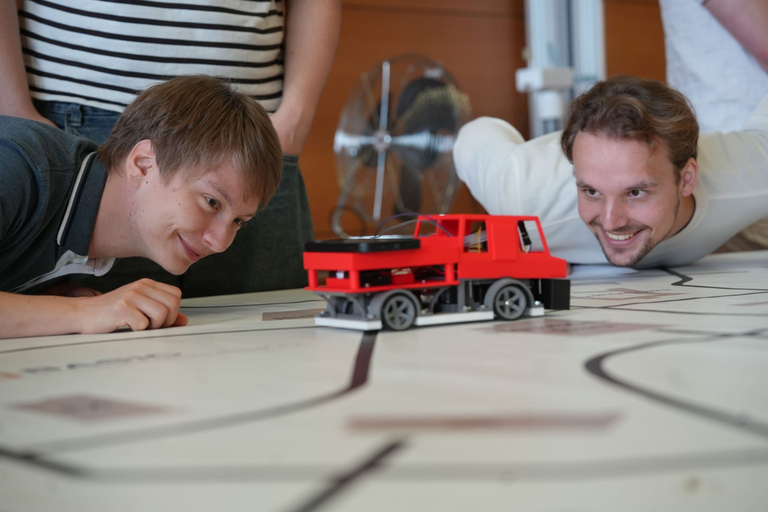
A fascination with electric mobility inspired another group of students to build an autonomous miniature transporter. Working together as Team “IID,” they developed a vehicle with four motors and four servo drives that control the vehicle’s moving components. To do so, they not only had to address technical issues but also acquire knowledge of regulatory requirements.
During the vehicle’s presentation, Prof. Thomas Sattel, Dean of the Department of Mechanical Engineering and Head of the Mechatronics Group at TU Ilmenau, expressed his enthusiasm for this approach:
That’s how guidance should be. They’ve already learned things in their first semesters that are sometimes not taught until later in a regular degree program.
Mentor Dr. Sylvia Bräunig from the Fundamentals of Electrical Engineering teaching group also highlighted a unique aspect of the project: The students made a conscious decision to make the technology visible. “I’ll hide everything that’s inside”: That was precisely not their approach. Instead, they displayed their design behind plexiglas, which they repurposed as leftover material from the COVID-19 era.
From project plan to wind turbine
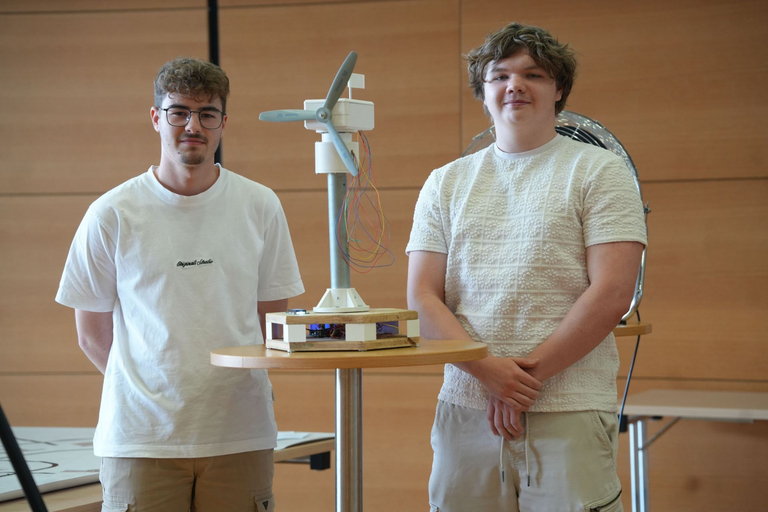
For “Team Innovativ,” the project assignment was to build a wind turbine. Working in pairs, Vincent and Stiven began their project by creating a project plan, defining milestones and deadlines, and conducting a stakeholder analysis. This was followed by the functional structure, the concept and design, a graphical requirements plan, and finally the technical design.
Then it was time for the practical implementation. “The first hurdle we had to overcome was that there were only two of us left after others on our team changed their majors during the orientation semester,” Vincent explains. After all, that’s what the orientation period is for.
The two students therefore had to organize the manufacturing process step by step. It quickly became clear that there can be a difference between a technical drawing and an actual manufactured component.
For Vincent, it was precisely these experiences that made the project so appealing. “I always think it’s cool when you don’t just hear about the theory. After all, when you develop and build something yourself, you experience firsthand how theoretical knowledge turns into a concrete solution:
I think it’s great that, above all, you can get a lot of hands-on experience here, even with things you had no idea about before. It was definitely worth it, and I’d recommend it to anyone.
Finding direction through one's own actions
The projects presented by the students are intended to help them discover early on what studying engineering entails, what career opportunities it offers, and which of their own interests and strengths come into play.
In addition to the hands-on projects, this includes company tours and presentations by alumni as well as industry and business partners, along with seminars on study skills, time management, academic research, project management, and self-management.
However, the focus is on interdisciplinary project work. Students from various bachelor’s degree programs work together on a challenging task, learning in the process to bring together different disciplinary perspectives and working methods.
For the Vice President for Studies and Teaching, Prof. Anja Geigenmüller, this became evident at the end of the past two orientation semesters: “A great deal of creativity, fantastic projects, and, above all, truly great teams.” Over time, the students have learned “to work together on a topic across disciplinary boundaries, across different degree programs, and across different ways of working and communicating to find solutions and perhaps even explore unconventional approaches.”
Geigenmüller sees this as the very essence of the orientation programs:
We want to make the academic challenges tangible, in the truest sense of the word, approachable and experiential, right from the start.
This allows students to better understand what their degree program entails and to find their own path based on their interests and inclinations. At the same time, they learn the value of teamwork.
A year of work and a tangible result
The project groups were supported by mentors from various academic disciplines across several faculties at our university. The mentors were available to answer technical questions, engaged in discussions with the teams, and shared their knowledge and experience. However, the actual project work was largely in the hands of the students. After all, first-year students shouldn’t have to wait several semesters to discover just how diverse an engineering degree can be. From the very beginning, they should experiment, create, and experience for themselves what it means to solve technical challenges together.
The growing demand shows that this concept is generating interest. “The rising demand for this type of program encourages us to continue offering this form of orientation,” says Geigenmüller.
She therefore also expressed her gratitude to the numerous faculty members and support staff who guided the projects. Without their extra dedication, their ideas, and their guidance of the student teams, these orientation programs would not be possible at this level.
The final presentation also made it clear what remains after a year: not only working models and technical solutions, but above all the experience of having developed something together and, in the process, having found their own path in their studies a step further.
Impressions