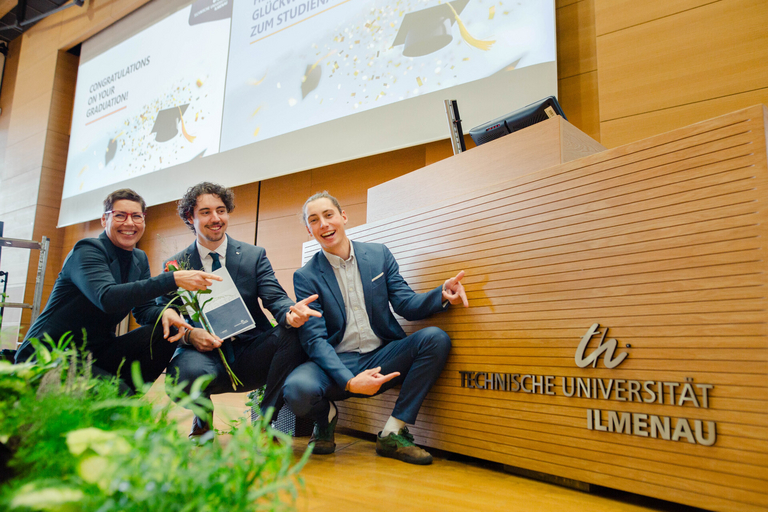
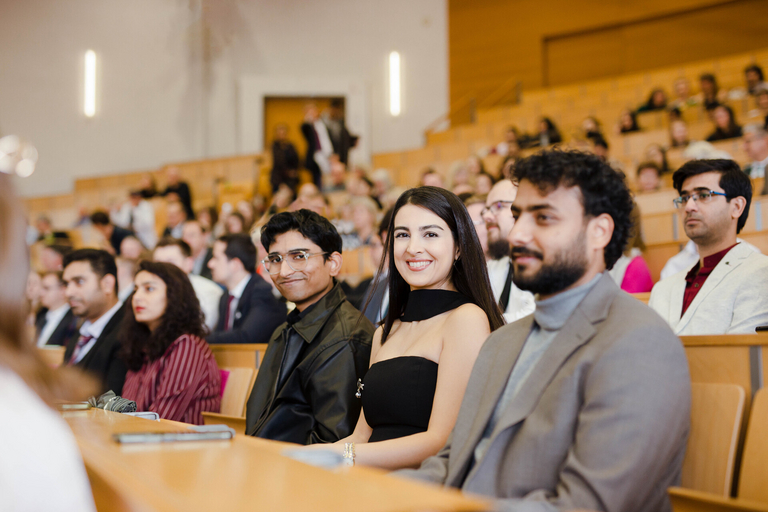
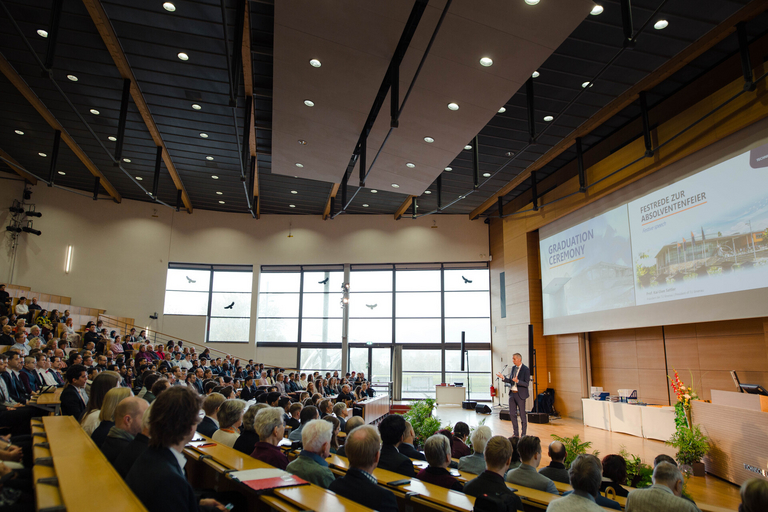
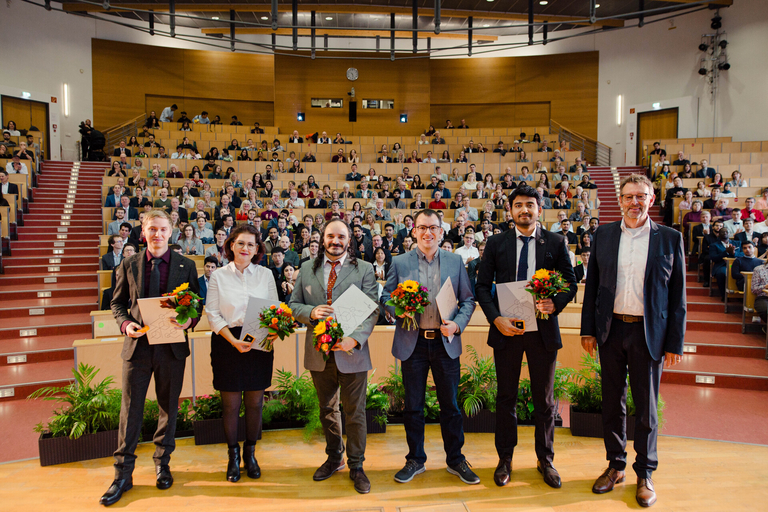
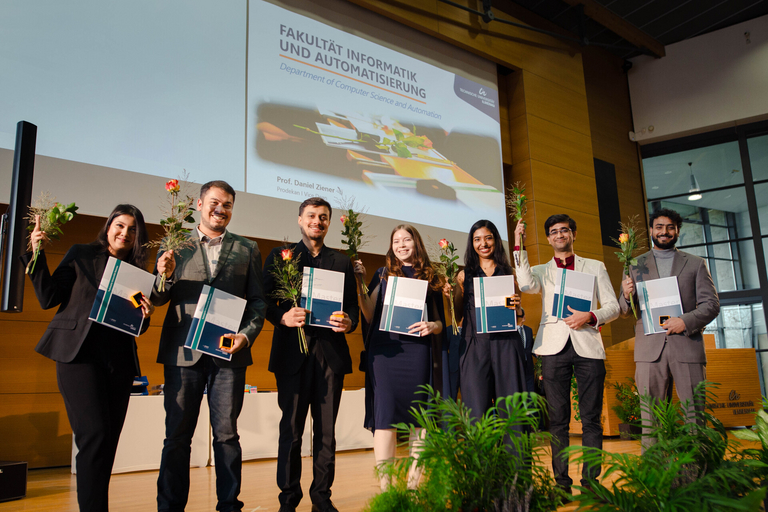
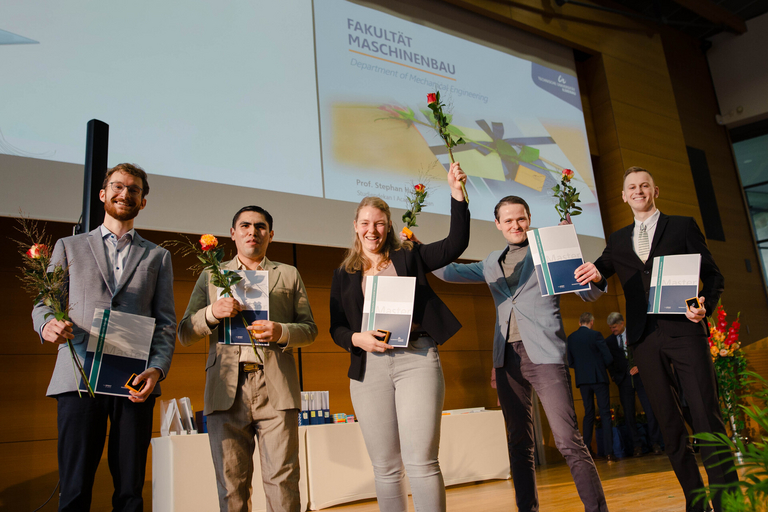
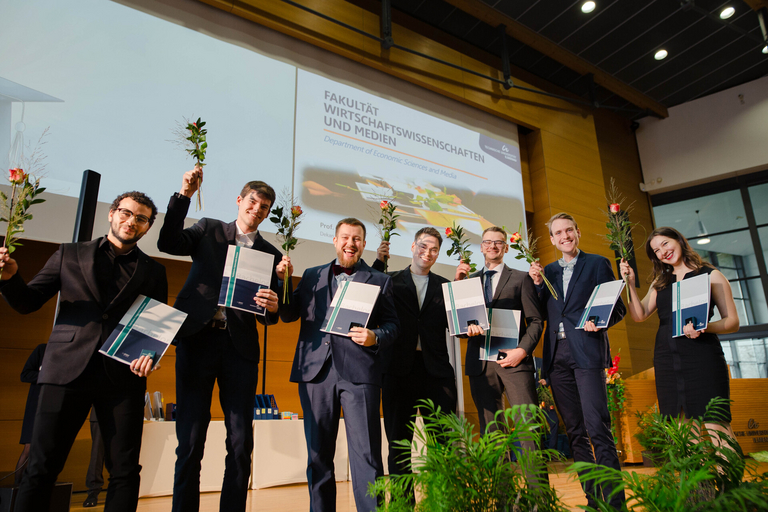
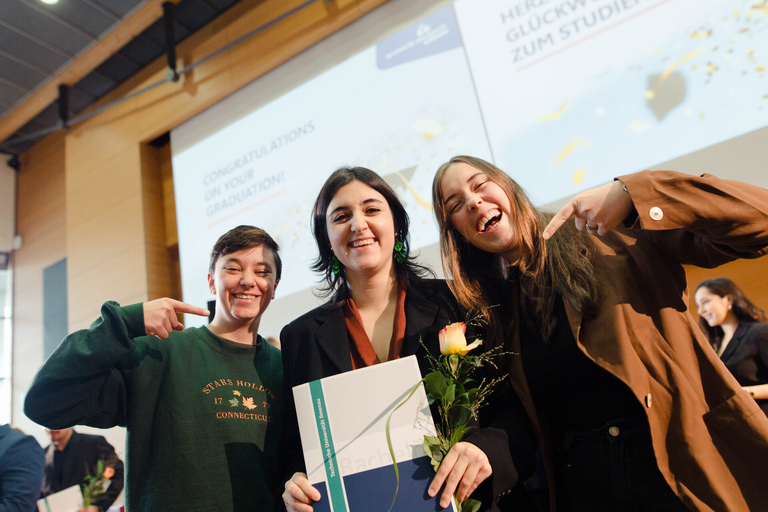
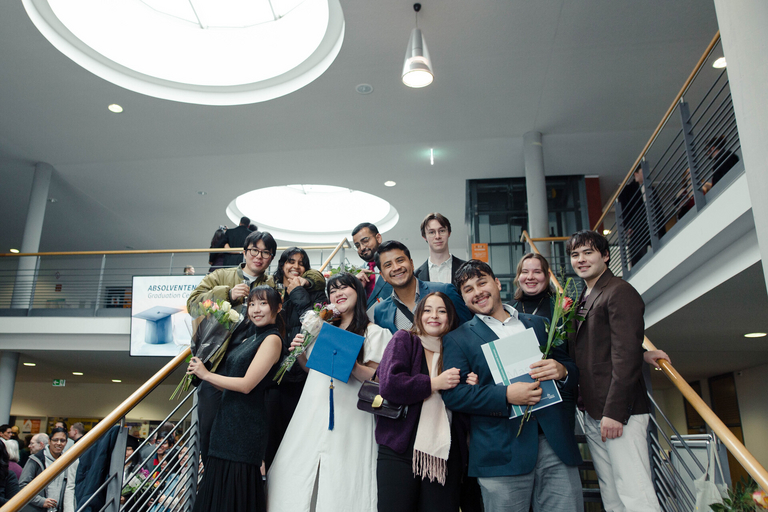
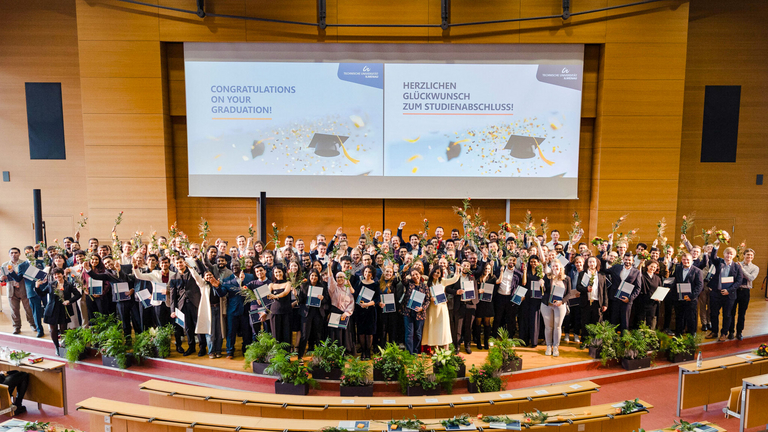
124 bachelor’s degrees, six doctoral degrees, and one habilitation: On October 24, the Audimax at the Technische Universität Ilmenau was filled with people who have acquired knowledge at the university, developed their own ideas, and are now embarking on new paths. Whether in research, business, or abroad, the graduation ceremony made it clear: Their time in Ilmenau has equipped them with the tools to seek answers to the questions of our time and to address societal challenges.
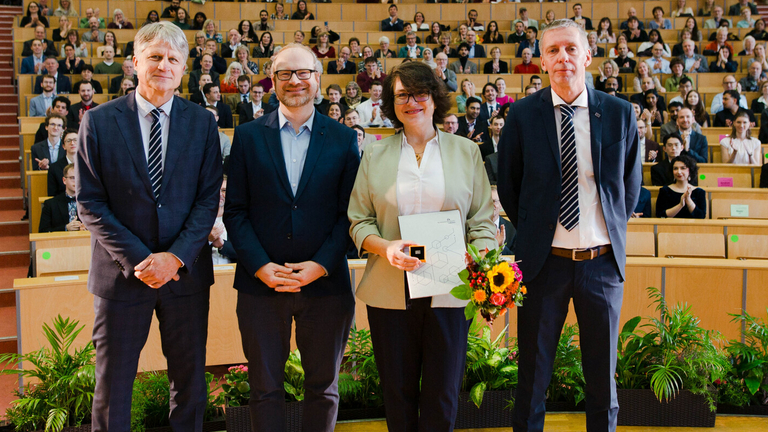
Can robots help people get back on their feet? Dr. Andrea Scheidig explored this question in her postdoctoral thesis at the Neuroinformatics and Cognitive Robotics Lab in the Department of Computer Science and Automation, under the supervision of Prof. Horst-Michael Groß. In various projects, she investigated how assistive robots can support people in walking independently after illnesses or injuries. The scientist will continue to focus in her research at TU Ilmenau on how these robots can move safely and recognize what a person needs in order to collaborate effectively with them:
The mobility and interactivity of assistive robots are key prerequisites for enabling patients to engage in effective self-directed training during gait rehabilitation. I look forward to applying the insights I’ve gained to both further research and teaching at our university.
Helping to shape the future of science and technology
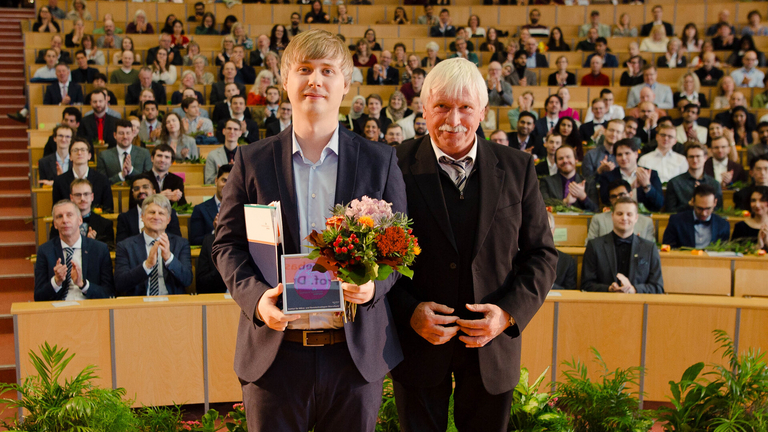
Dr. Sebastian Bohm is taking a different approach. For his doctoral thesis in the Theoretical Physics I Group under the supervision of Prof. Erich Runge, he developed a tiny pump that moves liquids using electrical voltage, without mechanical pistons or membranes. The “E-PunCh,” developed in collaboration with the Ilmenau-based company 5microns, could be used in the future in applications where minute amounts of liquid need to be moved with precision, such as in medical technology.
For the scientific quality of his work, its innovative nature, and his extensive use of the research infrastructure at the Center for Micro- and Nanotechnologies (ZMN) at TU Ilmenau, Bohm received two awards at the graduation ceremony: the ZMN Doctoral Prize, worth 1,000 euros, and the Dagmar Schipanski Prize, worth 2,000 euros, awarded by the “Universitätsgesellschaft Ilmenau – Freunde, Förderer, Alumni e. V.”, which honors outstanding scientific achievements and individuals whose work helps shape the future of science and technology. “Dr. Sebastian Bohm embodies the essential qualities for this: scientific excellence, methodological creativity, interdisciplinary thinking, and the ability to translate insights into practical solutions,” said the University Society’s Chairman, Prof. Dr. Dr. h. c. mult. Peter Scharff, in his laudatory speech. Today, Dr. Bohm works as a postdoc at Chalmers University of Technology in Gothenburg, Sweden, where he continues his research in the field of fluidics. Prof. Scharff:
This next step also demonstrates that his previous work is not a final destination, but rather a foundation for further scientific developments.
Speaking on behalf of all bachelor’s and master’s graduates, Georg Markus Thüsing reflected on his time as a student. His own academic path also took him beyond Ilmenau: After completing his bachelor’s degree in mechatronics, he worked as a visiting researcher at the University of Canterbury in Christchurch, New Zealand, as part of his master’s thesis. In his thesis, which received a grade of 1.0 and was supervised by the Mechatronics Department, he investigated how established control-based methods for the experimental recording of measurement curves of nonlinear systems can be applied to so-called parameter-excited systems. Prior to this, there were hardly any algorithms adapted for such systems.
In his speech, Thüsing particularly highlighted what he described as the “excellent conditions at the foot of the Rennsteig.” No other university or college had recently filed as many patents per employee as Ilmenau. In terms of third-party funding per professorship, the TU once again ranked exceptionally well this year among the top 10 of the 83 universities in Germany, and its student-to-faculty ratio was also impressive by national standards, he said:
Last but not least, our university also boasts an excellent international network. I myself had the unforgettable opportunity to spend part of my studies on the other side of the world. This was made possible by the contacts of the professor who supervised my thesis, Prof. Thomas Sattel.
Since July 2026, Thüsing has been continuing his research as a doctoral candidate and research assistant in the university's Department of Mechatronics.
Technology for People
As diverse as the career paths and achievements honored at the graduation ceremony may be, they are all united by a common belief: knowledge should not remain confined to the lecture hall or the laboratory. It should help solve technical challenges, support people in the region and around the world, and open up new social perspectives. And this comes with responsibility, as University President Prof. Kai-Uwe Sattler highlighted in his ceremonial speech:
You studied at a time when knowledge is just a keystroke away […] But an answer is not the same as insight. Whether a result is plausible, whether a source is reliable, whether what is technically possible should actually be done: No one can provide the answer to these questions for you. That responsibility lies with you. And that is what you learn at university […]: to examine, to question, to see the bigger picture. That is what distinguishes training from education.
The Student Council (StuRa) also honored students who have shown exceptional volunteer commitment by participating in clubs or taking on leadership roles in their community during their time at the university. University President Prof. Kai-Uwe Sattler also acknowledged this in his address: Many of the graduates had been active in clubs, initiatives, and committees during their time at the university:
Keep getting involved! […] You have left your mark: at the university, in the city, and in the hearts of your fellow students. You have built connections and networks that may last a lifetime. Keep doing that – even in your careers!
A tree that symbolizes the path ahead
This commitment should remain visible even beyond studies: Since 2025, the Student Council’s Sustainability Working Group therefore has been planting a tree on campus for its graduating members. This new tradition is part of TU Ilmenau’s journey toward becoming a “Sustainable Community” and gives the students’ commitment a lasting place on campus – coupled with the hope that they will continue to advocate for sustainable development in the future, as the Vice President for Studies and Teaching, Prof. Anja Geigenmüller, explained at the conclusion of the event:
The tree we plant together will take root, grow beyond its own limits, and benefit both nature and us – providing shade, producing oxygen, and helping to store water in the soil. May this tree serve as a symbol of your future path and serve as a lasting reminder of your valuable contribution to our university and a more sustainable future.
Impressions