

How can effective teamwork be achieved? How can students organize their studies and learning time efficiently? And which methods can help develop creative solutions to complex challenges? These were some of the questions explored by 18 master’s students from various disciplines in STEM, business, logistics and education as part of the Erasmus+ Blended Intensive Programme (BIP) “Assess Your Professional Soft Skills”, held at TU Ilmenau from 26 to 30 October.
Study
More than just Soft Skills: International students experience what makes for effective collaboration

The English-language program combined digital self-study with an intensive week of on-campus activities at the university and in the surrounding region. All participants came from partner universities of the European University SUNRISE Alliance, coordinated by TU Ilmenau, or had come to TU Ilmenau through the KOSPIE program of the German Academic Exchange Service (DAAD). KOSPIE stands for “Combined Study and Practical Stays for Engineers from Developing Countries”. The program is funded by the German Federal Ministry for Economic Cooperation and Development (BMZ) and enables students of engineering and natural sciences from Argentina, Colombia and Mexico to combine academic studies with a practical placement in Germany. Its aim is to strengthen international university cooperation and promote academic and professional exchange.
Before arriving in Ilmenau, participants from TU Ilmenau, the University of Information Technology and Management in Rzeszow, European University Cyprus, the Polytechnic University of Viana do Castelo and Mälardalen University Sweden had already explored important transferable skills for their studies and future careers through online learning. The focus in Ilmenau was then on putting what they had learned into practice.
From theory to job applications in practice

In workshops led by Anne Pohlig, Gesa Pries, and Natalia Sultanova from the Central Institute for Education (ZIB) and the university’s International Office, the students practiced teamwork, project management, presentation skills, creative techniques, and other career-related soft skills. The sessions alternated between small-group work, individual assignments, and group exercises. Anne Pohlig explains the practical relevance of the training:
This training optimally prepares students for everyday professional life. Working in project teams, taking creative approaches, and structuring daily challenges are standard practices in internationally active companies.
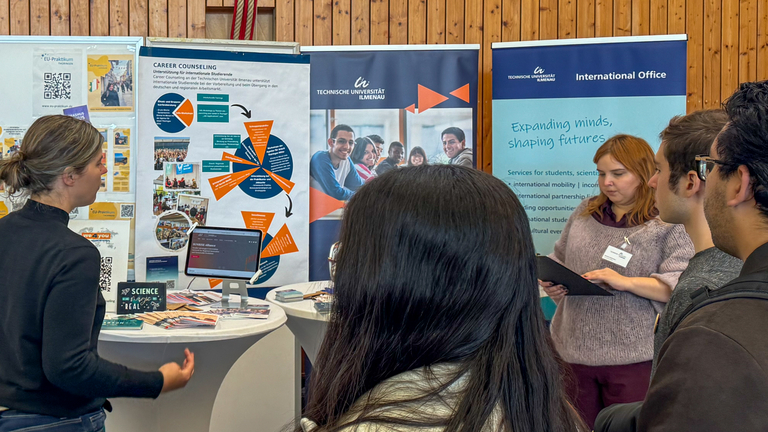
As early as the second day, the students put what they had learned to the test at “inovailmenau,” the student-organized career fair at TU Ilmenau, after having practiced the day before how to present themselves at the fair, engage with companies, and communicate their career interests.
At the fair, they gained insights into various companies and career paths and established contacts with potential employers.
Discover Ilmenau and Thuringia
In addition to the workshops and the career fair, there was also time to explore Ilmenau and the surrounding region. During a city tour and a visit to Café Makan, the students struck up a conversation with the student team that founded the café, an example of Ilmenau's student engagement and entrepreneurship.
Another excursion took the group to Erfurt to visit the Thuringian Agency for Skilled Workforce Recruitment (ThAFF) at LEG Thüringen. During a presentation, the students learned about the Thuringian job market and career prospects in Germany. They also gained cultural insights into the nearby state capital.
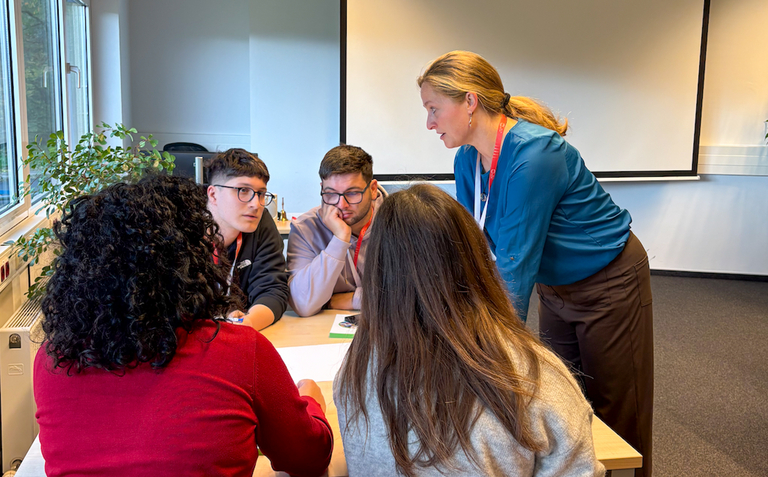
At the end of the workshop, the students presented their findings and reflected on their experiences. “The participants were particularly impressed by how well and successfully teams from different cultures and age groups can work together,” said workshop leader Anne Pohlig.
Participant Ereen Meglli, a master’s graduate from the European University Cyprus, also expressed in her feedback that the program was about much more than just teaching key professional skills:
You didn’t just teach us key professional skills; through your words, your actions, and the way you interacted with everyone, you showed us what true leadership means. I will really miss all the wonderful people I had the privilege of meeting during this program.
She also extended her heartfelt thanks to everyone who worked tirelessly behind the scenes to make this experience possible:
We came from different parts of the world and are now taking home new friendships, unforgettable memories, and a very special sense of community.
Erasmus+ Blended Intensive Programs at TU Ilmenau in March 2027
From March 16 to 19, 2027, the Institute for Thermal and Fluid Dynamics will host the English-language program “Imaging Methods for Turbulent Flows,” led by Prof. Christian Cierpka, Director of the Institute for Thermal and Fluid Dynamics. The BIP focuses on imaging techniques for investigating turbulent flows.
In collaboration with the Lublin University of Technology (Poland), the University of Bologna (Italy), and Mälardalen University (Sweden), participants will learn about various imaging methods for characterizing turbulent flows. These include, among others, particle image velocimetry, particle tracking velocimetry, and event-based imaging.
During the same week, students explore the role of light as a carrier of information, from measurement and modeling to the interpretation of real measurement data. In the BIP “Measurement Methods Using Light—What’s Behind Them?”, led by Dr. Meike Hoffmann, they work in the Optical Engineering Group with instruments such as spectrometers and white-light interference microscopes and fabricate micro-optical components in the cleanroom and in the holography laboratory. In the process, they learn which measurement method is suitable for which research question and where its limitations lie.
In addition, the Winter School on Green Micro- and Nanotechnologies will take place as early as December 2026.
Contact
Saskia Hoffmann
Coordination of short-term mobility programs