

Two Biomedical Sciences bachelor’s students from European University Cyprus spent eight weeks conducting research at TU Ilmenau – discovering new research methods along the way, as well as Germany and Europe.
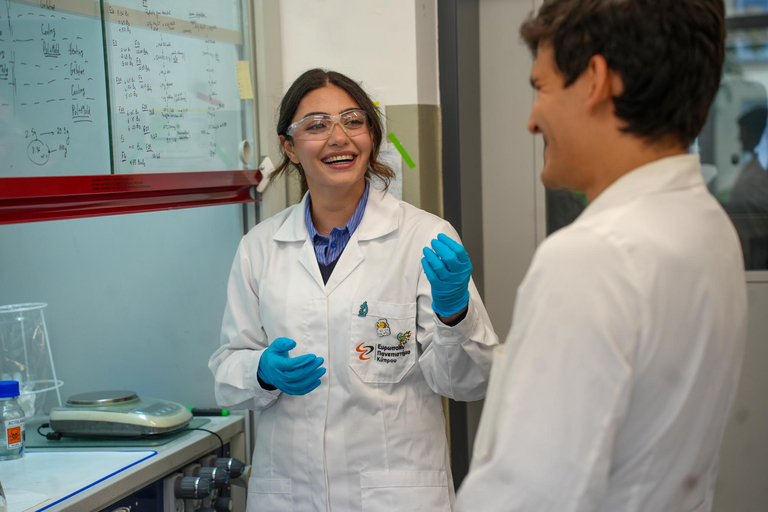
Two months of research, learning new laboratory techniques, and gaining many new insights: Jana Nammour and Oyeleke Marvellous Ayomide, bachelor’s students from the Biomedical Sciences program at European University Cyprus (EUC), a partner university of TU Ilmenau in the European University Alliance SUNRISE, completed a summer internship at TU Ilmenau from July to September 2026. Together with PhD student Aurelio Morales-Murillo, they worked at the Institute of Biomedical Engineering and Computer Science (BMTI) on new technologies for electroencephalography, or EEG for short.
Using hydrogels to capture brain signals
The research internship focused on hydrogel electrodes – soft, conductive materials that serve as an interface between the skin and the electrode. They are designed to provide good electrical contact while conforming flexibly to the skin, allowing the electrical activity of the brain to be measured as accurately as possible from the scalp.
“Conventional EEG electrodes are often applied using gel or paste,” explains Aurelio Morales-Murillo, a PhD student and the students’ internship supervisor. “This provides good electrical contact, but preparing the system can be time-consuming. Dry electrodes, on the other hand, are easier to use, but they often have higher electrical impedance at the skin-electrode interface.”
They can also be more susceptible to motion artefacts and may be less comfortable to wear over longer periods. Moreover, neither dry electrodes nor gel electrodes are currently suitable for particularly long-term measurements, as the gel can dry out or the dry electrodes can become uncomfortable over time.
Hydrogel electrodes essentially combine some of the advantages of gel-based and dry electrodes. This could pave the way for wearable, patient-centred EEG systems that can be used outside the laboratory for mobile and long-term measurements
Looking for the right “recipe”
During her internship, Jana focused primarily on producing the hydrogels and optimizing their composition. “After that, I tested them electrically and mechanically to find out which ‘recipe’ worked best.”
Among other things, she examined how effectively the hydrogels could transmit electrical signals and how stable they were. Their ability to adhere to the skin was also important, Aurelio Morales-Murillo explains: “We need the hydrogel to keep the electrode securely in place on the head. At the same time, it has to provide the right electrical conductivity so that we can capture the brain signals.”
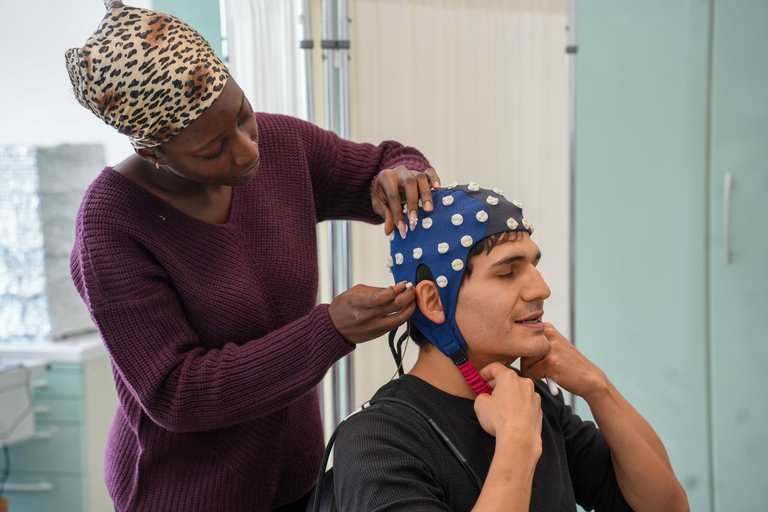
After numerous tests, Jana succeeded in identifying a particularly promising hydrogel formulation for the EEG sensors shortly before the end of her internship. Tests carried out in parallel by her colleague Marvellous confirmed the result. The student from Nigeria focused primarily on working with the EEG system itself. “I mainly worked with the EEG cap and attached the hydrogels Jana had produced to the electrodes.”
She then tested their electrical properties, including impedance, which indicates how well the electrode is electrically connected to the skin. The lower the impedance, the better the quality of the EEG signal usually is. To do this, Marvellous placed the EEG cap on participants and checked the contact between the electrodes and the skin. “If the value is too high, something is wrong. If it is within the normal range, that’s perfect. We then try to analyse the data and gain insights from it.”
From the classroom to the research lab
For both students, the internship offered an opportunity to experience research not just through textbooks, but by actively contributing to a research project themselves.
“I wanted to gain more experience, learn to work independently and acquire new knowledge here in Germany,” says Marvellous. Working independently in the laboratory was particularly valuable to her. “I learned to work independently and to work hard.”
Jana describes a similar experience. Planning experiments independently, researching information on her own and communicating results within the research team were all new experiences for her:
The unique nature of this research project really broadened my experience. For me, it was something completely new to work largely independently in the laboratory.
For Aurelio Morales-Murillo, the collaboration was equally rewarding:
It was a win-win situation. Just the work Jana did would probably have taken me three or four months alongside all my other responsibilities. After an intensive week of training, both students were already able to work very independently.
“Germany ist a leader in engineering”
The internship opportunity arose through the network of the SUNRISE European University Alliance, coordinated by TU Ilmenau.
“I heard about the opportunity from my programme coordinator in Cyprus,” Jana explains. “She knew that I was interested in research and wanted to develop academically. So I was very happy to have this opportunity.”
France and Germany were among the possible destinations for the internship. Marvellous and Jana chose Ilmenau, among other reasons because of the university’s technical facilities and the opportunity to work in an engineering-focused environment. “Germany is a leader in engineering and the development of innovative technologies,” says Jana.
But Germany was attractive to Jana for more than its research environment. During her stay, she also travelled to Berlin, Cologne, Bonn, Stuttgart, Weimar and Bavaria. The landscapes and architecture particularly impressed her.
Germany has taught me to be more adventurous and to connect more with nature. Here, in nature, I was able to experience real peace and quiet.
For her, this balance is particularly important alongside the demands of university life. It is about finding the right balance between achievement and personal time: “It’s always about balancing fun, relaxation and hard work.”
Marvellous also took away a lesson from everyday working life in Germany: punctuality. “If something starts at nine, you have to be there at nine. That’s a good rule – and a lesson for every day.”
What remains?
After eight weeks of the SUNRISE internship, both students are returning home with much more than new research experience. Friendships and personal impressions will also stay with them, says Jana:
I’m taking home friendships and a better understanding of German culture. And also a more refined palate when it comes to beer.
Marvellous plans to continue improving her German and take a German language course in Cyprus.
Curious to find out what’s in it for you?
You would also like to benefit from SUNRISE and make international connections? Then find out more about upcoming events and exchange opportunities here:
sunrise-alliance.eu/
www.tu-ilmenau.de/en/international/go-out