

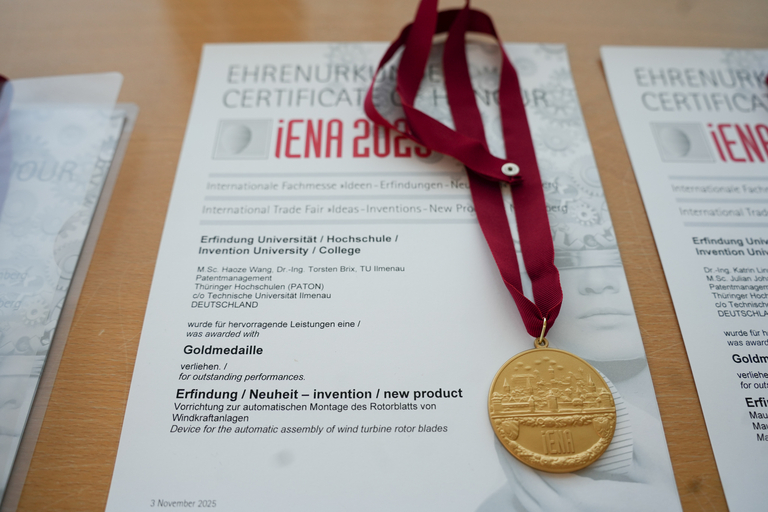
The assembly of rotor blades is one of the most challenging and risky steps in the construction of wind turbines. High wind loads in changing weather conditions, components weighing several tons and tight tolerances make it a task that until now can only be carried out by experienced specialists at great expense. Scientists at TU Ilmenau have now developed a new type of automated system that can make this process significantly safer, more efficient and largely independent of the weather. The innovation was presented at the international trade fair "Ideas - Inventions - Innovations" iENA 2025 and was awarded a gold medal at the Thuringian award ceremony of the PATON | State Patent Center Thuringia at the TU Ilmenau on 11 December.
Transfer
Automated rotor blade assembly on wind turbines: TU Ilmenau develops new technology for greater safety and efficiency

Choreopgraphy between man and machine
Electricity generation from wind power has become significantly more important in recent years in Germany and is now one of the central pillars of the German energy transition. According to the Federal Statistical Office, around 29% of all gross electricity in 2024 came from wind energy - generated both onshore and offshore. In Germany, more than 28,500 onshore turbines and around 1,500 offshore turbines now reliably feed electricity into the grid.
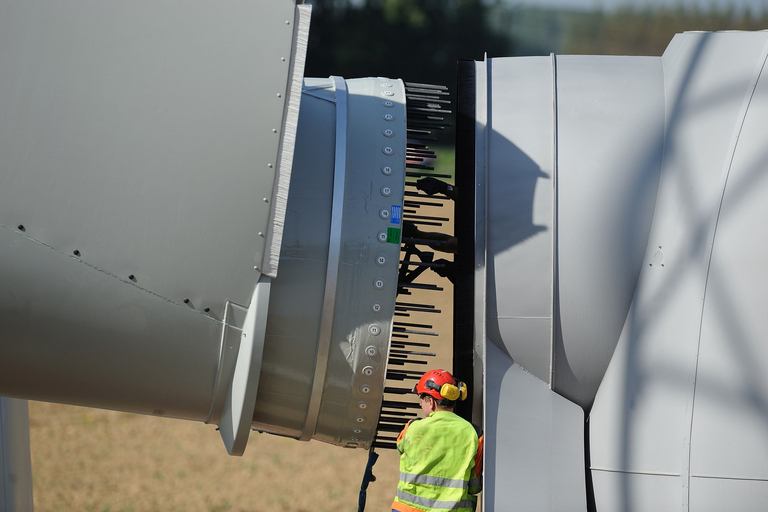
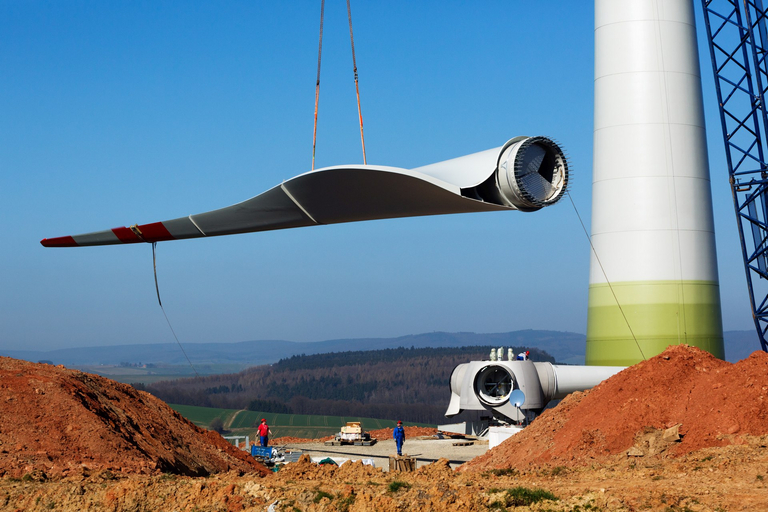
Currently, the installation of the rotor blades of these turbines, which are often over 70 meters long, is a logistical and technical tour de force: Even before the first blade is lifted to dizzying heights of over 140 meters tower height, heavy transports have to be guided along adapted routes and large, load-bearing and partially sealed working areas have to be created around the wind turbine so that the crane and lifting technology can work safely.
When lifting the blades, which weigh several tons, the assembly teams often have to contend with swaying and wobbling, usually caused by wind load, which makes precise, millimetre-accurate positioning to the hub difficult and increases the risk of collisions and structural damage to the hub and rotor root. Despite special rotating and tilting grippers, the fine adjustment of the rotor blades remains a weather-dependent, error-prone process: the crane operator is dependent on radio instructions, delays drive up effort and costs, and every assembly error can cause quality and safety risks.
The subsequent bolting also requires a great deal of experience in order to ensure uniform preload forces and guarantee operational safety in the long term.
"The assembly of a rotor blade is one of the most demanding steps in the entire construction process of a wind turbine, requiring a great deal of coordination, precision and safety routines," explains Dr. Torsten Brix, senior engineer at the Product and Systems Engineering Group at TU Ilmenau.
While the crane lifts the rotor blade from the ground, several fitters work together in clearly defined roles. Specialists on the ground accompany the lift with special grippers, dampen pendulum and wobbling movements and ensure that the component is guided towards the nacelle in a controlled manner. Further up, fitters are waiting to prepare the interface to the blade root. They give the ground crew and the crane operator precise instructions via radio for fine adjustment - such as small corrections in inclination or rotation - in order to position the blade precisely and bolt it securely in place.
Since the early days of wind turbine assembly, this process has been carried out like this: as a choreography between man and machine - time-consuming and dependent on wind, experience and dexterity.
From manual work to high precision
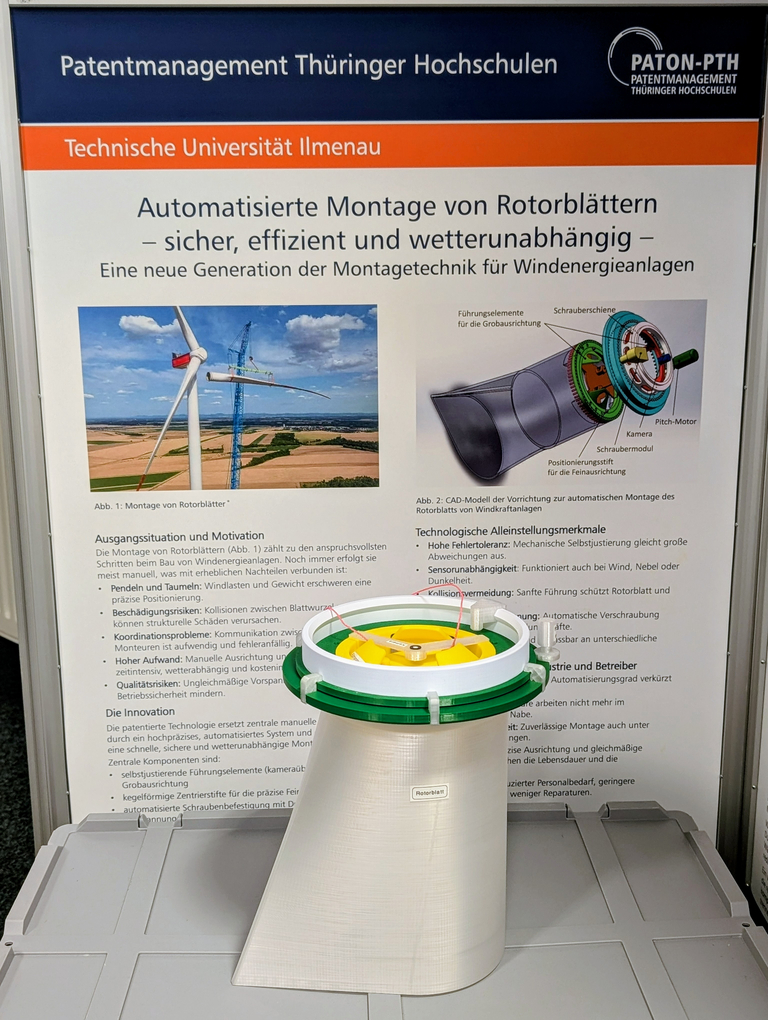
Together with his colleague Haoze Wang, Dr. Torsten Brix at TU Ilmenau has now developed a technology that could bring about a new generation of assembly technology for wind turbines: an automated system that makes assembly more precise, faster and safer - without the need for complex lifting technology and cranes directly from the nacelle.
At the heart of the innovation is an intelligent, mechanically and sensor-supported guide system that replaces central manual work steps: self-adjusting guide elements ensure robust rough alignment, while conical fixing pins take care of fine adjustment. An automated screw fastening unit, which is guided along a circular path inside the nacelle, tightens the connecting screws with monitored torque and controlled preload. The process is supported by optical and non-optical sensors that work reliably even in restricted visibility conditions.
"The innovation compensates for major deviations caused by wobbling movements, works largely independently of the weather and significantly reduces the risk of damage to the hub and rotor root in the event of contact," says Dr. Brix.
This is particularly relevant for offshore turbines, where weather windows are short and any delay causes high costs.
The specially designed centering elements on the hub and rotor root dampen acceptable collisions and thus prevent functionally relevant damage to the rotor root and hub.
"Our system also works when conventional position detection sensors reach their limits," emphasizes Haoze Wang.
Future potential: faster, safer, more sustainable
The patented system could bring enormous competitive advantages for the industry: Construction times are shortened, downtimes are reduced. Fitters no longer have to work in the danger zone of the hub during bolting. In addition, the uniform, weather-independent pre-tensioning of the bolted connection ensures greater operational reliability and a longer service life for the entire system.
"Our system represents a significant step towards fully automated assembly processes in the wind power industry," explains Dr. Brix.
The technology is scalable and can be adapted to different turbine types for the onshore and offshore sector.
The development at TU Ilmenau thus opens up new perspectives for the expansion of wind energy. Under the demanding conditions of offshore wind farms, the system offers the potential for significantly shorter construction times, lower downtime costs and stable process quality. The latter is largely independent of weather and daylight, even during the automated replacement of rotor blades.
According to Dr. Brix, however, the technology's application potential extends beyond the wind power industry:
During development, the focus was also always on using the idea in the assembly of any large-scale industrial components.
Dr. Torsten Brix
Oberingenieur Fachgebiet Produkt- und Systementwicklung