

From the initial idea to your own startup: Ilmkubator, the startup support service at TU Ilmenau, is strengthening its team with two new startup advisors. Magnus Kraus and Stefan Schmitz support students, researchers, and graduates on their path to entrepreneurship – from the initial idea through the development of a business model to the actual launch of their business.
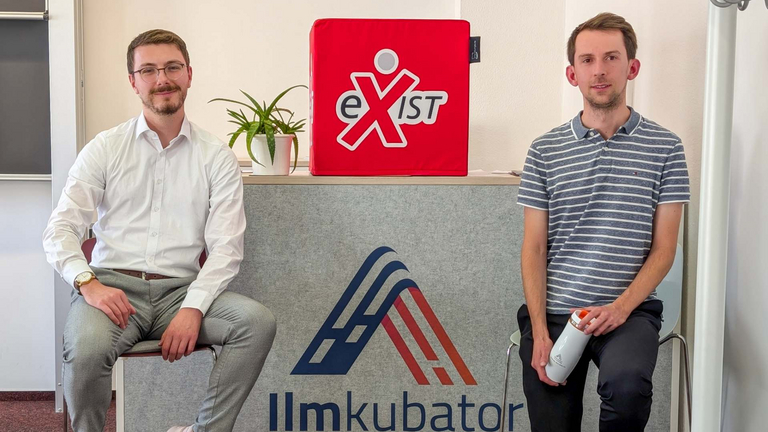
This goes far beyond mere consulting: The Ilmkubator connects startups with mentors, partners, and potential customers; provides information on funding opportunities; offers workshops and networking events; and, through the IlmkubatorLab, creates a space to test ideas in practice and develop prototypes. Through the Thuringian university startup network StarTH, a cross-university network with a wide range of expertise is also available.
In this interview, the two startup advisors share what inspires them about starting a business, what kinds of questions aspiring entrepreneurs can bring to them, and why a successful startup requires not only a good idea but also a strong team.
Mr. Kraus, Mr. Schmitz, how did you get into the world of startups?
Magnus Kraus: I’m originally from Munich and studied economics in Bayreuth and Mannheim. Even while I was a student, I was interested in university startups and innovation and was active in student networks.
Stefan Schmitz: I’m from Mainz and earned my master’s degree at Chemnitz University of Technology, where technology and innovation management were central components of the program. During that time, I worked for two and a half years at the Fraunhofer Institute for Machine Tools and Forming Technology and focused my master’s thesis on the economic feasibility assessment of green hydrogen technologies and related value chains.
What brought you to the TU Ilmenau?
Stefan Schmitz: I was particularly drawn to TU Ilmenau’s reputation as a “hidden champion.” The environment here is incredibly exciting: the work being done here is technically very sound. If you look, for example, at the cleanroom in the Center for Micro- and Nanotechnologies and the broader research infrastructure, it quickly becomes clear what the university has to offer. There’s enormous potential here, especially in the field of deep tech.
What exactly is your role as a startup advisor?
Magnus Kraus: We want to inspire students and researchers to consider starting a business as a possible career path – whether during their studies, after graduation, or while pursuing a Ph.D. In this way, research findings can be put into practice and generate social or economic benefits.
Within the Thuringian university startup network StarTH, we specialize in specific thematic areas as part of our startup support. My focus is primarily on the specialization area “Artificial Intelligence (AI) and Digital Business Models.” Stefan coordinates the “Technology and Deep Tech” specialization. These are areas in which the TU Ilmenau is particularly strong.
The advantage of collaborating through StarTH is that we don’t have to cover every topic ourselves.
Through StarTH, we can connect aspiring entrepreneurs with experts from other Thuringian universities – for example, when it comes to specific funding programs, Female Founders, or other specialized topics. We therefore explicitly see ourselves as a network and not as lone wolves.
What happens when someone comes to you with an initial idea?
Magnus Kraus: First, we schedule an initial meeting and assess the current status: What has already been done? What is the goal? Where does the person or team want to go? Then, we work with the team to determine what kind of support makes sense – from coaching, contacts, or workshops to specific funding opportunities.
Stefan Schmitz: Another important question is: Why do you actually want to start a business? Is the goal to build a company that can scale as quickly as possible? Is the plan to bring a technology to market or sell it in the foreseeable future? Or is the aim to create a long-term life’s work?
Depending on where someone wants to go, the consulting approach can vary greatly. Our goal is to identify the right next steps and connections.
What distinguishes a good idea from a viable startup venture?
Stefan Schmitz: A technology or invention alone isn’t enough. It has to connect with a market in order to become an innovation. That takes time, resources, and a team capable of bringing it to fruition.
That’s why we don’t just look at the technical idea, but also at whether the necessary expertise and capacity are in place and what might still be missing.
What role does the team play?
Stefan Schmitz: A very big one. Before starting a company, there’s often a sort of self-discovery phase: You have to figure out how to work together, make decisions, and create shared structures.
For example, I’ve advised teams that were spread across Peru, Germany, and Taiwan and still worked exceptionally well together. Conversely, it’s possible that people living in the same shared apartment might not work well together. So proximity alone isn’t a factor for success.
Magnus Kraus: That’s precisely why we also try to bring together people whose skills complement each other. Through StarTH, we can establish contacts with people from other universities who, for example, bring business knowledge or project management skills to the table.
How important is it for a startup team to combine different skill sets?
Stefan Schmitz: Very important. Just because researchers have developed an outstanding technology doesn’t automatically mean they can also build a company. That also requires entrepreneurial skills. Or, for example, they may lack skills in product design or programming.
If such skills are lacking within our own network, we can use the StarTH network to search for suitable people at other universities. In the best-case scenario, this leads to the formation of new teams.
The network also helps bring people with similar interests together. This can lead to new collaborations or even startup teams.
You talk a lot about networks. Who exactly do you collaborate with?
Magnus Kraus: Within TU Ilmenau, there are numerous partners, such as PATON, UNIKAT, and, of course, the various departments. In addition, there are external partners like the Ilmenau Technology and Startup Center, the Thuringian Center for Startups and Entrepreneurship (ThEx), the Chamber of Commerce and Industry (IHK), and various research institutions. The Ilmenau Startup Forum e.V., the TU Ilmenau startup alumni, and TU Ilmenau Transfer GmbH are also part of our network. Furthermore, we work closely with other universities outside Thuringia, such as the Technical University of Chemnitz and the Technical University of Freiberg.
Stefan Schmitz: We recently took stock of just how many partners we’re actually connected to and came up with around 60 to 70 right off the bat. That shows just how broad the network is.
You both have different perspectives on entrepreneurship. What fascinates you personally about it?
Magnus Kraus: I’m inspired by the opportunity to pursue my own ideas and passions – and above all, by the entrepreneurial spirit. That’s exactly what we want to foster in our IlmkubatorLab. There, for example, there are 3D printers and other machines that let you test out ideas right away.
So you don’t have to wait until everything is perfectly prepared. You can start building something, testing it, and learning from the experience.
Stefan Schmitz: I’m actually more risk-averse myself, so I like to see myself as an optimizer. I’m fascinated when people have the courage to try new approaches and consciously take risks.
My job is then to critically scrutinize the ideas: Are the resources available? Is it technically feasible? Do we have the necessary expertise? These questions can sometimes be annoying, but they help turn a good idea into a realistic plan.
So doesn’t critical scrutiny stifle the entrepreneurial spirit?
Stefan Schmitz: On the contrary. It’s not meant to slow things down, but to help keep us grounded in reality. If the answer is: Yes, we have the know-how, the resources, and the necessary people – all the better. If something is missing, we work together to figure out how to close that gap.
I’ve been advising startups on a volunteer basis on the side for several years now, working with a wide variety of people and technologies. You learn something new every time.
The focus in Ilmenau is on “AI and Digital Business Models” as well as “Technology and Deep Tech.” What if someone comes up with a completely different startup idea?
Magnus Kraus: Even then, we’re the right people to talk to, and we’ll help with business model development. At the Ilmkubator, any startup idea from members of the TU Ilmenau is welcome! Through StarTH, for example, we can cover topics like female founders, social impact, or sustainability.
What resources are available for students who don’t yet have a specific startup idea?
Magnus Kraus: We offer events related to entrepreneurship every semester. Additional low-barrier opportunities, such as hackathons or workshops, are available through our partners as part of the European University Alliance SUNRISE. The International Office provides support for funding stays at partner universities.
With the IlmkubatorLab, we have a space where you can experiment hands-on to see what’s possible. For example, you can work with machines, build prototypes, or simply learn how certain technologies work. These are intentionally accessible opportunities. You don’t need to come with a fully formed business idea.
What would you say to someone who has an idea but doesn’t dare to come to you with it?
Magnus Kraus: That’s exactly what our advisory services are for. Ideas are usually not fully developed at the beginning. So you don’t have to come with a fully formed business model. We’ll look at it together: What is the idea? What would be a sensible next step? What methods, contacts, or resources could help?
So what do you need to have to start a business?
Stefan Schmitz: Above all, a willingness to engage with the idea. There’s no such thing as an “entrepreneurial gene,” and you don’t have to fit the stereotype of the brilliant lone wolf.
We welcome anyone who comes to us with an idea, whether it’s just starting to take shape or is already well developed. At the Ilmkubator and within our network, there are many people who are eager to build something together.
You don’t have to live in your own garage like Steve Jobs. You can just stop by if you have an idea. We’ll figure out the rest together.
What do you hope to achieve with your work at TU Ilmenau in the coming years?
Magnus Kraus: This year, two teams at TU Ilmenau have already successfully secured funding for EXIST research transfer projects. We want to build on that and further institutionalize startup consulting at TU Ilmenau. Universities play an important role in innovation and entrepreneurship, especially where new technologies are emerging.
Stefan Schmitz: For us, it’s about more than just creating as many startups as possible. We want to promote entrepreneurial thinking at the university. Even those who don’t end up starting a business can benefit from this: Anyone who has learned to recognize opportunities, tackle problems in a structured way, and test ideas can apply these skills in their studies, in research, or in their future careers.
Finally: If you were to start a business today—what would your venture be?
Magnus Kraus: I could imagine setting up a place like the IlmkubatorLab in my hometown. I think it’s important to introduce people to practical skills early on and give them a space where they can try things out. That’s exactly what I felt was missing to some extent during my studies.
Stefan Schmitz: I’d probably focus on green hydrogen and its industrial applications. There are still gaps in that field and exciting business opportunities.
And it wouldn’t have to be a unicorn at all. I could also imagine a company that grows slowly and sustainably. It doesn’t always have to be about scaling up as much as possible.
Innovative Startups from Thuringian Universities
On November 5, 2026, the Thuringian University Startup Network StarTH will bring together startup teams, aspiring entrepreneurs, and partners from the technology and deep tech sectors at the Technology and Startup Center (TGZ) in Ilmenau for the StarTH Technology & Deep Tech Forum 2026.
The focus will be on innovative startups from Thuringian universities, personal startup stories, and the question of what—besides strong technology—is needed to turn research and ideas into successful startup ventures.
Contact
Dr. Dörte Gerhardt
Leiterin Referat Forschungsservice und Technologietransfer (FuT)