

International recognition for Ilmenau-based scientist Dr. Lina Jaurigue: The Head of the CZS Early-Career Research Group for Interpretable Models for Efficient Analog Time Series Forecasting at the TU Ilmenau – funded by the Carl Zeiss Foundation – has been awarded the 2026 Argyris Visiting Professorship at the Stuttgart Center for Simulation Science (SimTech). This prestigious visiting professorship recognizes her scientific work at the intersection of nonlinear dynamics, machine learning, and novel computer architectures.
Awards
Ilmenau researcher awarded prestigious visiting professorship
2026 Argyris Visiting Professorship for Dr. Lina Jaurigue
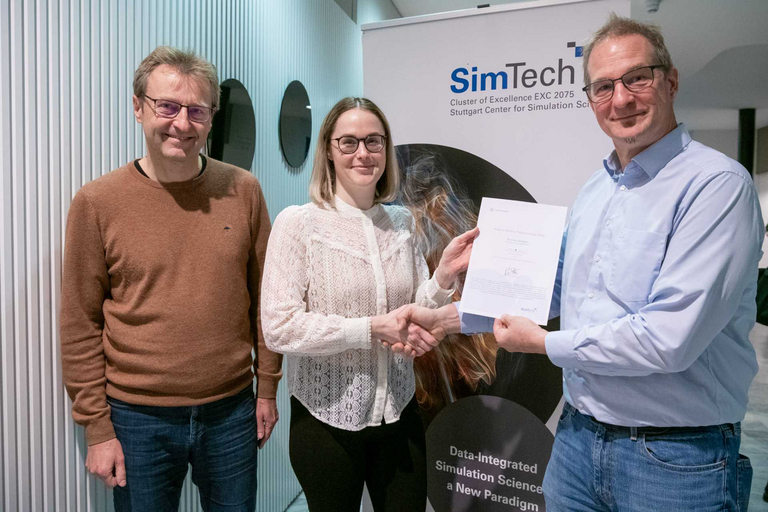
Whether for applications in sensor technology, time-series forecasting, or climate modeling, Dr. Lina Jaurigue uses the complex dynamics of physical systems for calculations and investigates how various machine learning methods can utilize these dynamics. This research approach has also attracted significant international interest. At the University of Stuttgart, the early-career researcher from the TU Ilmenau was honored on November 5, 2026, as the Argyris Visiting Professor 2026.
The award included a four-week research stay at the Stuttgart Center for Simulation Science (SimTech), the Cluster of Excellence “Data-Integrated Simulation Science,” which is part of the University of Stuttgart’s Center for Simulation Sciences. From October 12 to November 6, 2026, Jaurigue exchanged ideas with researchers from various disciplines, developed concepts for joint research projects, and contributed her expertise to the local scientific community.
Lina Jaurigue’s research focuses on what is known as reservoir computing. This approach to machine learning utilizes the dynamics of complex systems to process information and predict temporal developments. Instead of traditional software solutions, physical systems – such as optical, analog, or quantum systems – are employed for information processing.
This research opens up new perspectives for energy-efficient and high-performance methods in machine learning and simulation. Among other things, Dr. Jaurigue is investigating how complex time series can be predicted using analog computational approaches and how interpretable models can be developed in the process. Other research activities focus on optical reservoir computing and neuromorphic acoustic sensing.
New impulses through international collaboration
The Argyris Visiting Professorship provided an opportunity to combine these research approaches with the expertise of the SimTech Cluster of Excellence in Stuttgart. The focus was particularly on questions important for data-integrated simulations: How can complex dynamic systems be modeled efficiently? How can physical knowledge and data be combined in so-called predictive models? And how can machine learning models be both powerful and transparent?
In addition to the academic exchange, the visit also aimed to identify opportunities for long-term collaboration, including in the areas of hybrid modeling approaches and future computer architectures.
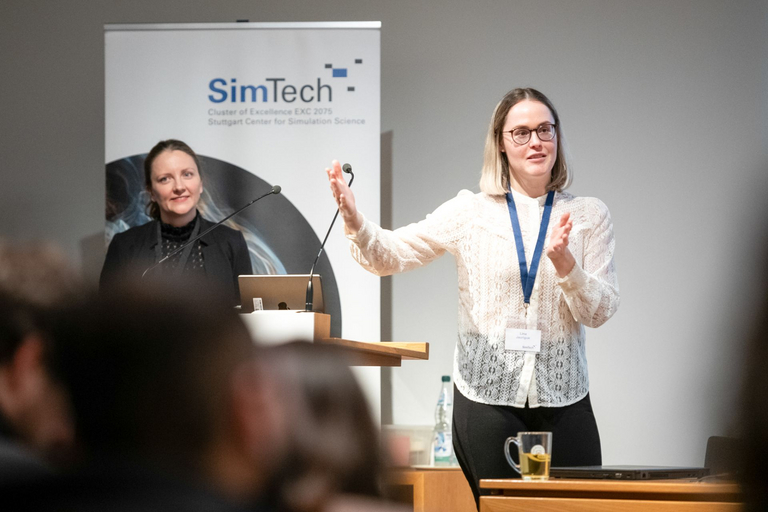
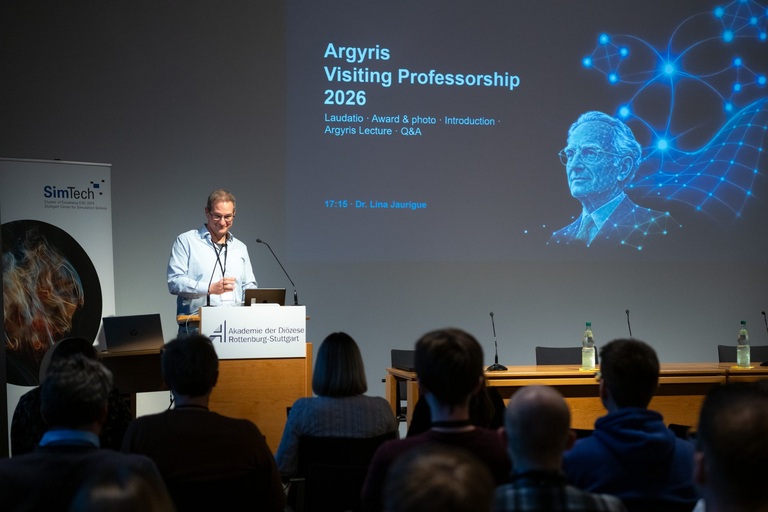
Another key component of the visit was the transfer of knowledge to early-career researchers. In addition to the public Argyris Lecture and a seminar for the SimTech Graduate School, Dr. Jaurigue also led a one-on-one exchange session with doctoral students and postdocs. The discussion also covered academic career paths and how to refine one’s personal research profile.
An award as recognition and incentive
Established in 2014, the Argyris Visiting Professorship honors John Argyris, a pioneer of computer-aided simulation at the University of Stuttgart. Through this visiting professorship, SimTech promotes international and interdisciplinary exchange and brings together outstanding researchers at various stages of their careers with its own research community.
For Dr. Lina Jaurigue, the award is also recognition of her scientific work in a research field that has garnered significant international attention, demonstrating how the combination of basic research, innovative computational concepts, and machine learning can open up new perspectives:
The visiting professorship was a wonderful opportunity for me to share my knowledge in this field and to learn new things from others.
Contact
Dr. Lina Jaurigue
Head of CZS Early-Career Research Group for Interpretable Models for Efficient Analog Time Series Forecasting