

From the analysis of digital protest networks to new methods for processing ultrathin materials and energy-efficient machine learning, to the use of artificial intelligence in turbulence research: The works honored with the TU Ilmenau 2025 Publication Award on October 6 demonstrate the societal relevance of research at the university.
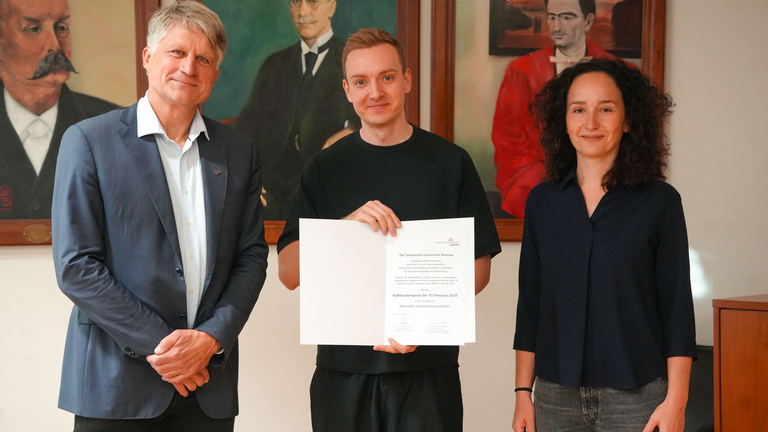
The publication award, worth 2,500 euros, is presented every two years. The selection process conducted by the Research Committee of the TU Ilmenau takes into account, among other factors, international visibility, methodological strength, and societal or technological relevance.
Economic and Social Sciences: How Protest Networks Work on Telegram
The Publication Award in the “Economic and Social Sciences” category went to Maximilian Zehring and Prof. Emese Domahidi. Their study examines the communication of the Querdenken movement – the driving force behind the German COVID-19 protests – on Telegram.
To investigate possible links between this movement and the far-right scene and alternative media – and to explore key themes of the Querdenken network over time – Maximilian Zehring and Emese Domahidi analyzed 6,294,955 messages from 578 public Telegram channels.
Using computer-aided methods, they were able to identify which content is shared particularly frequently, which actors within the network are particularly influential, and which topics dominate the discourse.
“This made our study one of the very first systematic investigations of the Querdenken movement on Telegram,” said lead author Maximilian Zehring at the award ceremony. The study’s findings show that subgroups within Querdenken primarily share content from far-right and QAnon communities, while far-right and conspiracy-theory-driven alternative media channels serve as content distributors for the movement. Prof. Emese Domahidi, co-author and head of Computational Communication Science, explains that the study thus makes an important contribution to political decision-makers’ understanding of digital public spheres:
Many of the actors examined remain active to this day, including at the political level. This, of course, makes the study still relevant these days.
Engineering Sciences: Microsystems Technology for the Electronics and Sensors of Tomorrow
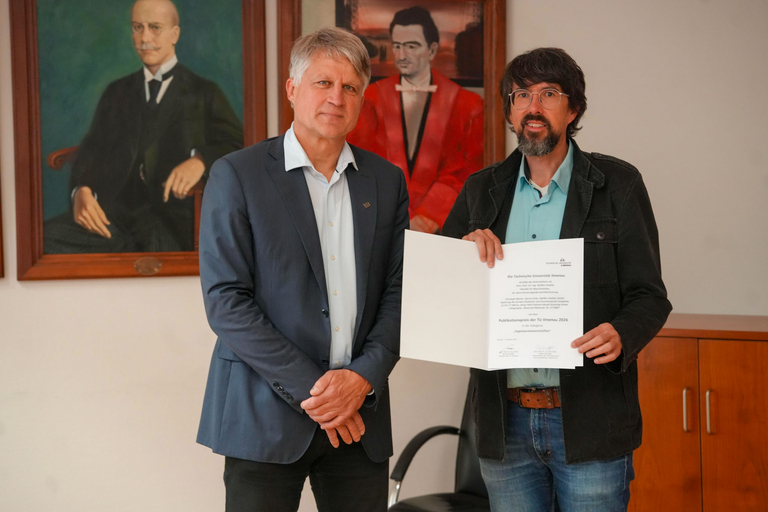
In the “Engineering Sciences” category, the university awarded the Publication Prize to Dr. Christoph Reuter, Dr. Gernot Ecke, and Prof. Steffen Strehle for their paper published in the renowned journal Advanced Materials. Using the semiconductor material molybdenum ditelluride (MoTe₂) as an example, they jointly developed an unconventional method for precisely structuring, shaping, and integrating extremely thin and delicate two-dimensional materials without damaging them.
MoTe₂ is considered a promising material for future applications in electronics and sensor technology, such as for particularly small, fast, and energy-efficient components. However, its thinness and fragility make processing it a particular challenge.
The award-winning publication presents a new and comparatively simple approach to this problem: Using an extremely fine, nanoscale tip, the surface of the material is chemically modified locally. In this way, minute structures can be incorporated into the material without the need for additional coating or protective layers.
The research results were produced as part of the Research Training Group “Tip- and Laser-Based 3D Nanofabrication in Extended Macroscopic Working Areas (3D-NanoFab).” “As a doctoral student in the second cohort of the Research Training Group, Dr. Reuter played a pivotal role in shaping this research. I am very pleased that he is now successfully continuing his scientific career,” said Prof. Steffen Strehle, spokesperson for the Research Training Group and head of Microsystems Engineering at TU Ilmenau, on the occasion of the award ceremony.
Mathematics and Natural Sciences: Artificial Intelligence for Predicting Turbulent Flows
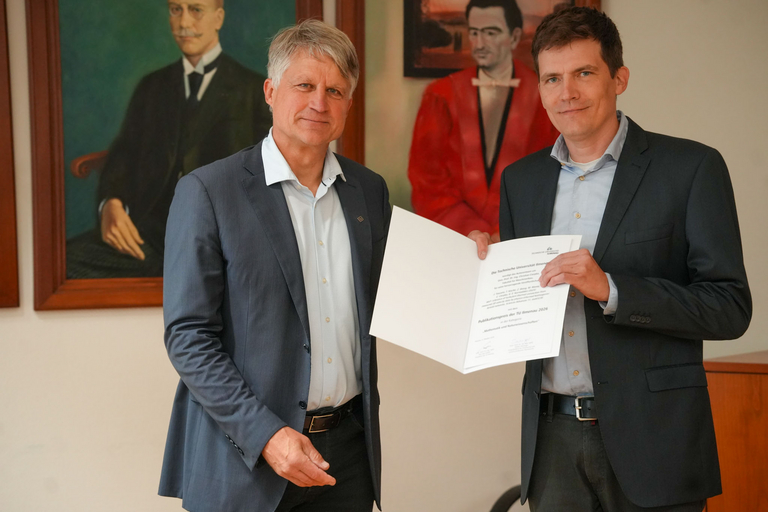
The Publication Award in the “Mathematics and Natural Sciences” category went to Dr. Theo Käufer and Prof. Christian Cierpka of the Institute for Thermal and Fluid Dynamics. Their work, conducted in collaboration with scientists at Brown University in the U.S., demonstrates how thermal turbulence can be better studied using artificial intelligence and high-resolution measurement data.
Thermal turbulence occurs when temperature differences cause liquids or gases to move in irregular, swirling patterns. Such processes play a role, for example, in the atmosphere, in technical systems, and in energy conversion. However, they are difficult to fully characterize because not all variables can be directly measured at every location.
This is where the award-winning study comes in. For the first time, the scientists have combined real three-dimensional measurement data of a flow with an AI model that not only learns from data but also takes physical laws into account. This enables the model, for example, to predict temperature fields at locations where direct measurement is not possible. Prof. Christian Cierpka, Director of the Institute for Thermal and Fluid Dynamics, explains:
The unique combination of our measurement technology – which allows us to capture velocity and temperature in three dimensions – with the novel physics-based neural networks developed at Brown University opens up entirely new possibilities for analyzing complex physical systems more accurately and modeling them more effectively.
The study also served as a springboard for Dr. Theo Käufer’s scientific career. As a postdoctoral researcher, he is now conducting research at the Massachusetts Institute of Technology (MIT) in the U.S. on turbulent flows and their prediction using artificial intelligence.
Special Award for Exceptional Originality: More Efficient Machine Learning for Complex Systems
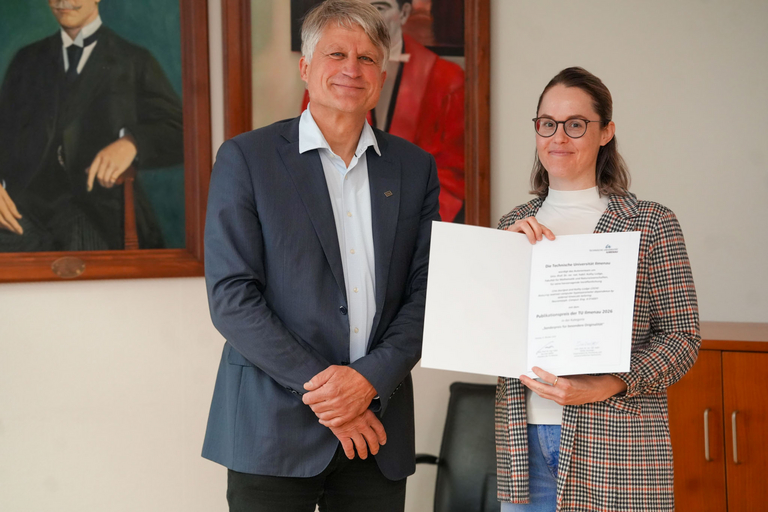
The Research Committee awarded Dr. Lina Jaurigue and Prof. Kathy Lüdge a special prize for exceptional originality. Their work focuses on how complex dynamic systems can be optimized to process data as efficiently as possible.
Complex dynamic systems such as the human heart, traffic, weather, or the global climate are difficult to predict – especially when not all relevant measurement data is available. At the same time, the need for precise and energy-efficient forecasting methods is growing.
In their work, the scientists therefore developed compact, computationally efficient algorithms that make it easier and more reliable to use so-called reservoir computers for machine learning and the prediction of complex temporal processes. By specifically adapting the temporal dynamics of the reservoirs to the respective task, fewer parameters need to be laboriously tuned, which makes the method particularly flexible and efficient.
“This may sound very theoretical at first, but it has great practical relevance,” explains Dr. Lina Jaurigue, head of the CZS Junior Research Group for Interpretable Models for Efficient Analog Time Series Forecasting at the TU Ilmenau.
In the long term, these methods can contribute to the development of dynamic systems that are not only powerful but also resource-efficient—for example, for applications in medicine, industry, or mobile devices.
Original Publications
Economic and Social Sciences
Zehring, M., & Domahidi, E. (2023). German COVID-19 Protest Organizers on Telegram and Their Ties to the Far Right: A Network and Topic Analysis. Social Media + Society, 9(1).
doi.org/10.1177/20563051231155106
Engineering
Reuter, C., Ecke, G., & Strehle, S. (2023). Exploring the Surface Oxidation and Environmental Instability of 2H-/1T'-MoTe2 Using Field Emission-Based Scanning Probe Lithography. Advanced Materials.
doi.org/10.1002/adma.202310887
Mathematics and Natural Sciences
Toscano, J., Käufer, T., Wang, Z., Maxey, M., Cierpka, C., & Karniadakis, G. E. (2025). AIVT: Inference of Turbulent Thermal Convection from Measured 3D Velocity Data Using Physics-Informed Kolmogorov-Arnold Networks. Science Advances, 11, eads5236.
doi.org/10.1126/sciadv.ads5236
Special Award for Exceptional Originality
Jaurigue, L., & Lüdge, K. (2024). Reducing reservoir computer hyperparameter dependence by external timescale tailoring. Neuromorphic Computing and Engineering, 4, 014001.
doi.org/10.1088/2634-4386/ad1d32
More about the award-winning work
In a nutshell: Nanoscale tip shapes two-dimensional materials with high precision