

A research team from Technische Universität Ilmenau, together with scientists from the Julius Kühn Institute, has developed a new method for automatically detecting parasites in wild bees. The study Deep learning based detection of wild bee parasites under natural conditions was published in the journal Ecological Informatics: https://doi.org/10.1016/j.ecoinf.2026.103754.
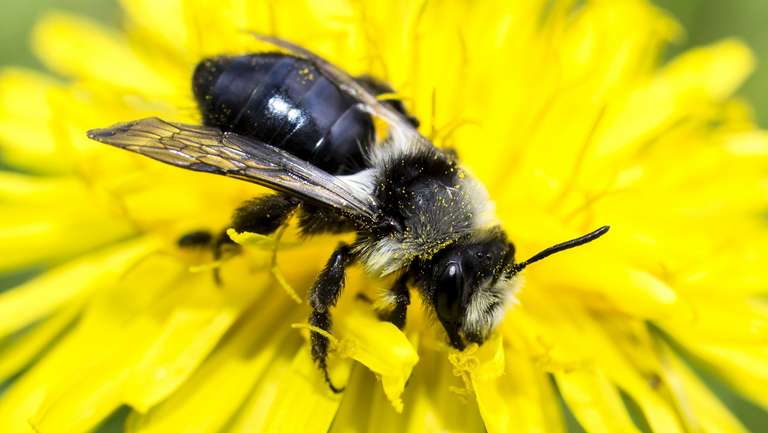
Wild bees are important pollinators for many plants and are indispensable for both ecosystems and agriculture. Since 2018, World Bee Day has therefore been celebrated annually on May 20 to raise awareness of the importance of honey bees and wild bees for biodiversity and food security.
Worldwide, there are more than 20,000 species of wild bees. However, of the more than 550 species found in Germany, nearly half are threatened — due to landscape sealing, herbicides, the loss of food sources, and also parasites that can weaken or even wipe out entire populations.
Until now, automated monitoring has focused mainly on honey bees under laboratory conditions. In contrast, the new study investigates wild bees directly in their natural environment. The researchers focused on two parasite groups: twisted-wing parasites (Stylopidae) and larvae of oil beetles (Meloidae).
According to Svetlana Ionova, first author of the study and doctoral researcher at the Data-intensive Systems and Visualization (dAI.SY) Group, the challenge was significant:
The parasites are tiny, often blurry in images, and difficult to detect in complex natural scenes.
To achieve reliable results nevertheless, the research team developed an AI-based detection system using a modern image analysis approach. In addition, the researchers from the dAI.SY research group used artificially generated training images to expand the limited number of available field photographs. Co-author Marco Seeland explains:
Our results show that the method can detect parasites with very high accuracy: the model achieved a precision of 0.96 in detecting Stylopidae and 0.85 in detecting Meloidae larvae.
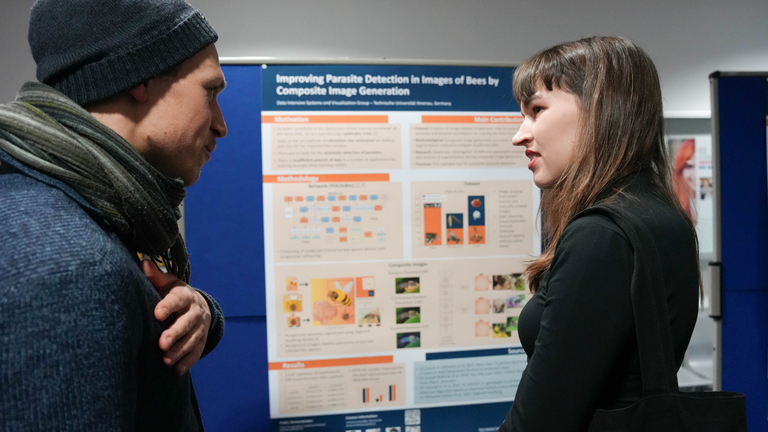
Particularly relevant in practice: In a test application, it was possible to drastically reduce the amount of manual image checking required - from around 2,500 images to just 31 that had to be checked by researchers. The technology could therefore help to monitor biodiversity more efficiently and cost-effectively in the future.
"Wild bees play a central role in functioning ecosystems. With our AI-supported method, parasites can be detected much more efficiently for the first time, even under real field conditions. This opens up new possibilities for biodiversity monitoring and the protection of important pollinator species," summarizes Svetlana Ionova.
The study was carried out in collaboration with Henri Greil from the Julius Kühn Institute as part of the "BeesUp" project, which is funded by the Federal Agency for Nature Conservation.
Original publication
Svetlana Ionova, Henri Greil, Patrick Mäder, Marco Seeland, Deep learning based detection of wild bee parasites under natural conditions, Ecological Informatics, Volume 95, 2026, 103754, ISSN 1574-9541, https://doi.org/10.1016/j.ecoinf.2026.103754.
More information on the "BeesUp" project and the topic of artificial intelligence for wild bee detection will also be available at the Ilmenau Science Night on June 20, 2026.
Contact
Dr. Marco Seeland
Data-intensive Systems and Visualization Group (dAI.SY)