

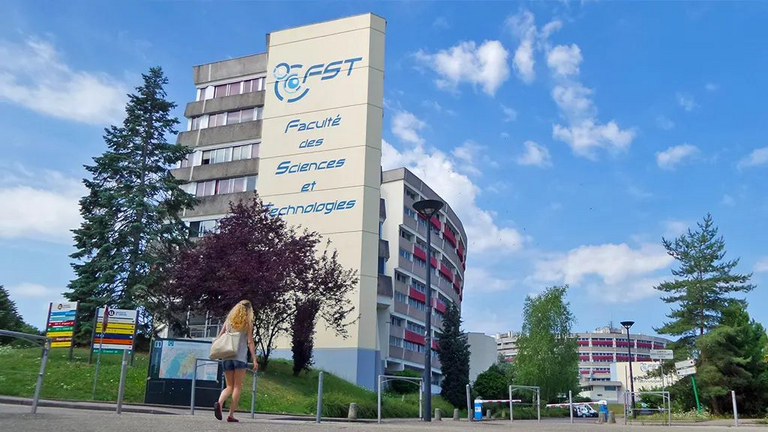
To the delight of the organisers and with great interest from students, the new double degree programme in the Master’s degree programmes ‘Master of Science in Communications and Signal Processing (CSP)’ and ‘Master Ingénierie des Systèmes Complexes’ has been launched at the TU Ilmenau and the Université de Lorraine in Nancy. The joint programme marks an important step in the international academic cooperation between the two universities and opens up unique opportunities for students in academia, in research and development departments of leading companies, and for the further development of their personal and intercultural skills. A unique degree programme has been created that combines specialisations in signal processing and communication systems with the field of Artificial Intelligence (AI).
Successful launch of the new Double Degree Program between TU Ilmenau and the Université de Lorraine in France
Delving into the world of complex data
Anyone using ChatGPT today, for example, is utilising complex algorithms that filter out the most likely answers based on large language models. These are sophisticated mathematical structures capable of analysing and processing highly complex data. This is not only of interest for chatbots, but also, for example, for medicine, robotics and modern communication systems.
A key concept here is the so-called ‘tensor’. This is a generalisation of the matrix known from school lessons, extended to three or more dimensions in which the data can be described. For example, mobile phone signals received by several antennas at different times and on different frequencies can be represented in three dimensions (e.g., in the dimensions of space, time, and frequency) – and can be analysed and optimised much more efficiently using tensor-based methods than with conventional approaches. This makes communication systems more powerful, whether in satellite communications or in the field of driver assistance systems. The algorithms have a wide range of applications. This is evident from current research topics, which range from forecasting pollen concentrations to recommendation systems, for example for personalised advertising, music, film or travel recommendations.
Both universities have been collaborating for many years on pioneering research into tensor-based signal processing, with the aim of processing multidimensional data (for example, for wireless communication systems or in biomedical signal processing) more efficiently. Through the double-degree programme, students are actively involved in this international research.
Selection of Students
The dual degree programme is aimed at high-achieving and internationally-minded students who wish to deepen their specialist knowledge in the field of signal processing. What makes this programme unique is that students from TU Ilmenau spend their third semester at the Université de Lorraine in Nancy, where they attend specialised modules (Green IT; Detection, Estimation, Reconstruction; Numerical Optimisation and Data Science; Statistical Processing and Big Data; Adaptive and Array Signal Processing; Advanced Research Project) and immerse themselves in a new academic environment.
The double-degree programme offers selected students from TU Ilmenau the opportunity to study at the Université de Lorraine. Details of the programme are regularly presented to students during the introductory week and at further information sessions. The programme is aimed in particular at students who have achieved very good results in the first semester of the CSP degree programme. In addition, however, students of Electrical Engineering and Information Technology, Engineering Informatics or Media Engineering who wish to delve deeper into the world of signal processing and are considering gaining experience in an international context through this double-degree programme after completing their Bachelor’s degree are also actively encouraged to apply. For the first intake, the first four students have already been selected for admission to the programme on the basis of their excellent academic performance.
One of the participants describes his motivation as follows:
Studying in both Germany and France will give me the opportunity to experience different academic environments and cultures. I believe this will help me grow both personally and professionally and prepare me for working in international teams.
Flexibility regarding the Master's Thesis
Students can complete their thesis either in Nancy or in Ilmenau – depending on their research focus and personal preference. Supervisors from both Ilmenau and Nancy are assigned to provide guidance. This flexibility helps students develop their individual academic profiles and facilitates their entry into international research projects.
A degree programme with international added value
By combining two renowned degree programmes, participants not only acquire in-depth technical knowledge but also valuable intercultural and language skills – abilities that are increasingly in demand in the globally interconnected world of engineering. The selected students become members of the prestigious Franco-German University (DFH, www.dfh-ufa.org) and can thus benefit from the DFH’s extensive academic, financial and cultural support and networking opportunities.
The Franco-German University (DFH) is an international institution with its own legal status, founded in 1997 by Germany and France. Its main task is to initiate, evaluate and provide financial support for Franco-German degree programmes. A broad spectrum of subject areas is represented, ranging from engineering, the humanities and social sciences to the natural sciences, law, economics and teacher training. The degree programmes are offered by a network of 210 universities and Grandes Écoles in almost 140 cities in Germany, France and other countries. Currently, almost 6,000 students are taking part in the partnerships supported by the DFH. There is no comparable binational project anywhere in the world.
Support from the university
At present, students receive in-depth advice from experts at the respective ‘International Offices’ of both universities. Through personalised guidance, administrative support and assistance with funding opportunities, they create the ideal conditions for a successful study period in France. Particular emphasis is placed on helping students apply for grants to cover travel and living costs. This funding enables students to plan their time abroad with financial security and to concentrate fully on their studies.
A promising start
The successful launch of the double-degree programme demonstrates just how fruitful international cooperation between universities can be. Students benefit from an innovative study model that combines academic excellence with international experience. The programme coordinators at both universities are optimistic about the coming years and look forward to jointly developing and expanding the programme.
More about the Double Degree Program

Contact
Prof. Martin Haardt
Head of the Communications Research Laboratory and Coordinator of the Double Degree Program