Thermal boundary layers in turbulent Rayleigh-Bénard convection with rough and smooth surfaces

Experiments by du Puits


Available data

The data set incorporates wall-normal profiles of the normalized mean temperature  Θ(z/H) and its fluctuations Θ′(z/H).

The data files can be downloaded as compressed archives.
rbc_temperature_rough_surface.zip

Description

In this data set, we provide wall-normal profiles of the mean temperature   T(z) ( z is the coordinate perpendicular to the wall ) and its fluctuations   T(z)  in turbulent Rayleigh-Bénard convection with rough and smooth walls. The data has been obtained in the large-scale Rayleigh-Bénard experiment "Barrel of Ilmenau (BOI)". We used very tiny micro-thermistors of 150 µm diameter and 350 µm length to measure the temperature in and outside the thermal boundary layer at the heated bottom plate with, up to now, unsurpassed spatial and temporal resolution. Our measurements covered Rayleigh numbers between   Ra=  5.4x10⁹ and Ra<   9.6x10¹¹ and two aspect ratios Γ=1.1 and Γ=2.9. The Prandtl number was fixed at Pr=0.7. The definition of these numbers is as follows:


Ra=βgΔTH3νκ,Pr=νκ ,Γ=DH.

ΔT  is being tehe temperature difference between the heated bottom and the cooled top plate. H and D are their distance and the diameter of the test cell. β,  ν and κ are the thermal expansion coefficient, the kinematic viscosity and the thermal diffusivity of the fluid. And, g is the gravitational constant of the Earth. The mean temperatures T and the fluctuations were calculated from 90 min time series with a sampling rate of 50 samples/s. A more detailed description of the experimental facility, the measurement technique and a table 1 with a selection of the parameters will be provided in the subsequent section. Moreover, we refer to a recently published paper in Physical Review Fluids (du Puits, 2024).


Experimental set-up, measurement technique and main parameters

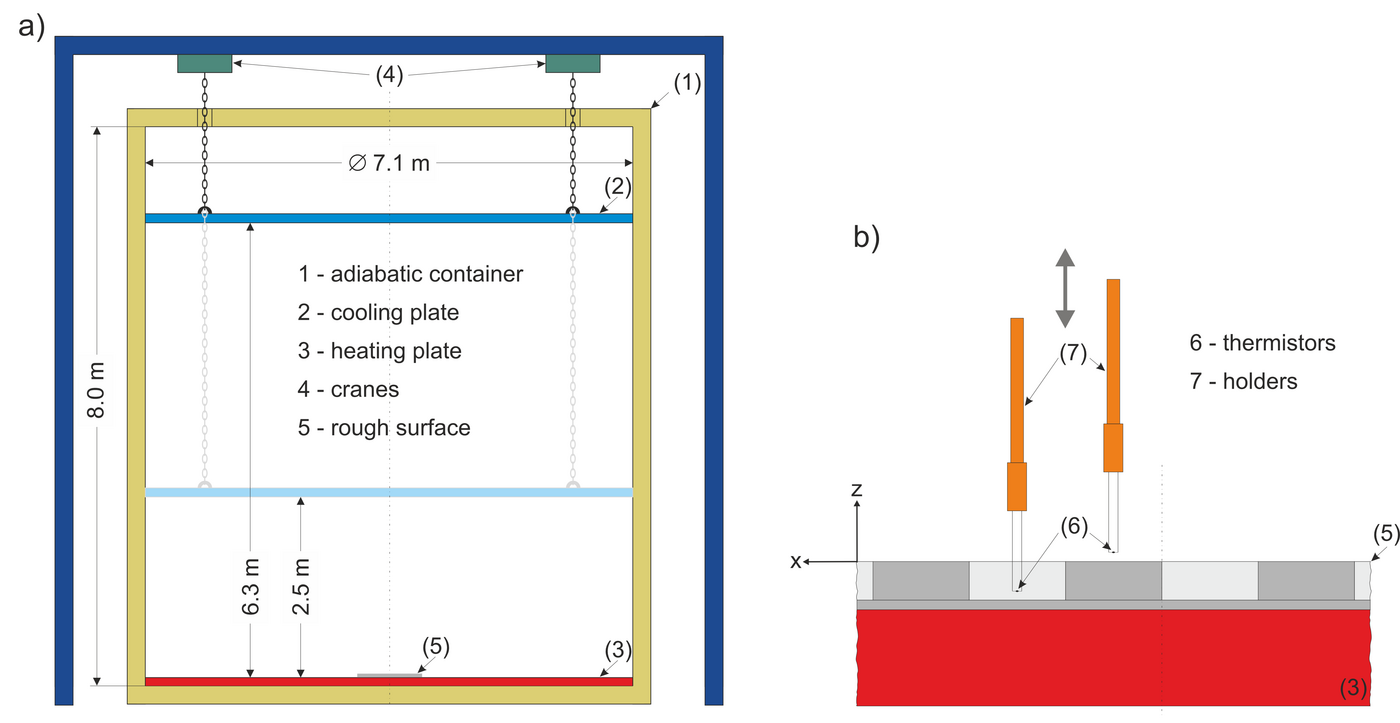
All measurements have been undertaken in the large-scale RB experiment "Barrel of Ilmenau" (figure 1)(a) (see also Cases 1, 2 and 3). The experiment consists of an adiabatic container of 8.0 m in height and 7.1 m in diameter which is filled with air ( Pr=0.7). At the bottom of the container, a heating plate composed of an electrical underfloor heating and a water-flown plate of Aluminum on top heats the air. The cooling plate at the top of the container consists of 16 segments with water circulation inside as well. The segments are mounted on a solid steel construction and are separately leveled perpendicular to the vector of gravity. The entire construction with a weight of about 6 tons is mounted on a crane and can be lifted up and down. The sandwich technology of the heating and the cooling plates guarantees a uniformity of the temperature at their surfaces with a deviation of the local temperature less than 1 per cent (1.5 per cent for the cooling plate) of the total temperature drop ΔT between the plates. Separate PID-controllers keep the temperature of both plates in a band of ±0.02 K around the value adjusted. The sidewall of the container is shielded by an active compensation heating system. Eighteen electrical heating elements are arranged between an inner and an outer isolation of 16 and 12 cm thickness, respectively. Their temperatures are controlled to be equal to the temperatures at the inner surface of the wall with the consequence of virtually no heat flux across the sidewall. More detailed information on the experimental facility can be found in du Puits et al (2013).

We placed 336 cuboid roughness elements of 30 mm by 30 mm cross section and 12 mm height at the surface of the heating plate. They are made of aluminum and form a chessboard-like pattern with a period of 2d = 60 mm (figure 1(b)). The cuboids are mounted at a circular aluminum disk, 950 mm in diameter and 3 mm thick, using adhesive pads with high thermal conductivity. This “rough” disk was placed at the center of the heating plate adding a 0.15-mm-thick foil of silicon rubber in the gap between the surface of the plate and the disk. The foil significantly improves the thermal contact and ensures that the temperature drop between the plate and the disk remains as small as possible. For the measurements at the smooth surface, we removed the disk temporarily.

Fig. 1: (a) Principal setup of the large-scale convection facility "Barrel of Ilmenau''. (b) Detailed sketch of a fraction of the rough surface with the temperature sensors. The sketch shows the elements in the correct proportion except the temperature sensors, which are up-scaled by a factor of 2 for better visibility.

We used very tiny thermistors to measure the temperature field near the rough surface. They have an ellipsoidal shape. Their diameter and their length amount to 150 μm and 350 μm, respectively. They are fixed at a holder which can be moved in steps of 10 μμm up and down. The temperature at the top of one cuboid and in one valley in between the cuboids was measured using two of them in an arrangement shown in figure 1(b)  The resistance of the thermistors was measured using a PC based data acquisition system. The data rate amounts to 50 samples/s and is sufficiently high to capture even the fastest temperature fluctuations. Before we used the thermistors in the BOI, we calibrated them against a certified PT-100 in a calibration chamber. The remaining uncertainty of ±20 mK was further reduced by an in-situ calibration in the measurement chamber.

Our experiments spanned two and a half decades in Rayleigh number  Ra=5.4x10⁹ to Ra  <   9.6x10¹¹ and two aspect ratios Γ=1.1 and Γ=2.9.  To vary the Rayleigh number within a single aspect ratio, we changed the temperature difference ΔT. The temperature of the heating and the cooling plates was always set symmetrically above and below a temperature of 30.0°C, except for the measurements at Γ=1.1,   Ra  =   9.6x10¹¹ and Γ=2.9Ra=5.9x10¹⁰.  For those measurements, the theoretical center temperature amounted to 42.5°C. The main parameters of all measurements are listed in table below, where the Nusselt number Nu results from direct measurements of the local wall heat flux at the smooth plate, and the boundary layer thickness δth=H/(2Nu) is given as a reference in comparison to the roughness height h .


ΓRaΔT[K]Tb[°C]H[m]Nuδth[mm]
1.15.8 x 10¹⁰2.730.46.3164.219.18
1.18.6 x 10¹⁰4.030.56.3256.812.26
1.11.5 x 10¹¹7.030.66.3313.910.04
1.12.2 x 10¹¹10.030.86.3361.68.71
1.14.3 x 10¹¹20.031.26.3429.27.34
1.16.3 x 10¹¹30.031.66.3471.56.68
1.18.0 x 10¹¹38.031.86.3542.85.80
1.19.6 x 10¹¹55.045.06.3559.05.64
2.95.4 x 10⁹4.030.32.571.717.44
2.99.4 x 10⁹7.030.52.590.413.82
2.91.3 x 10¹⁰10.030.62.5106.411.75
2.92.7 x 10¹⁰20.031.12.5127.19.83
2.94.0 x 10¹⁰30.031.52.5143.48.72
2.95.1 x 10¹⁰38.030.52.5160.67.78
2.95.9 x 10¹⁰54.743.72.5165.07.58

  In addition, we mounted heat flux plates to measure the local heat flux re-leased and absorbed from the surfaces of the hot bottom and the cold top plates, respectively. The sensors, developed and provided by the company Phymeas GbR are little discs with a well known heat conductivity. They have a total diameter of 33 mm, however, only the inner 25 mm area is being active for the measurement. We installed five such sensors each in the bottom and the top plates of our experiment. One is located at the center of each plate and the other four are equally spaced at a radius of R=0.45m. They are flush-mounted in a notch in the surface of the bottom (top) plate to prevent measurement errors caused by artificial turbulence at the edges of the sensors.


Available data

The data set incorporates wall-normal profiles of the normalized mean temperature  Θ(z/H) and its fluctuations Θ′(z/H):


Θ=T(z)-TbThp-Tb ,Θ′=1Ni=1N(Θi-Θ)2


z/H is the coordinate perpendicular to the wall normalized by the plate distance.

The data files can be downloaded as compressed archives.

The Excel files contain profiles of mean and rms normalized temperature obtained above the top of a cuboid, above the valley in between the cuboids, and from a smooth surface as a reference, for each aspect ratio and Rayleigh number in a seperate sheet. The underlying time series can be requested from Ronald du Puits.


References

[1]du Puits, R. (2024), Thermal boundary layers in turbulent Rayleigh-Bénard convection with rough and smooth surfaces, Phys. Rev. Fluids, Vol. 9, p. 023501.
[2]du Puits, R., Resagk, C., Thess, A. (2013), Thermal boundary layers in turbulent Rayleigh–Bénard convection at aspect ratios between 1 and 9, New J. Physics, Vol. 15, p. 013040.

Acknowledgment

The authors wish to acknowledge the funding by the Deutsche Forschungsgemeinschaft (DFG,German Research Foundation) under Grant No. 495678007.
Moreover, they wish to acknowledge Sabine Scherge for her technical assistance running the experiments.