PD Dr.-Ing. habil. Ronald du Puits
Arbeitsgruppenleiter Ilmenauer Fass
+49 (0) 3677 69-1353
The data files can be downloaded as compressed archives: Boundary_Layer_Profiles.zip

Fig. 1: Description of the experiment. (left) Sketch of “Barrel of Ilmenau” with the new inset cell of 2.5 m height and 2.5 m diameter. In this paper we present the results at center and side window 1, 2, and 3. (right) Setup of the 3D-laser Doppler anemometry measurement, which is mounted above the cooling plate. 𝑢, 𝑣, and 𝑤 are the desired velocity components in Cartesian coordinates.

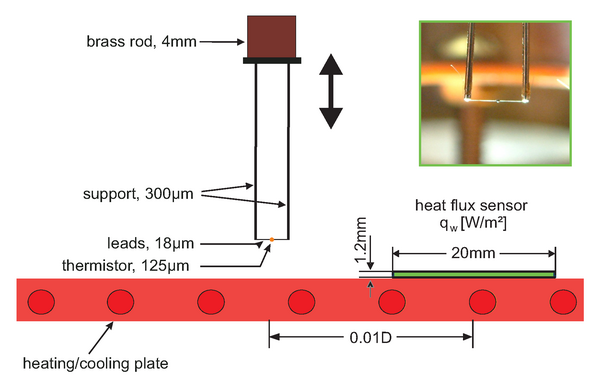
Fig. 2: Set-up of the temperature measurement
In order to compare the results with the experiments in “Barrel of Ilmenau” the same measurement procedure was followed, by taking time series of the turbulent fields at several locations in the cell, which allowed wall-normal mean profiles of the turbulent fields to be determined. For the lower Rayleigh number case there were four arrays containing 40 measurement points each. They were seeded in order to track fully resolved time series of the three velocity components and the temperature. Probe arrays were positioned as in the experiment. There were 100 measurement points for the larger Rayleigh number run.
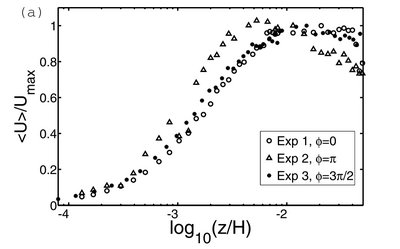
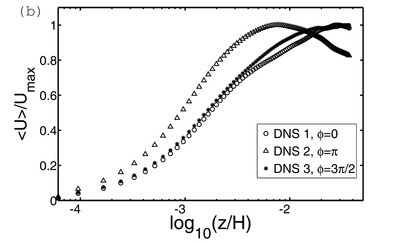
Data available includes:
Mean and rms velocity and temperature profiles across the boundary layers on the cold plate: mean_hvel_profiles, mean_temp_profiles, mean_wnvel_profiles
Mean velocities at side windows 1, 2 and 3: mean_hvel_profiles_at_side_windows, mean_wnvel_profiles_at_side_windows
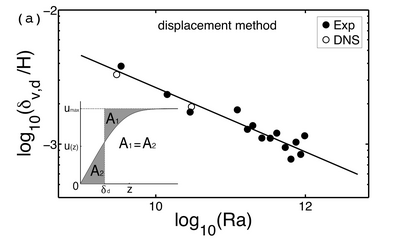
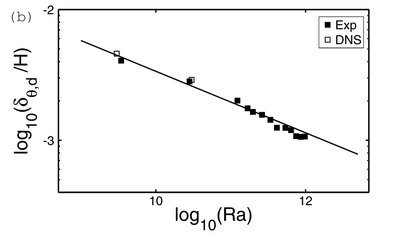
Dynamic and thermal boundary layer thicknesses for a range of Rayleigh numbers: Boundary layer thicknesses with Exp and DNS
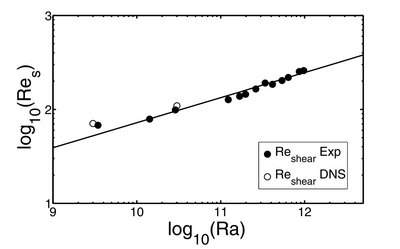
Shear Reynolds number for a range of Rayleigh numbers: Shear Reynolds numbers with Exp and DNS
The data files can be downloaded as compressed archives: Boundary_Layer_Profiles.zip

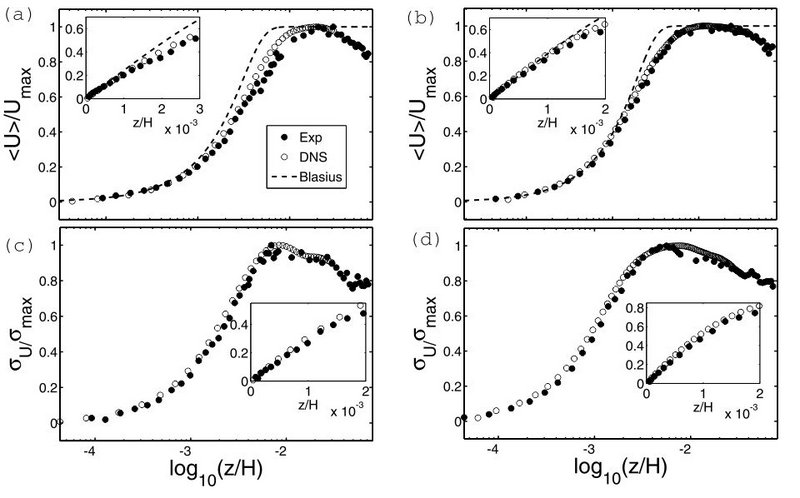
Fig. 4: Profiles of the mean horizontal velocity (a,b) and the standard deviation (c,d) measured in the experiment (closed circles) and obtained from the DNS (open circles) at Ra = 3 × 10⁹ (a,c) and Ra = 3 × 10¹⁰ (b,d). The dashed lines in (a) and (b) represent the velocity field of a laminar flat plate BL according to Blasius [9]. The insets of (a) and (b) show the entire mean velocity profile in logarithm scale, and the insets of (c) and (d) show the near-wall region of the BL fluctuations.

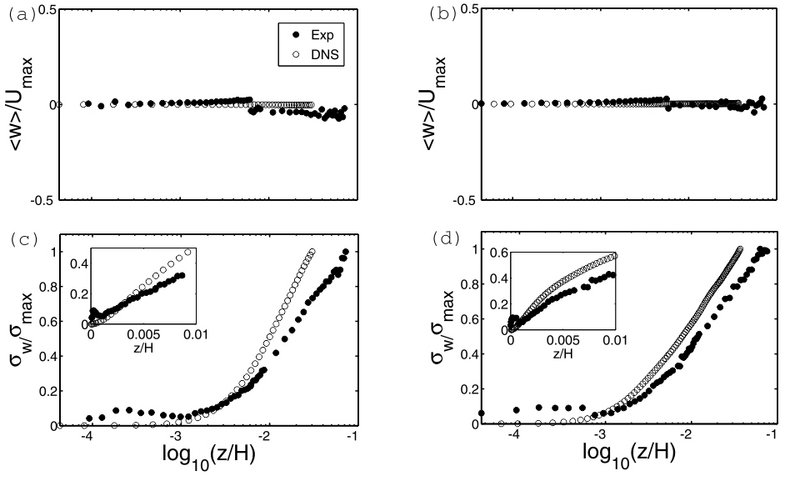
Fig. 5: Profiles of the wall-normal velocity (a,b) and the standard deviation (c,d) measured in the experiment (closed circles) and obtained
from the DNS (open circles) at Ra = 3 × 10⁹ (a,c) and Ra = 3 × 10¹⁰ (b,d). The insets show the near-wall region of the BL.

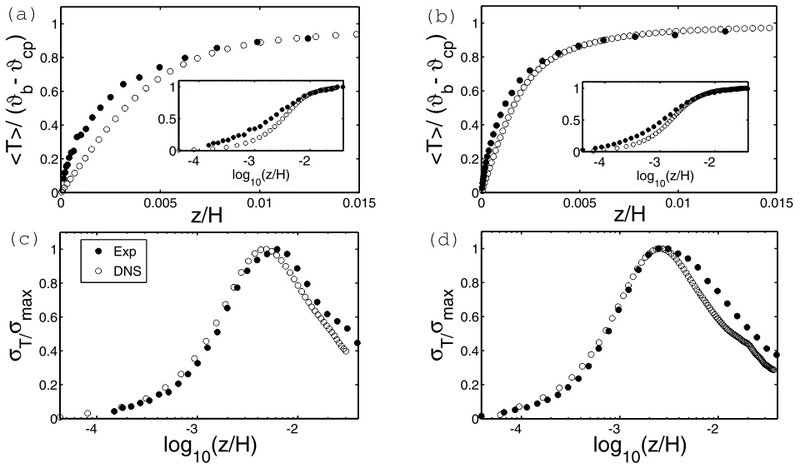
Fig. 6: Profiles of the mean temperature (a,b) and the standard deviation (c,d) measured in the experiment (closed circles) and obtained
from the DNS (open circles) at Ra = 3 × 10⁹ (a,c) and Ra = 3 × 10¹⁰ (b,d). The insets show the entire mean temperature profile in logarithmscale. Here ϑb and ϑcp denote the mean bulk temperature and the surface temperature of the cooling plate.


Fig. 7: Mean horizontal velocity profiles at side windows 1, 2 and 3 at the higher Ra. (a) Profiles of the measured data at window 1 (circle), window 2 (triangle) and window 3 (star). (b) Profiles of the DNS data at window 1 (circle), window 2 (triangle) and window 3 (star).


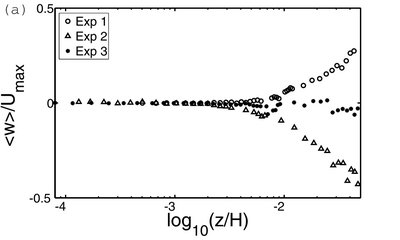
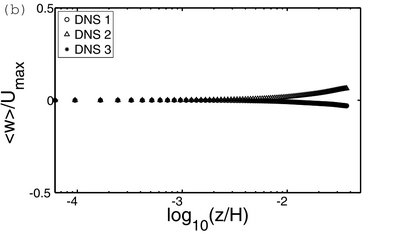
Fig. 8: Mean wall-normal velocity profiles at side windows 1, 2 and 3 at the higher Ra. (a) Profiles of the measured data at window 1 (circle), window 2 (triangle) and window 3 (star). There is a clear pair of upwelling and downwelling mean velocities. (b) Profiles of the numerical data at window 1 (circle), window 2 (triangle) and window 3 (star).


Fig. 10: Shear Reynolds number Res versus Ra from experiment (closed circles) and DNS (open circles). The solid line is the fit to all data.
| [1] | du Puits, R., Resagk, C., Thess, A. (2009), Structure of viscous boundary layers in turbulent Rayleigh-Bénard convection. Phys. Rev. E, Vol. 80, p. 036318. |
| [2] | Funfschilling, D., Ahlers, G. (2004). Plume Motion and Large-Scale Circulation in a Cylindrical Rayleigh-Bénard Cell. Phys. Rev. Lett., Vol. 92, p. 194502. |
| [3] | Grossmann, S., Lohse, D. (2000). Scaling in thermal convection: a unifying theory, J. Fluid Mech., Vol. 407, pp. 27–56. |
| [4] | Li, L., Resagk, C., du Puits, R. (2011).Viscous boundary layers in turbulent Rayleigh-Bénard convection, Journal of Physics: Conference Series, Vol. 318, p. 082004. |
| [5] | Li, L., du Puits, R. (2012). 3-d Measurements of the Velocity in the Boundary Layer of Turbulent Convection. Springer Proceedings in Physics, Vol. 141, p. 283. |
| [6] | Li, L., Shi, N., du Puits, R., Resagk, C., Schumacher, J., Thess, A. (2012). Boundary layer analysis in turbulent Rayleigh-Bénard convection in air: Experiment versus simulation. Phys. Rev. E, Vol. 86, p. 026315. |
| [7] | Shi, N., Emran, M.-S., Schumacher, J. (2012). Boundary layer structure in turbulent Rayleigh–Bénard convection. J. Fluid Mech., Vol. 706, p. 5. |
| [8] | Sun, C., Cheung, Y. H., Xia, K. (2008). Boundary layer structure in turbulent Rayleigh–Bénard convection. J. Fluid Mech., Vol. 706, p. 5. |
| [9] | Verzicco, R., Orlandi, P. (1996). A Finite-Difference Scheme for Three-Dimensional Incompressible Flows in Cylindrical Coordinates. J. Comput. Phys., Vol. 123, pp. 402–414. |