23.07.2026

New publication in the DryPole project on a charge-based boundary element method with residual-controlled adaptive mesh refinement for high-resolution modeling of electrical stimulation.

New publication in the DryPole project on a charge-based boundary element method with residual-controlled adaptive mesh refinement for high-resolution modeling of electrical stimulation

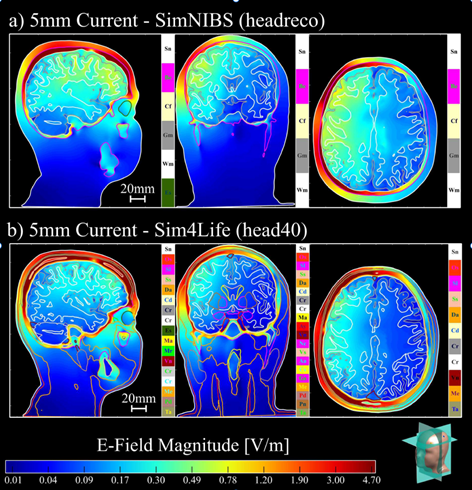
Figure: Calculated electric fields of subject P01 for 5-mm current electrodes using the segmentations a) SimNIBS (headreco) and b) Sim4Life (head40). The electric fields are plotted on a logarithmic scale. Cross-sections of the head model are shown in the lower right corner.

For accurate forward modeling of transcranial electrical stimulation (TES), electroconvulsive therapy (ECT), and electroencephalography (EEG), numerical singularities in the charge density near electrodes and tissue interfaces must be resolved. We present a strategy for adaptive mesh refinement (AMR) for the charge-based boundary element method (BEM), accelerated by the Fast Multiple Method (BEM-FMM), that accounts for electrode and interface singularities. We derive a new error estimator that accounts for both local and nonlocal contributions of the single-layer potential operator and construct a refinement criterion based on the difference in the charge solution across AMR iterations. We evaluate this approach on a 5-layer sphere model as well as on several subject-specific head models derived from the 7-tissue segmentations of SimNIBS (headreco) and the 40-tissue segmentations of Sim4Life (head40), using both voltage-controlled and current-controlled electrode formulations. Through a convergence analysis on the target structures of the white matter and the hippocampus, we find that the SimNIBS and Sim4Life models produce electric fields with relative residual errors of less than 0.1% and 1%, respectively. Our results show that residual-based AMR applied to BEM-FMM leads to numerically stable TES and EEG forward solutions in realistic head models.

Original publication:
Derek A. Drumm, Gregory M. Noetscher, Hannes Oppermann,Jens Haueisen, Zhi-De Deng & Sergey N. Makaroff: Charge-based boundary element method with residual-driven adaptive mesh refinement for high-resolution electrical stimulation modeling. Scientific Reports, 2026
DOI: 10.1038/s41598-026-61208-z