Mechanical ventilation is an indispensable and routine part of intensive care medicine. However, prolonged ventilation can lead to weakening of the diaphragm, thereby making weaning from ventilation more difficult and prolonging the recovery process. Electrical stimulation of the phrenic nerve (nervus phrenicus) represents a promising approach for maintaining diaphragmatic activity during mechanical ventilation. However, a better understanding of appropriate stimulation parameters is necessary for future clinical application.
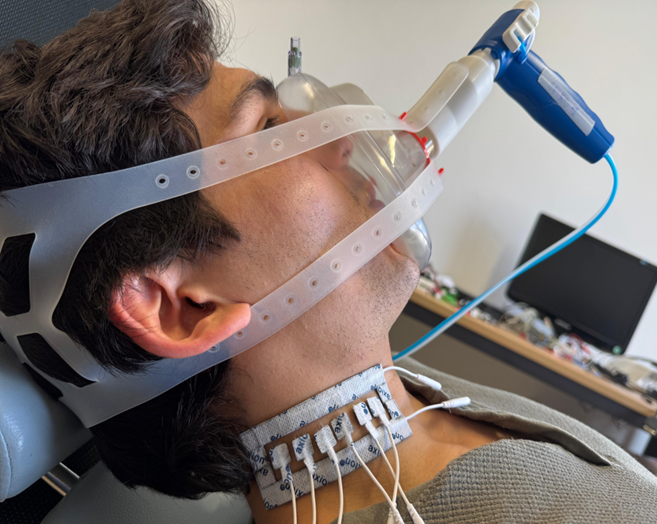
In the recent publication “Influence of frequency and pulse train duration on respiratory responses during transcutaneous phrenic nerve stimulation in humans,” a study investigated the influence of stimulation frequency and duration on respiratory responses. For this purpose, twelve healthy participants received bilateral electrical stimulation in the neck region. The resulting respiratory responses were recorded using various measurement methods, including spirometry, chest and abdominal movements, and ultrasound examinations of the diaphragm.
The results show that stimulation of the phrenic nerve elicits measurable respiratory responses in all participants. In particular, longer stimulation pulses led to a significant increase in tidal volume, thoracic and abdominal movements, and maximum inspiratory flow. In contrast, while short stimulation pulses did increase inspiratory flow, they did not produce a comparable increase in volume. Furthermore, a correlation was observed between the stimulation frequency and the respiratory response, albeit with individual differences.
The study provides important insights for optimizing stimulation strategies. In particular, it becomes clear that, in addition to stimulation frequency, stimulation duration also has a decisive influence on the resulting respiratory movement. The results thus form an important foundation for the further development of non-invasive methods to support ventilation and could, in the long term, help reduce ventilation-related weakening of the diaphragm and sustainably improve the situation for ventilated patients.
The study was published as open access and can be read at https://iopscience.iop.org/article/10.1088/1741-2552/ae857d
Original publication: Tim Kalla, Irene Lange, Laureen Wegert, Jens Haueisen and Alexander Hunold, „Influence of frequency and pulse train duration on respiratory responses during transcutaneous phrenic nerve stimulation in humans” in Journal of Neural Engineering, Vol. 23, Num. 4, 2026