24.11.2026

New study in Leukemia examines the immune response in chronic blood disorders

New study in Leukemia examines the immune response in chronic blood disorders

How do natural killer cells respond to chronic blood disorders with different genetic causes? An international team led by Karl Landsteiner University in Krems investigated this question in myeloproliferative neoplasms, a group of disorders in which the bone marrow produces too many blood cells. Sascha Klee and Uwe Graichen, who currently work at the Institute for Biomedical Engineering and Computer Science (BMTI) at the Technical University of Ilmenau, were involved in analyzing the data as part of their work at the Karl Landsteiner Private University at the time. The study was published in Leukemia on 3 November 2026.

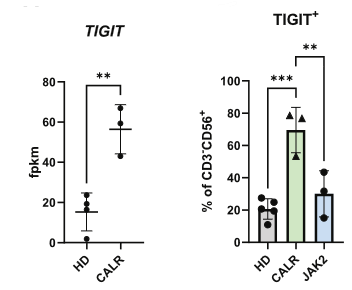
Natural killer cells are part of the innate immune system and can kill malignant cells. In patients with a mutation in the calreticulin gene (CALR), these immune cells were better able to release the substances they use to attack target cells than in patients with a JAK2 mutation. At the same time, the cells from patients with CALR mutations carried more of the inhibitory receptor TIGIT on their surface. The findings suggest that TIGIT can limit natural killer cell activity when these cells encounter malignant cells.

In laboratory experiments, blocking TIGIT helped natural killer cells kill malignant cells more effectively. In a mouse model, platelet counts also tended to be lower after TIGIT blockade. These preclinical findings provide a basis for further research into TIGIT blockade in patients with CALR-mutant myeloproliferative neoplasms. 

Original publication
Witalisz-Siepracka, A., Harm, T., Klampfl, T. et al. Mutant calreticulin-driven myeloproliferative neoplasms favour the emergence of TIGIT-positive NK cells. Leukemia (2026). https://doi.org/10.1038/s41375-026-03175-y