Electrical stimulation of the phrenic nerve represents a promising approach to artificial ventilation and has the potential to reduce the side effects currently associated with mechanical ventilation. Targeted stimulation of the nerve activates the diaphragm, thereby generating a physiological breathing movement and preserving the function of the respiratory muscles.
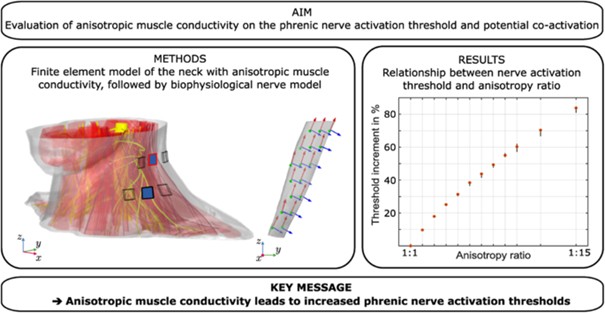
The development and optimization of suitable stimulation parameters are supported by modeling and simulation studies. The recent publication “Muscle anisotropy influences the phrenic nerve activation threshold in non-invasive electrical stimulation” investigates the influence of anisotropic muscle properties on the activation of the phrenic nerve. For this purpose, an anatomically detailed multi-scale neck model with realistic muscle fiber orientations and a coupled nerve model is used.
The results show that taking into account the anisotropic electrical conductivity of muscle tissue alters the distribution of electrical currents in the neck. This leads to an increase in the activation thresholds of the phrenic nerve. These effects are particularly pronounced with larger muscle volumes and when electrodes are positioned directly over muscles. Furthermore, accounting for muscle anisotropy increases the likelihood of unintended co-activation of other nerves in the neck region.
This study underscores the importance of high-resolution anatomical models with anisotropic tissue properties for the research and optimization of non-invasive phrenic nerve stimulation. It thus provides important insights for the future development of safe and effective stimulation strategies in mechanical ventilation.
Original publication:
Wegert, L., Ziolkowski, M., Hunold, A. et al. Muscle anisotropy influences the phrenic nerve activation threshold in non-invasive electrical stimulation. Med Biol Eng Comput 64, 2377–2391 (2026). doi.org/10.1007/s11517-026-03584-2