
Chris Liebold
 TU Ilmenau
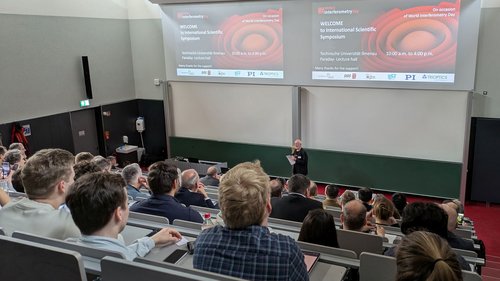
How can we measure the tiniest movements that are invisible to the naked eye? And how can light help us gain new insights into materials, technologies, or even distant planets? Answers to these questions will be the focus of an international scientific symposium marking World Interferometry Day, which will take place on April 20, 2026, at the TU Ilmenau. All interested parties are cordially invited to attend. Participation in the symposium is free of charge.
Program and registration: www.world-interferometry-day.com/program_2026
To mark World Interferometry Day, the symposium will bring together leading scientists from around the world in Ilmenau on April 20, 2026. In their presentations, researchers and industry representatives from the U.S., China, France, Germany, and other European countries will provide insights into current developments and the future of one of the most precise measurement technologies in existence: interferometry. This technology uses light to make even the smallest structures and changes visible—down to the nanometer range, i.e., millionths of a millimeter.
The symposium will be opened by Prof. Stefan Sinzinger, Vice President for Research and Young Scientists, with an introduction to holography – "the magic of recording and tailoring light". The session will then explore applications of interferometry in the semiconductor industry, optical metrology for industrial use, and innovative holographic technologies for medicine and microelectronics. Dr. Chiara Lindner, postdoc at Fraunhofer IPM and recipient of the “Quantum Future Award” and the “For Women in Science” award, will also discuss how infrared spectroscopy can be improved using quantum technology methods. Prof. Jeff Kuhns from the Institute for Astronomy at the University of Hawaii will talk about interferometry and the search for extrasolar moons and life in the universe.
The symposium is organized by the Institute for Process Measurement and Sensor Technology (IPMS) at the TU Ilmenau under the direction of Prof. Thomas Fröhlich and Prof. Thomas Kissinger. For 60 years, research has been conducted here on increasingly precise measurement methods. The goal is to continuously advance interferometry and push its boundaries. Today, researchers at the IPMS work with resolutions of up to 1 picometer – equivalent to one billionth of a millimeter. To achieve such extreme precision, even the smallest disturbances, such as vibrations, acoustic effects, or changes in air pressure and CO₂ content, must be taken into account.
The symposium addresses these challenges and offers a forum for exchange: scientists will present best practices, discuss innovative case studies, and provide direct insights into current technological developments that are driving innovation and concrete applications worldwide – from semiconductor manufacturing and modern sensor technology to astronomy. “The goal of the symposium is to share our enthusiasm for interferometry with other scientists around the world,” says initiator Prof. Eberhard Manske.
World Interferometer Day, launched by the TU Ilmenau and SIOS Meßtechnik, commemorates the seminal birth of the interferometer in general and the Michelson interferometer in particular: In the early days of April 1881, 145 years ago, Albert Abraham Michelson successfully made his measurements of the relative motion of the Earth with respect to the light ether using his now world-famous interferometer setup. Since then, the interferometer has truly triumphed in science and technology.
As simple as the principle of this interferometer was, as ingenious was its invention, which thus became practically synonymous with high-precision measurement technology. Today, the applications of interferometers range from nano and precision technologies to the exploration of space and the mysteries of gravitational waves. They embody, more than any other technology, the art of measuring extraordinarily minute quantities and effects.
Susanne Ecke
Institute of Process Measurement and Sensor Technology
+49 3677 69 1235
susanne.ecke@tu-ilmenau.de