Every year, approximately 250,000 patients in Germany alone require mechanical ventilation. Although modern ventilators save lives, mechanical ventilation continues to carry significant risks. Since the diaphragm is only partially active during prolonged ventilation, this can lead to atrophy of the respiratory muscles. This makes weaning from the ventilator particularly difficult and often prolongs the stay in the intensive care unit.
In the ELBAS research project, the Institute for Biomedical Engineering and Computer Science (BMTI) at the Technical University of Ilmenau and neuroConn GmbH are developing a novel demonstrator for non-invasive electrical stimulation of the phrenic nerve. The phrenic nerve controls the diaphragm, the human body’s most important respiratory muscle. The goal is to physiologically activate the diaphragm during mechanical ventilation and thus preserve its natural function for as long as possible.
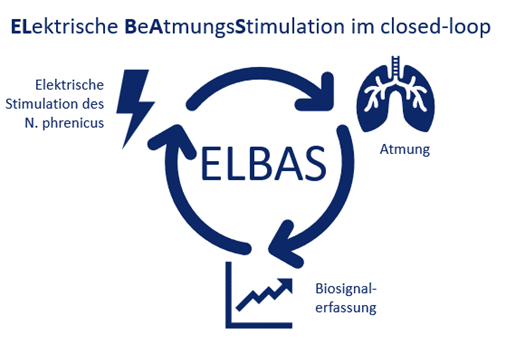
Unlike previous approaches, the stimulation will not be based on fixed parameters. Instead, a closed-loop system is being developed that continuously records respiratory biosignals and evaluates them in real time. Depending on the current respiratory status, the timing and parameters of the electrical stimulation are automatically adjusted. This is intended to enable respiratory support that is as precise and patient-specific as possible.
Another focus of the project is the modeling of a digital twin of the neck region. This model accounts for anatomical differences between individual patients and supports the selection of optimal stimulation parameters. The goal is to reliably activate the phrenic nerve using the lowest possible current while minimizing unwanted side effects.
To this end, the BMTI is investigating various biosignals—such as respiratory belts, spirometry, electromyography, and ultrasound—to determine their suitability for reliably triggering stimulation. At the same time, algorithms are being developed to process these signals in real time and determine the optimal timing for stimulation. The results, together with the digital twin, are fed into the closed-loop control system.
In the long term, ELBAS aims to lay the foundation for a new generation of intelligent ventilatory support. By combining biosignal processing, model-based optimization, and adaptive neurostimulation, more physiologically appropriate ventilation could be made possible in the future. This has the potential to facilitate weaning from the ventilator, reduce ventilation-related complications, and sustainably improve intensive care.