Prof. Dr.-Ing. habil. Jens Haueisen
Director of the BMTI Institute and head of Biomedical Engineering Group
Prof. Dr.-Ing. habil. Jens Haueisen
phone: +49 3677 69 2861
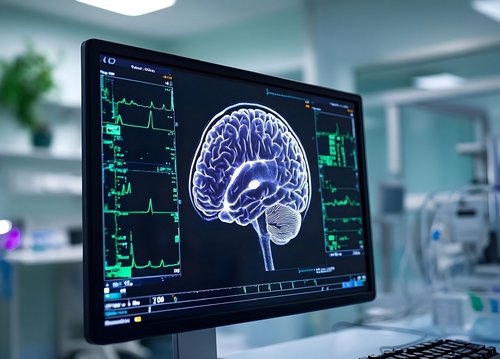
AdobeStock-DibaniStrokes are among the most common causes of long-term disability worldwide. Many people affected continue to suffer from impaired motor function even after acute treatment. There is therefore a great need for innovative rehabilitation approaches.
Brain-computer interfaces (BCIs) open up new possibilities in this regard. Using electroencephalography (EEG), the brain’s electrical activity is recorded non-invasively and with high temporal resolution via electrodes placed on the scalp. When a person imagines a movement, characteristic changes occur in the EEG. If these can be reliably detected, they can be used as a control signal for a rehabilitation system.
Whilst BCIs have already been extensively studied for the rehabilitation of arms and hands, their use for the lower limbs has so far been less well researched, as the EEG activity associated with imagined leg movements is more difficult to classify. The project is therefore developing novel AI-based classification algorithms based on transformers, which are designed to recognise such imagined movements more reliably using EEG sources and their functional connectivity. By integrating these algorithms with a rehabilitation robot, the aim is to create a closed-loop system that recognises imagined movements, triggers corresponding leg movements and provides sensory feedback. This innovative approach could support the recovery of motor skills following a stroke and open up new prospects for neurorehabilitation.