3D Particle Tracking Velocimetry (PTV) is a flow measurement technique in which multiple cameras record the movement of tracer particles within a volume of interest and use this data to reconstruct the instantaneous velocity field. To date, this technique has been used only in relatively small measurement volumes and primarily in liquids.
As part of this research project, the 3D PTV method is to be further developed for very large measurement volumes in air convection flows, such as those occurring inside the passenger cabins of large commercial aircraft. To this end, an omnidirectional stereoscopic recording system with four cameras and special volumetric lighting will capture image sequences of large-scale flow structures in a cylindrical measurement cell with a diameter of 7 m and a height of 7 m. Using digital image processing methods, characteristic trajectories will be determined from these image sequences, and a visual representation of the coherent flow structures will be reconstructed from them.
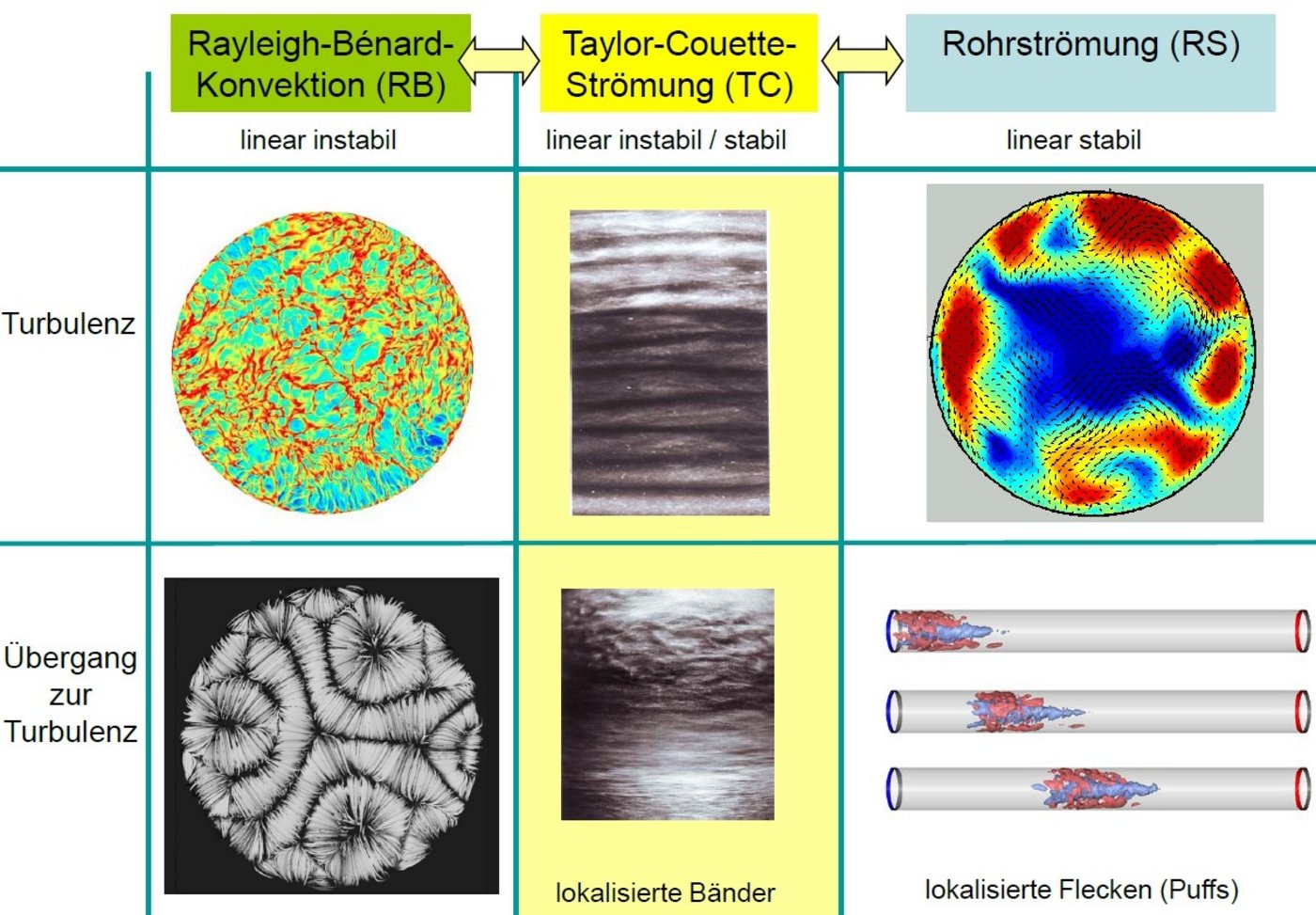
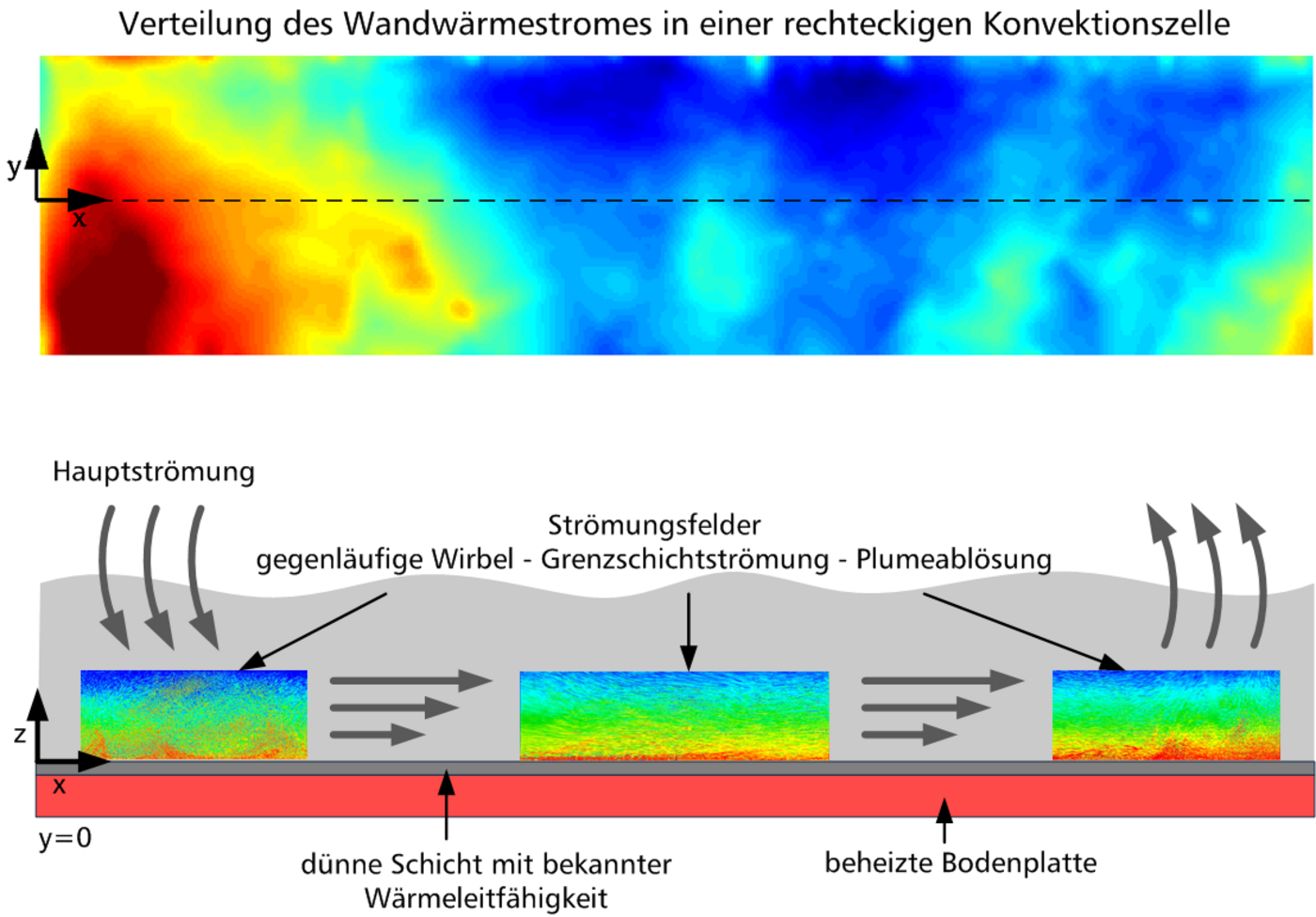
The measurement system to be developed is intended for use on the "Ilmenau Flask" turbulence research apparatus for the systematic investigation of large-scale flow structures for the reference case of Rayleigh-Bénard convection at variable Rayleigh numbers and aspect ratios. This will enable us to answer fundamental questions regarding the role of coherent structures in heat transfer within natural convection flows. Furthermore, the imaging measurement method opens up new possibilities for investigating indoor air flows and fire simulations. --- Principle of the 3D PTV Method The 3D PTV method is a flexible technique for determining time-resolved, spatial velocity fields, which are visualized using suitable particles. By recording and analyzing a sequence of images, particle trajectories can be reconstructed.
To determine the 3D coordinates of all particles at all time points, a multi-frame analysis must be performed. For this purpose, either multiple synchronized cameras are used, or a single camera that captures multiple partial images via beam splitters. To minimize ambiguities during spatial assignment, the use of a 3- or 4-camera system is recommended (MAAS 1992). More info --> --- Phase I: "Ilmenau Model Room" Test Cell The initial research was conducted in a rectangular cell measuring (L/W/H) 4.2 m x 3.0 m x 3.6 m. During this phase, the individual components of the 3D PTV system were tested, followed by validation measurements using model flows. Cameras
The cameras were selected based on the required high spatial resolution. The CANON EOS 20D is an 8-megapixel digital SLR camera that, when combined with a wide-angle lens (CANON EF-S 10-22mm), optimally captures the measurement volume in the "Ilmenau barrel." In continuous shooting mode, the camera can capture up to 5 images per second. Illumination
To obtain usable images of small particles moving within a large volume, light sources with very high intensity are required. However, the light sources must not generate heat, as this would affect the convective flow within the measurement volume.
Several light sources were tested, and studio flash lamps were selected as the most suitable. They have high flash intensity, short charging times, and have only a minimal impact on the convective flow. Particles
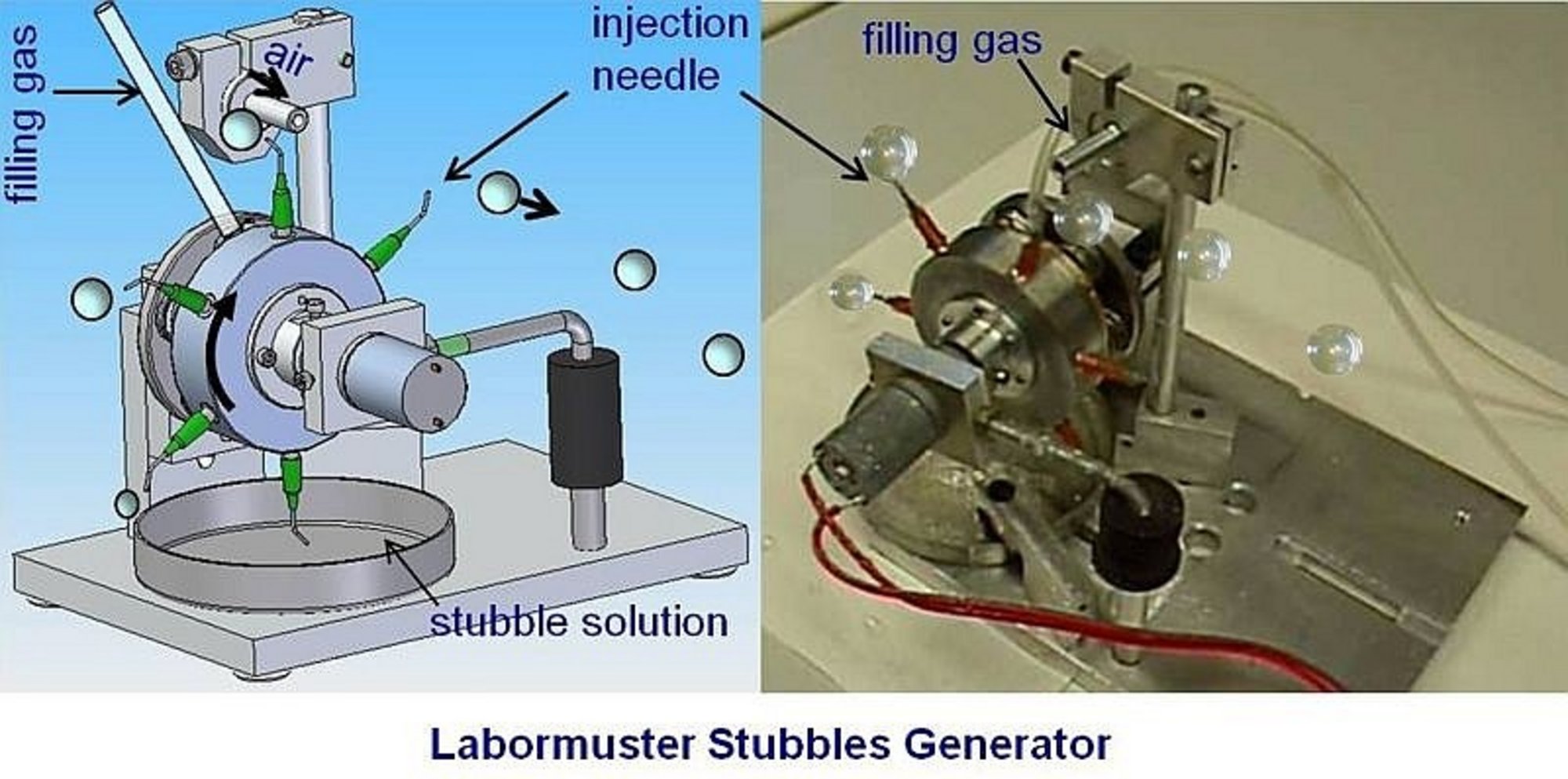
So-called tracer particles are necessary for visualizing air flows. These particles “float” in the flow and show us the movement of the fluid elements as a function of position and time. Since the goal is to analyze the flow rather than the movement of the tracer particles, these should follow the flow without any slip. On the one hand, they must have the same density as the flowing fluid and be small in size so that their flow resistance and inertia are not too great (Stokes number). On the other hand, however, they should be large enough to be reliably detected by the camera even from a greater distance. We use helium-filled soap bubbles as density-neutral particles. To produce these, Prof. Müller’s group at TU Berlin developed a bubble generator capable of producing a sufficient quantity of bubbles over several hours. Phase II: "Ilmenau Barrel" In preparation! Funding agency: DFG Duration
November 1, 2005 – September 30, 2009 Partners: TU Dresden, Prof. Dr. H.-G. Maas, DI T. Putze
TU Berlin, Prof. D. Müller, DI R. Rank Project team: Dr. C. Resagk E. Lobutova, M.Sc.
|