Anna-Maria Matz
Team Assistant
Ernst-Abbe-Zentrum, Ehrenbergstraße 29, 98693 Ilmenau
Media Psychology and Media Design Group
+49 3677 69 4703
Often, groups of friends live all over Germany, couples are in long-distance relationships, or grandparents live far away from their grandchildren. While it is possible to spend time together in video conferences, this is perceived as a shared experience only to a limited extent. Social virtual reality offers more extensive possibilities for this. But how can interaction that conveys social closeness be further improved in virtual space? This question is the focus of the GROOVE project.
The aim of the researchers in the collaborative project GROOVE is to enable synchronously perceived social interaction in virtual reality. Both technical and cognitive psychological factors are being used to improve the perceived synchronicity. For example, it will be investigated whether external stimuli, light signals and acoustic or haptic signals on people's bodies can be helpful for this.
The research project, which started on April 1, 2023, combines the expertise of Bauhaus University Weimar, Ilmenau University of Technology, the companies Brandenburg Labs GmbH, and Consensive GmbH, thus enabling an interdisciplinary approach.
Alexander Kulik, Consensive GmbHProf. Dr. Nicola Döring (Head of Media Psychology and Media Design, TU Ilmenau)
Jun.-Prof. Dr. Jan Ehlers (Head of Usability, Bauhaus-Universität Weimar)
Prof. Dr. Bernd Fröhlich (Head of Virtual Reality and Visualisation, Bauhaus-Universität Weimar)
Prof. Dr. Eva Hornecker (Head of Human-Computer Interaction, Bauhaus-Universität Weimar; project coordination)
Brandenburg Labs GmbH (Ilmenau)
Consensive GmbH (Weimar)
The Project GROOVE is funded by the Federal Ministry of Research, Technology and Space (BMFTR) as part of the research program Interactive Technologies for Health and Quality of Life in the Call Proximity over Distance – Enabling Interpersonal Connectedness with Interactive Technologies, with funding of more than 1.5 million euros.
Federal Ministry of Research, Technology and SpaceWithin the GROOVE Project, the Research Group Media Psychology and Media Design is responsible for the work package Entrainment Studies, and contributes to work package Human-Centered Development Process and work package Entrainment-Enhancing Interaction Design.
Principal investigator is Prof. Dr. Nicola Döring.
The TU Ilmenau GROOVE team is led by principal investigator Prof. Döring from psychology, and comprises two research assistants from the fields of human-computer interaction and communication science, and also two student assistants with a background in communication science.
The TU Ilmenau GROOVE team contributes social-psychological and methodological expertise in the areas of:
Through controlled laboratory experiments and user-centered evaluations, TU Ilmenau examines the psychological, physiological, and behavioural mechanisms underlying social entrainment. The team’s work ensures that the project’s virtual environments are both scientifically grounded and optimized for fostering genuine human connectedness.
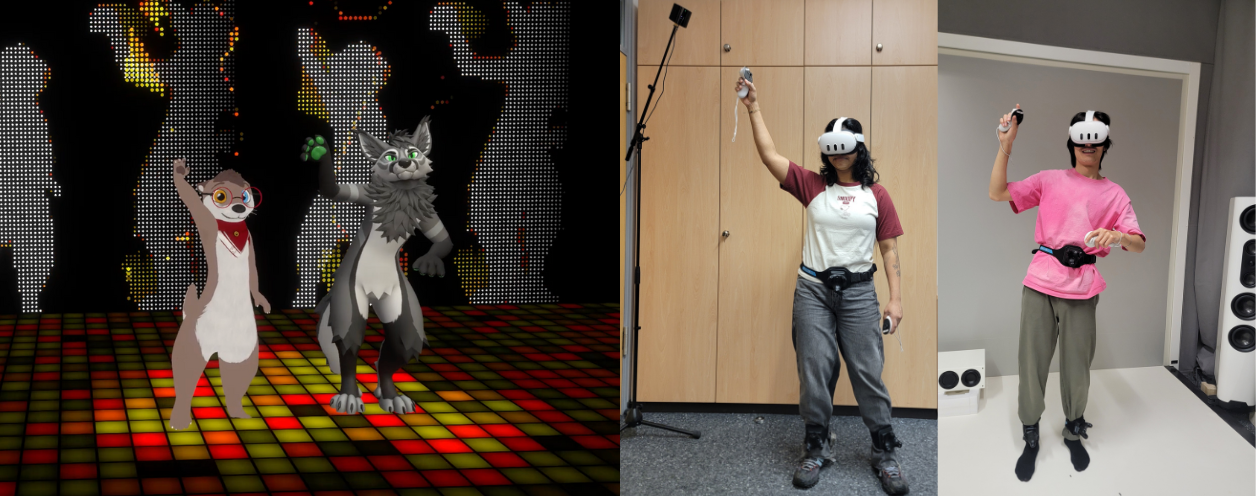
Between November 2023 and April 2024, we conducted in-depth qualitative interviews with 15 experienced VRChat dancers to explore their experiences with full-body-tracking dance in social virtual reality. Although most participants primarily engaged in solo dancing, many expressed a strong desire for more social dance opportunities, underscoring the potential of VRChat dance as a pathway to social interaction and shared presence.
Participants reported a range of positive psychological and physical outcomes, including enhanced well-being, opportunities for self-expression, and increased physical activity. At the same time, they emphasized technological challenges—especially latency—that hindered smooth synchronization and disrupted entrainment. Despite these limitations, dancers developed creative coping strategies to maintain rhythm and coordination during shared dance sessions.
Overall, the study provides valuable insights for researchers, designers, and practitioners interested in improving immersive, synchronized, and socially engaging SVR dance experiences.
Yin, Y., Adolph, M., & Döring, N. (2026, March 21–25). Dance experiences in social virtual reality: A qualitative interview study. Poster presentation at the IEEE Conference on Virtual Reality and 3D User Interfaces (IEEE VR 2026), Daegu, Korea.
GROOVEIn January 2024, we conducted a content analysis of N = 545 publicly available social media posts related to VR dance, collected across six major platforms: YouTube, TikTok, X, Instagram, Reddit, and Discord. The dataset included 400 videos and 145 text-based posts, all manually coded using a deductively and inductively developed, reliability-tested codebook.
The analysis shows that avatars in VR environments function as powerful tools for self-presentation, allowing users to explore expressive identities—such as through provocative or unconventional clothing—that may be less accessible or socially acceptable in their everyday lives. At the same time, the wide range of interaction forms depicted in the posts demonstrates that VR is not only a space for social interaction in groups or couples, but also supports highly individualized expression, reflected in the heterogeneity of VR dance styles and performance contexts.
These findings highlight the multifaceted role of VR as both a social and expressive environment, offering distinctive opportunities for identity exploration and digital performance.
Reddit
GROOVE
GROOVEIn early 2025, we convened an expert panel specializing in motor-synchronization activity design to further clarify and refine the concept of entrainment experience. Based on the panel’s input, we developed a conceptual model and generated an initial pool of scale items for measuring entrainment experiences.
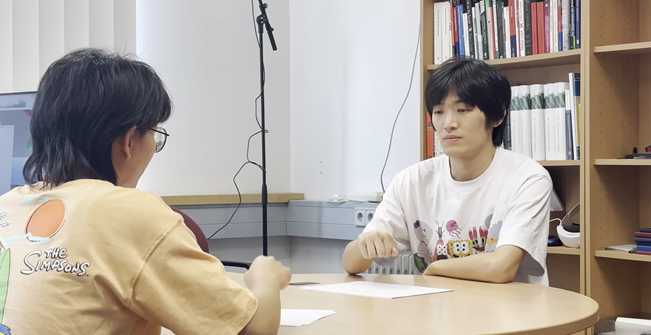
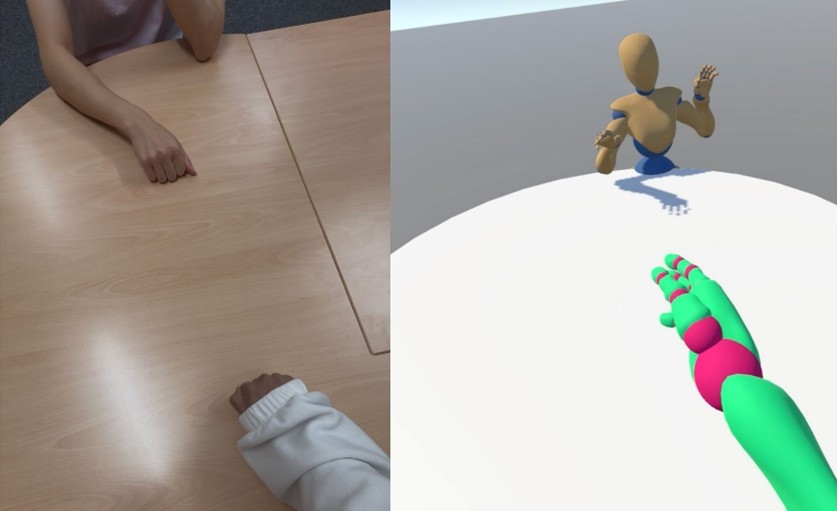
For the subsequent validation study, over 150 participants were invited to our laboratory. Each participant completed a knocking task first in real life and then in virtual reality, followed by an online questionnaire assessing their subjective experiences under both conditions.
The resulting Entrainment Experience Scale (EES) consists of 4 dimensions and 15 items and can be applied in both real-world and VR environments. The scale captures entrainment across four components: sensory consistency, cognitive engagement, motor entrainment, and emotional entrainment. This instrument provides a solid foundation for assessing subjective entrainment and supports future research on synchronized interaction in immersive settings.
The first results of the scale validation were presented at the Media Psychology 2025 Conference in Duisburg:
Stelzmann, D., Yin, Y., & Döring, N. (2025, September 10–12). Measuring entrainment experiences: A new scale for real-world and virtual reality environments. Paper presented at the conference of the Media Psychology Division (FG Medienpsychologie) of the German Psychological Society (DGPs), Duisburg, Germany.
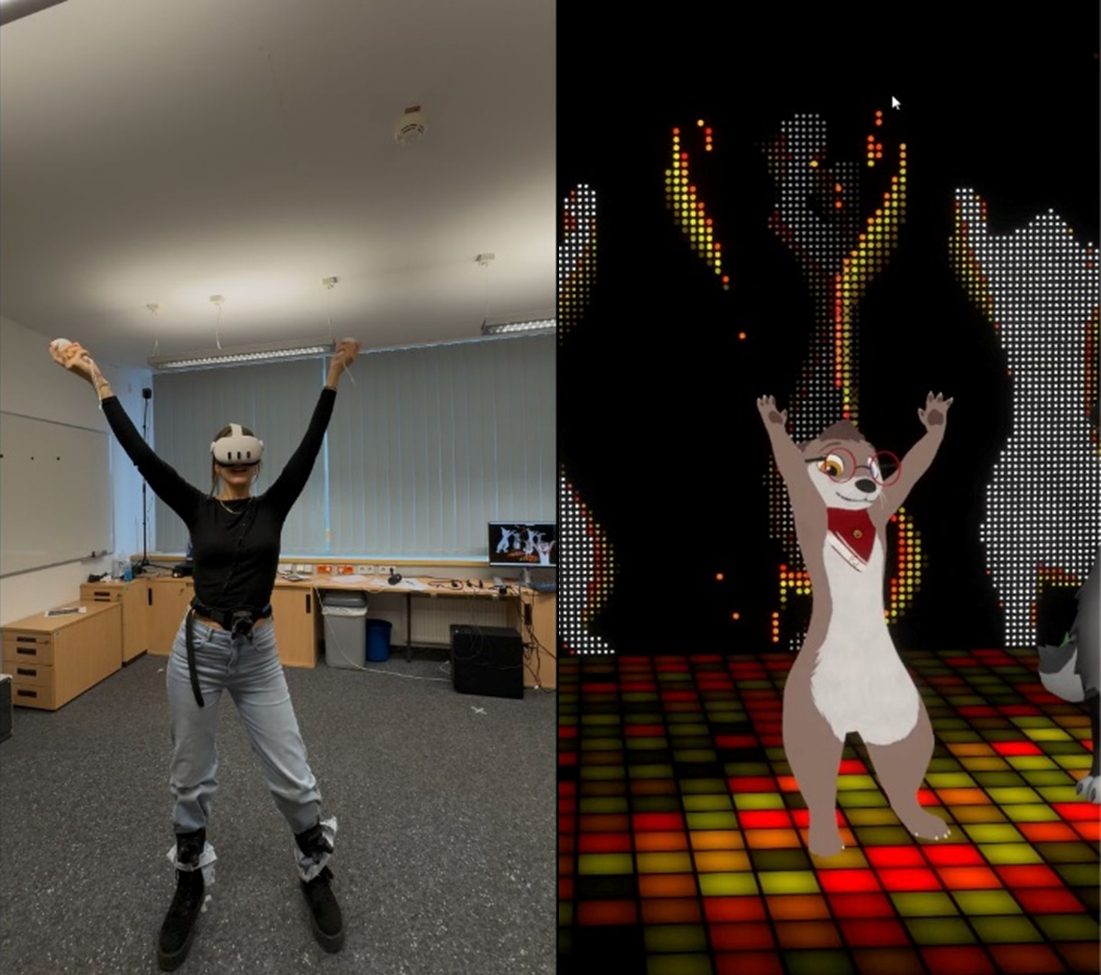
Starting in November 2025, we began offering VR dance sessions to individuals with no prior experience in VR dance. Two age groups were invited to our laboratory: adults aged 65 and above, and students under 25.
Using a six-point full-body tracking system, participants were embodied as personalized avatars in VRChat and engaged in a guided social dance session with a member of the research team. This setup enabled participants to experience synchronized movement, coordination, and shared rhythm within an immersive virtual environment.
After the dance session, participants took part in semi-structured interviews focused on their entrainment experiences. They reflected on how they perceived synchrony, connection, and rhythm during the interaction, providing valuable insights into how entrainment emerges among VR dance newcomers across different age groups.
GROOVETo deepen our understanding of the question “What will actually evoke prosocial and positive feelings after synchronized interaction?”, we will design a controlled experimental study in virtual reality. In this study, participants will perform a synchronous table-knocking task together with a researcher in a shared virtual environment.
When synchrony is achieved, participants in the experimental group will receive a melodic audio cue as positive feedback. Participants in the control group will complete the same task without any additional feedback.
If synchrony is lost, the melody will stop immediately — and when synchrony is regained, the melody will return.
This setup will allow us to examine whether entrainment itself will be the primary source of prosocial and positive feelings, or whether additional incentives—such as rewarding auditory feedback—will play a crucial role in shaping these emotional and social responses.
If you are interested in joining the experimental study as participants, please do not hesitate to contact us: yuanyangyang.yin@tu-ilmenau.de
* All photos were taken and published with the written consent of the participants.