Michelle Andrä
Secretariat of the Plastics Technology Group
Phone: +49 3677/69-2841
Fax: +49 3677/69-1597
E-Mail: kti@tu-ilmenau.de
Visitor Address:
Meitnerbau Room 1.2.104
Gustav-Kirchhoff-Str. 5
98693 Ilmenau
The European economy is to be made sustainable and competitive by 2050 as part of the European Green Deal. Important starting points for this are defossilization, resource efficiency and the circular economy. Bio-based materials can make a key contribution, as they emit up to 90% less CO₂ emissions during production. Bio-based composite materials consist of two or more bio-based components, at least one of which forms a continuous phase - such as natural fiber-reinforced or wood-filled plastics. In order to make these materials usable in technical applications, functional elements such as local reinforcements, ribs or connecting elements often have to be integrated. In the case of thermoplastic composites, this can be done using established processes such as injection molding as well as additive manufacturing processes (tape laying, 3D printing). The result is innovative lightweight components that reduce CO₂-emissions during their use phase as they reduce mass and energy consumption. Lightweight construction is therefore considered a key technology for decarbonization, especially in combination with bio-based materials. The project aims to produce bio-based composite materials and plastic compounds (granulates) based on natural fibers and wood particles. The composite materials are formed and provided with functional elements using the plastic compounds. The aim is to produce a functional model that is designed with the help of local reinforcements in a load case-oriented manner and thus to advance the production of sustainable lightweight components, close material cycles and contribute to the decarbonization of the plastics industry.
Supported by the Free State of Thuringia with funds from the European Regional Development Fund. - FKZ 2025 FGR 0054


The proportionate use of recycled material (from post-consumer or post-industrial sources) in the manufacture of injection-molded components conserves resources and thus opens up potential for optimization in terms of both cost-effectiveness and sustainability of production. Due to the change in the flow properties of the material caused by the recycled content, the machine parameters for recycled material processing must be adjusted in order to produce good parts. Since the cost-benefit ratio for the parameter optimization phase quickly becomes unattractive, the project idea involves the development of a software tool that determines a suitable process window based on the proportion of recycled material and the material properties. This is intended to minimize optimization time and maximize the productivity of the production line. Based on trained data obtained from the comparison of simulated components and the results of statistical design of experiments (DoE), the tool determines a process window (see Figure 1) in which high-quality molded parts can be produced with individualized recycled content.
REZYPLAN: KK5007915CL2; The RezyPlan research project - FKZ KK6013201EB5 - is funded by the Federal Ministry for Economic Affairs and Energy (BMWE) via the "Central Innovation Program for SMEs (ZIM)" funding program. The project partners would like to thank the BMWE for its financial support for this research topic.

Fiber-reinforced plastics are often used in lightweight construction applications, but their recyclability is limited due to their structure of fibers and matrix. Thermoplastic fiber-reinforced thermoplastic composites, in which fiber and matrix consist of the same material, offer a solution.
Supported by the Free State of Thuringia with funds from the European Regional Development Fund. - FKZ 2025 IIP 0030


The market for long and continuous fibre-reinforced thermoplastics (hereafter abbreviated to CFRP) is growing because these materials have excellent weight-specific mechanical properties and are characterized by other significant advantages such as short cycle times, storability, repeated melting, good formability and the use of alternative joining processes that enable automated manufacturing processes in large quantities. The production of CFRTP generates dry fiber waste (DFW). In addition, up to 30% offcuts and old parts with matrix material must be considered as a waste stream. Today, the value chain of composite materials is very linear and the main disposal routes for composite materials are co-processing in cement plants or landfills. For CFRTP, mechanical recycling is a promising alternative. Although there have been individual studies on the mechanical recycling of CFRTP, there is still a lack of transparency regarding the costs, environmental impact and properties of the recycling materials from the available options and still room for innovative approaches. In addition, the recycling scope for DFW needs to be expanded beyond carbon fibers, as glass fibers are readily available DFW streams that are mainly disposed of in landfills.
The first objective of the projects is therefore the pre-competitive development of alternative recycling approaches for CFRTP such as the direct dosing of chopped CFRTP recyclate in injection molding (IM), the use of a (foamed) core layer of CFRTP recyclate in 2K sandwich IM and extrusion complemented by high-quality outer layers, and the load-oriented application of chopped CFRTP recyclate for compression molded parts. These approaches complement existing recycling routes and make better use of the CFRTP recyclate. In addition, a recycling route for dry glass fiber waste and mixed waste from dry glass and carbon fibers via nonwoven production is being developed. The approaches investigated in this project will further expand the range of recycling technologies for CFRTP and DFW. The second objective is a systematic assessment, evaluation and comparison of different mechanical recycling value chains to identify the best options for different fiber-reinforced components and DFW in terms of environmental impact, cost and key material properties (e.g. mechanical properties). Based on the systematic evaluation, transparency will be created on the evaluated material value chains and recommendations for the industry - especially for small and medium-sized enterprises (SMEs) - will be derived.
In order to achieve the above-mentioned goals, the research organizations CTI, TITK and Sirris as well as the associations WNR and Sirris will work together on two pillars: On the one hand, experimental studies will be carried out to develop new, innovative material recycling approaches and collect data on material recycling; on the other hand, a value chain analysis will provide information on the economic, ecological and technical feasibility of material recycling approaches. This structure of the project will enable SMEs to make informed decisions about their future recycling strategies for CFRTP and DFW based on data.
Consequently, the project contributes to shifting the linear value chains of composites towards circularity and meeting the European goal of becoming a circular continent by 2050 and the United Nations Sustainable Development Goals.
The project "Development and evaluation of mechanical recycling value chains for thermoplastic composite materials (RecyComp)", funding code 01IF00376C, is funded by the Federal Ministry of Economics and Climate Protection as part of the "Industrielle Gemeinschaftsforschung (IGF)" program based on a resolution of the German Bundestag.


The ReEnAdd project aims to increase energy efficiency and conserve resources in industrial production, particularly in the mobility sector. Process optimization, material clustering and the use of innovative additives are intended to facilitate single-variety recycling. Three fundamentally different approaches are to be pursued for this purpose. Firstly, the existing manufacturing processes are to be examined using the example of injection molding. For this purpose, energy conversion rates for melting and cooling are measured for each selected plastic and an ideal energy conversion rate is determined. This results in a delta compared with the energy conversion actually measured at the systems. The processes are evaluated according to this delta and the amount of material turnover per year in order to identify energy-efficient processes with long production times. A series of tests are then carried out to increase the efficiency of the injection molding processes without significantly affecting the quality of the molded parts. Processes with the highest delta values will also be transferred to the flow chart simulation so that simulated process parameter sets can be used as a starting point for process optimization. A CO2 balancing tool will be developed on the basis of the determined energy conversions. Secondly, novel and polymer-specific additives are to be developed that improve the flow behavior of the plastics and enable processing at lower processing temperatures and pressures. This directly reduces the necessary energy conversion and the use of polymer additives means that the processed material can be recycled by type. Thirdly, the procedure makes it easier to increase the proportion of recyclate in the injection molding process without obtaining foreign polymers in the produced goods. The procedures described require detailed analyses so that the moulded part properties and flow behavior can be optimized.
Funded by the Free State of Thuringia with funds from the European Regional Development Fund. – FKZ 2024 VFE 0088


The use of direct current is not limited to high-voltage energy transport over long distances, such as HVDC connections at sea or from the coast to the south of Germany. LVDC and MVDC applications will cover a wide range of different sectors from industry to mobility and the home. Flexible PVC of various blends is predominantly used for cable insulation in low voltage applications as it is cheap and its mechanical, electrical and chemical properties are sufficient if the blend is suitable for the intended use. The results of the research project DC-Industry 2 show a different behavior of different PVC-based cable insulations. It can be assumed that the additives and fillers contained in the PVC compounds play a significant role in the long-term behavior of the insulation. In particular, the interaction with the electric field leads to different behavior under alternating and direct current loads. During operational loading, however, the constant and unidirectional electric field leads to different effects and thus to different loads than in AC applications: Electrophoresis becomes an effect that must be taken into account in DC applications. In addition, electrochemical processes can cause corrosion on conductors, especially in the presence of water. The identification and quantification of the main factors for degradation and thus the contribution to the long-term behavior of PVC-based insulation materials for low-voltage cables under combined electrical, thermal and water stress was identified as a significant research gap. Based on the preliminary work, material components (plasticizers, fillers, stabilizers, etc.) and environmental conditions were identified as factors of significant importance. It is intended to control the composite matrix and environmental conditions to separate the influence of the factors on the long-term electrical behavior. For the proposed project, the polymer matrix will be reduced to the main components relevant for cable insulation: PVC, plasticizer and CaCO3 Closing this research gap is of great importance for exploiting the increasing possibilities of low voltage DC applications and grids and a possible conversion of existing grids from AC to DC. The investigations contribute to the general understanding of materials and durability. In addition, the electrical behavior can be described mathematically using network models. Under defined conditions, the use of a PVC compound is reduced to limited, specific additives: CaCO3 and plasticizers.
Funded by the German Research Foundation (DFG) - Project number 559008720

In resin injection processes, different flow velocities occur within the fiber bundles and the channels between them during the impregnation of fabrics and fabrics with resin systems due to the effects of viscous forces and capillary forces. This so-called "dual-scale" flow behavior leads to the formation of air inclusions in the production of fiber composite components. In order to better describe this phenomenon, it is necessary to take into account a large number of factors, which are currently usually calculated using semi-empirical models or empirical corrections. The description of dual-scale flow is based on a complex concatenation of material and process parameters, which has so far been carried out using independent calculation models under the assumption of constant input parameters. The aim of the research project is to extend the semi-empirical partial models to include parameters that change dynamically during the injection process in order to enable a reliable analytical calculation of dual-scale flow. A transfer of the description of the flow conditions extended by dynamic parameters into numerical simulations serves to validate the models and forms the basis for a later simulative prediction of flow-related air inclusions.
Funded by the German Research Foundation (DFG) - project number 565746455

Procurement of a twin-screw extrusion system for the recycling and upcycling of plastics and reactive extrusion as equipment for research projects (FKZ 2022 FGI 0014)


Procurement, construction and commissioning of equipment for determining the rheological and thermal properties of polymer materials such as bio-based plastics, plastic recyclates or conductive inks and stretchable materials for flexible electronics (FKZ 2024 FGI 0008)


Dynamically operating mechanical and electrical systems are always accompanied by energy losses that result in heating. Excessive temperature increases must be avoided in order to prevent the operating points from shifting to less efficient areas.
Active cooling systems can effectively reduce temperatures, but are sometimes only possible in complex ways and rely on transport media. Passive cooling systems are generally less effective, but reliable in their application.
The removal of heat using thermally conductive thermosets is a tried and tested means of passively cooling components. The current state of scientific knowledge already provides information on achievable thermal conductivity coefficients in the additivation of thermosets (Figure 1).
The aim of the current research project "High Eff-Heat M" is to use the anisotropy of thermally conductive thermosets to transport heat out of the system in a targeted manner and to protect adjacent assemblies from heating. The resin injection process from the field of composite production is to be used to create defined paths for temperature conduction and at the same time to protect sensitive components from environmental influences. A low viscosity of the modified thermosets must be guaranteed in order to ensure complete filling of the smallest gaps even at low process pressure (Figure 2). An optimum of directional thermal conductivity and high flowability is to be found by combining different particle geometries. The anisotropic thermal conductivity is used by intelligent tool and process design to form paths in the material that enable efficient cooling of the molded components. This project is funded by the Federal Ministry of Economics and Climate Protection (BMWK) on the basis of a decision by the German Bundestag.
High Eff-Heat M: KK5007915CL2; The research project High Eff-Heat M KK5007915CL2 is funded by the Federal Ministry of Economics and Climate Protection (BMWK). The project partners would like to thank the BMWK for the financial support of this research topic.
In times of the COVID-19 pandemic, wearing FFP2 masks has been of immense importance in protecting our health. These masks offer high filtration efficiency and help to contain the spread of pathogens. The increased use of such disposable masks made of poorly degradable plastics has led to an increased burden on landfills.
The aim of the InnoMask project is to develop a process chain for processing sustainable plastics (bio-based and/or recycled) and functionalizing them with antibacterial ingredients from pine heartwood extract. The innovative products are characterized by many technical and ecological advantages. The highly effective extract can already ensure significant antibacterial effects in polyethylene plastic in small addition quantities of three percent; the transfer to bioplastics and recyclates is a key objective. The work is aimed at maintaining and maximizing the effectiveness in the process, ensuring it over the period of use and, if necessary, testing it for subsequent applications.
The new products are to be made more sustainable, more resource-efficient and optimized for recycling processes.
InnoMask is a project funded by the Federal Ministry of Economics and Climate Protection conducted in cooperation with the partners WTA Technologies GmbH, Thorey Gera Textilveredlung GmbH and the Group of Nanobiosystems Technology at Technische Universität Ilmenau.

The Group of Plastics Technology (KTI) at Technische Universität Ilmenau, in collaboration with its partners Steinbeis Qualitätsicherung und Bildverarbeitung GmbH (SQB), Institut für Mikroelektronik- und Mechatronik-Systeme gemeinnützige GmbH (IMMS), eitech Werkzeugbau GmbH (eitech) and Kunststoff- und Holzverarbeitungswerk GmbH (KHW), is launching the joint project ProQuaOpt, which is investigating whether the productivity and quality of plastic injection molding processes can be increased through the use of machine learning methods in conjunction with information from various sensors.
According to manufacturers, the proportion of rejects in the manufacturing process for plastic components is around 5%. For the German plastics industry, this corresponds to approx. 750kt of plastic that has to be recycled. A common solution for preventing rejects is to monitor the actual values of the injection molding machine so that the machine operator has to intervene if there is a defined deviation from the target value [1]. The system can only react to faults that occur within the predefined parameter range, even if non-conforming (NiO) parts are detected before the threshold value.
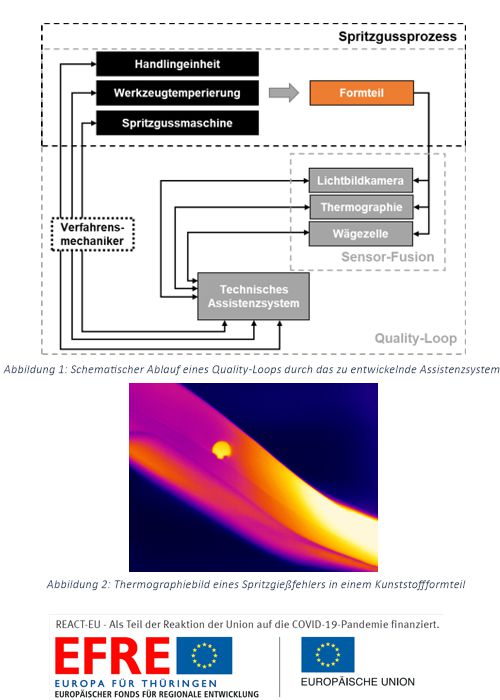
The product-process quality control loop (PPQRK) to be developed, as shown in Figure 1, does not monitor the actual values of the machine, but the quality characteristics of the molded parts via sensor technology. AI methods, such as machine learning [2], are used to develop a learning spectral image processing method for quality inspection in combination with other sensors (e.g. IR camera, load cell, temperature sensor). The correlation of different sensor data enables a more precise fault diagnosis, so that in the next process step an AI-based self-learning assistance system varies suitable process parameters to restore the quality of the moulded parts and find an optimal operating point for the process in order to minimize cycle time and energy consumption [3].
To teach the AI algorithm, faulty molded parts are generated by machine as shown in Figure 2. In addition, the project aims to develop a process that can generate synthetic data of surface defects with a CAD model of the injection molded part, which reduces the testing effort of the machine-produced defective parts.
The AI-supported PPQRK to be developed is not tied to specific manufacturers of injection molding machines and should be retrofittable.
The ProQuaOpt 01IS22019 research project is funded by the German Federal Ministry of Education and Research (BMBF). The project partners would like to thank the BMBF for its financial support for this research topic.