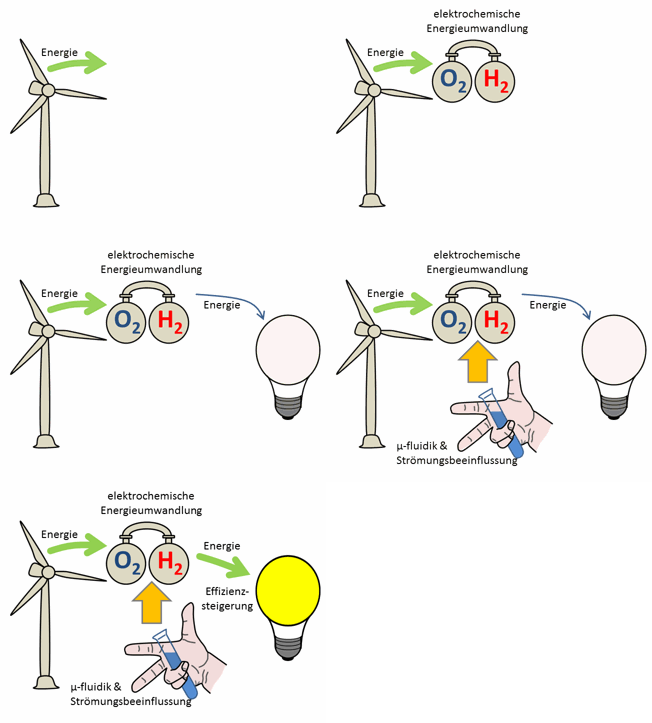
Die effiziente elektrochemische Energieumwandlung spielt im Rahmen der Brennstoffzellentechnik in Form von Wasserelektrolyse eine signifikante Rolle. Die Energieumwandlung findet dabei immer an der Elektrodenoberfläche statt, wodurch mikrofluidische Systeme besonders geeignet erscheinen, da hier das Verhältnis von benetzter Oberfläche zum Volumen stark gesteigert werden kann. Durch die Parallelisierung solcher Mikrobrennstoffzellen und Elektrolysezellen lassen sich Einheiten mit quasi beliebiger Leistung erzeugen. Ziel der DFG geförderten Emmy Noether Nachwuchsgruppe (CI 185/3) ist es die Effizienz der elektrochemischen Energieumwandlung durch wandnahe Strömungskontrolle zu steigern und die zugrunde liegenden physikalischen Prozesse aufzuklären, um zukünftige Systeme optimieren zu können. Dazu sollen zeitlich und räumlich hochaufgelöste experimentelle Untersuchungen der Geschwindigkeits- und Skalarfelder (Temperatur, pH-Wert, Druck) in ein- und mehrphasigen Mikroströmungen durch das neu entwickelte und erweiterte 3D Astigmatismus PTV beitragen. Der Fokus der Arbeiten liegt dabei zum einen auf der effektiven Temperaturkontrolle durch Nanofluide und Partikel-Partikel Interaktion im Fluid, zum anderen auf der gezielten Beeinflussung der wandnahen Konvektionsströmung durch elektromagnetische Volumenkräfte.
Partner:
Universität der Bundeswehr München, Technische Universität Dresden, Leibniz-Institut für Festkörper- und Werkstoffforschung Dresden, Helmholtz-Zentrum Dresden-Rossendorf, University of Washington, University of Purdue
Bearbeiter:
Aktuelle Publikationen:
W. Rösing, T. Schildhauer, J. König, C. Cierpka (2019) Passive control of the concentration boundary layer in electrochemical microfluidic devices using Dean‐vortices, Microfluidics and Nanofluidics 23, 110, DOI: 10.1007/s10404-019-2274-2, open access
J. Massing, N. van der Schoot, C. J. Kähler, C. Cierpka (2019) A fast start up system for microfluidic direct methanol fuel cells, International Journal of Hydrogen Energy 44, 26517-26529, DOI: 10.1016/j.ijhydene.2019.08.107
J. Massing, G. Mutschke, D. Baczyzmalski, X. Yang, K. Eckert, C. Cierpka (2019) Thermocapillary Marangoni convection during hydrogen evolution at microelectrodes, Electrochimica Acta 297, 929-940
X. Yang, D. Baczyzmalski, C. Cierpka, G. Mutschke, K. Eckert (2018) Marangoni convection at electrogenerated hydrogen bubbles, Physical Chemistry Chemical Physics 20, 11542
T. Weier, D. Baczyzmalski, J. Massing, S. Landgraf, C. Cierpka (2017) The effect of the rotating MHD flow on the detachment of gas bubbles from the electrode surface. International Journal of Hydrogen Energy 42, 20923-20933
D. Baczyzmalski, F. Karnbach, M. Uhlemann, G. Mutschke, X. Yang, K. Eckert, C. Cierpka (2017) Growth and detachment of single hydrogen bubbles in a MHD shear flow. Physical Review Fluids 2, 093701
R. Irwansyah, C. Cierpka, C.J. Kähler (2016) On the reliable estimation of heat transfer coefficients for nanofluids in microchannels, Journal of Physics: Conference Series 745, 032078
D. Baczyzmalski, F. Karnbach, X. Yang, G. Mutschke, M. Uhlemann, K. Eckert, C. Cierpka (2016) On the Electrolyte Convection around a Hydrogen Bubble Evolving at a Microelectrode under the Influence of a Magnetic Field, Journal of the Electrochemical Society 163, E248-E257
D. Baczyzmalski, T. Weier, C.J. Kähler, C. Cierpka (2015) Near-wall measurements of the bubble-driven and Lorentz-force-driven convection at gas-evolving electrodes. Experiments in Fluids 56, 162