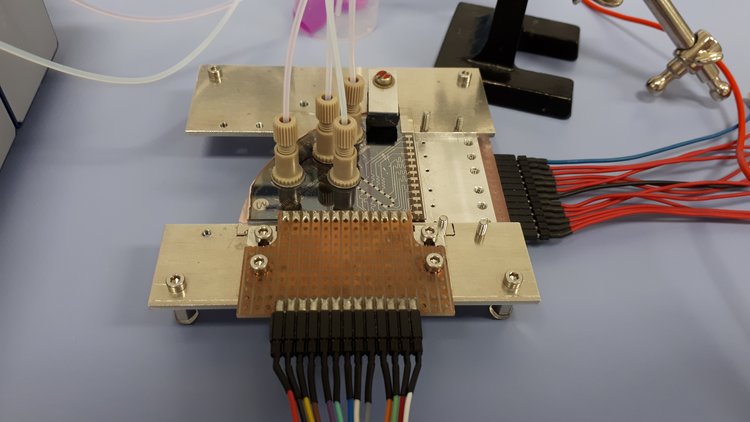
The miniaturization of systems has become an important topic of research in the field of chemical, biological and pharmaceutical process engineering. Reducing the size of fluidic structures causes a change of the dominant forces. Instead of body forces and inertia, surface forces dominate. As a result, completely new physical effects can be exploited.
Main research topics
Investigation of acoustic fields originating from surface acoustic waves on transport phenomena in microfluidic systems
Optimization of mass transport in microfluidic fuel cells and electrolyzers to increase efficiency
Development of optical measurement techniques for the simultaneous measuring of velocity and scalar quantities (e.g. temperature)
Range of services
Experimental and numerical investigation of microfluidic systems based on surface acoustic waves
Design and optimization of flow control systems using surface acoustic waves
Non-contact temperature and three-dimensional velocity measurement in microchannels
Laboratory equipment/test rigs
Zeiss Axio Observer 7 microscope (contrast method: brightfield, polarization, fluorescence) with up to 63x magnification for three-dimensional characterization of microflows
Motic microscope (contrast method: brightfield, phase contrast, fluorescence) with up to 40x magnification
UV ozone chamber for cleaning and surface functionalisation of substrates
Electrochemistry workstation with extraction system
Bipotentiostat (VSP-300, Fa. BioLogic) with impedance module for operation and investigation of electrochemical systems
2-channel PowerSAW generator for excitation of high-frequency surface acoustic waves (up to 215 MHz) for SAW microfluidics
Measuring station for spectral analysis of fluorescent and phosphorescent dyes
Pollen-related respiratory allergies affect up to 30% of the world's population. Climate change is further exacerbating the problem. However, forecasting pollen fields is extremely difficult. PollenNet aims to provide a more accurate and up-to-date forecast of local pollen levels.
Pollen-related allergies cause high medical costs, lead to absences from work and school and result in early deaths. Due to climate change, more and more aggressive pollen is expected over longer periods in the coming years.
Using and further developing AI methods, the team is pursuing four goals:
(1) precise analysis and prediction of the spread of allergenic plants and in particular their growth phases (phenology), (2) better characterization of pollen properties, in particular with regard to allergenicity and spread. (3) development of pollen transport and dispersal models for high-resolution local, temporal and taxonomic prediction of pollen loads, and (4) research into objective individual markers in the EEG for allergy sufferers in the domestic environment.
By integrating these findings, an approach is to be developed that enables a significantly more accurate and up-to-date prediction of local pollen exposure.
Funding:
Carl Zeiss Stiftung
Partner:
TU Ilmenau Fachgebiete: Nachrichtentechnik, Datenbanken und Informationssysteme, Strömungsmechanik, Biomedizintechnik
Universitätsklinikum Leipzig, Klinik und Poliklinik für Dermatologie, Venerologie und Allergologie
Max-Planck-Institut für Biogeochemie, Biogeochemische Integration
Green hydrogen is a central pillar of our future energy economy. The production of green hydrogen is a key technology for reducing carbon emissions in areas that cannot be decarbonized through electrification alone. In addition, hydrogen plays a role as an important raw material in the chemical industry, offers itself as a flexible energy carrier due to its transportability and can be produced in Germany, thus reducing geopolitical energy dependence.
Anion exchange membrane water electrolysis (AEM-EL) is a comparatively young but very promising technology for the production of green hydrogen. It achieves the same good performance as proton exchange membrane electrolysis (PEM-EL) at significantly lower target costs as found in AEL. A major advantage of AEM-EL over PEM-EL is the possible use of precious metal- and PFAS-free materials. This makes AEM technology more sustainable than PEM technology.
Funding:Thüringer Aufbaubank und Europäische Union
Partner:
TU Ilmenau Group of Theoretical Solid State Physics
Fraunhofer IKTS in Hermsdorf und Arnstadt
Researcher:
Prof. Dr.-Ing. Christian Cierpka (Projektleiter)
M. Sc. Sebastian Sachs (Projektleiter)
Hemanth Pippari (Bearbeiter)
Publications:
Research projects completed
The aim of the research project is to characterise a 2D single-cell analysis arrangement based on surface acoustic waves (SAW). For the first time, the position of the cells, the flow velocity of the surrounding liquid and the local temperature distribution will be analysed using novel, high-resolution measurement techniques in order to obtain detailed findings on the influence of high-frequency sound waves (>100 MHz) on liquids and the corpuscular components (particles, cells) suspended in them. Experimental characterisation of the SAW fields in the fluid-loaded microchamber using laser Doppler vibrometry and measurements of the velocity and temperature distribution using APTV will be used to specifically investigate microacoustic, flow and thermodynamic issues and highlight their interdependencies. This will be supported by the development of models for the numerical simulation of local pressure and flow gradients. Based on the results, it should be possible in future to derive design and application criteria for a 2D single-cell analysis arrangement that not only ensure stable operation of the arrangement but also promise low mechanical and thermal stress on the cells in long-term tests.
Funding organisations: DFG
Associate:
Leibniz Institut für Festkörper und Werkstoffforschung (IFW) Dresden
Z. Deng. V. Kondalkar, R. Weser, H. Schmidt, C. Cierpka, J. König: Experimentelle Untersuchung eines SAW-Systems zur Parallelanalyse einzelner Zellen. Tagungsband der 28. GALA-Fachtagung "Experimentelle Strömungsmechanik", 7.-9. September 2021, Bremen, Herausgeber: Fischer, A., Stöbener, D., Vanselow, C., Ruck, B., Leder, A., ISBN 978-3-9816764-7-1
In microfluidic reactors and heat exchangers, it is often necessary to simultaneously measure the three-dimensional flow and temperature field with time resolution in order to draw conclusions about the fundamental physical phenomena. With astigmatism PTV, velocity determination is based on the three-dimensional tracking of particles in the measurement volume. The basic principle is the encoding of the depth position of the particles via optical distortions using an additional cylindrical lens in the observation optics. If particles loaded with a temperature-sensitive dye are used for the measurement, the fluorescence signal can also be used to determine the temperature. The aim of this research project is therefore to improve the signal-to-noise ratio of the measurement technology and to use it for microfluidic heat exchangers with nanofluids and other complex microfluidic components.
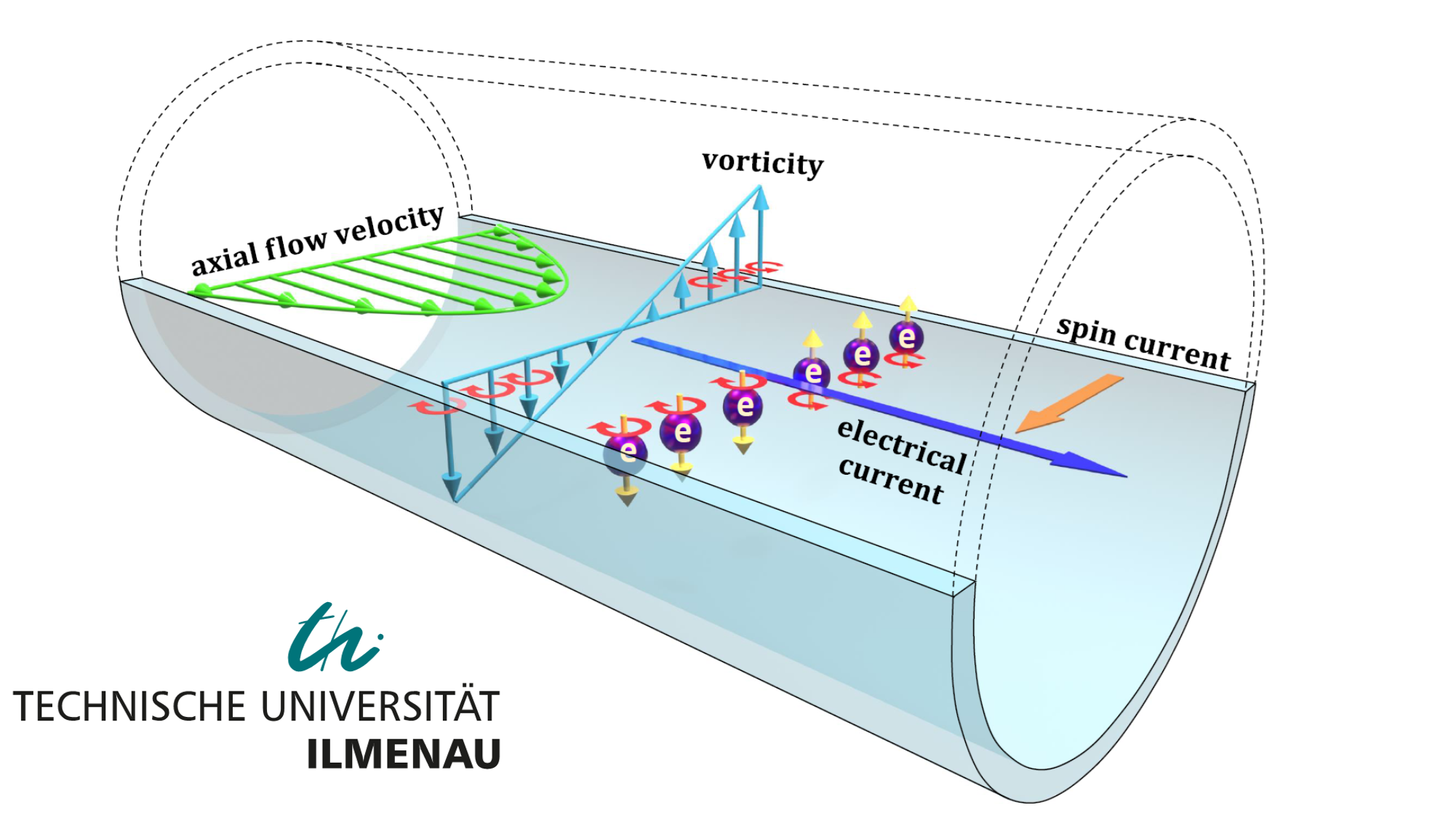
The magnetohydrodynamic conversion of kinetic energy of fluids into electric energy is well known and applied for power generation. A recent experiment shows a similarity between the magnetic field and the spin-orbit orientation in liquid metals, which opens a completely undiscovered path for energy conversion. This promising technique, known as spin hydrodynamic generation, relies on a coupling between the flow vorticity and electron spins to generate electricity with no needs of any external magnetic field. The spin hydrodynamic generation, however, is in its early infancy stage and many unresolved questions need to be addressed to enhance our understanding of how the macroscopic hydrodynamic world couples with the spin-orbitals on atomistic levels. In this regard, an experimental setup consisting of a large box to control the environmental conditions, a pressure vessel which is filled with the eutectic alloy Indium-Gallium-Tin (GaInSn), and connecting circular and non-circular capillary tubes was built. When a pressure (up to 10 bar) is applied the liquid metal is pushed through the capillary into another storage vessel placed on a high precision scale to determine the mass flow rate. The electrical potential is then measured between the electrodes at the beginning and at the end of the capillary. The primarily experimental results show a significant agreement with previous studies in the same range of the flow Reynolds number. For the extended range to lower and higher Reynolds numbers, measurements have provided compelling evidence for the validity of the proposed theories describing the generated electrical voltage via the spin-vorticity coupling.
Despite the first successful experiments, there is still a great need for a very good control of many parameters. Rigorous investigation of the concept could alter our perception of spintronics and our way of electric energy production completely.
Funding: Volkswagen Foundation
Partner:
Prof. Dr. Jörg Schumacher
Project staff:
Prof. Dr.-Ing. Christian Cierpka
Dr. Hamid Tabaei Kazerooni
Publications:
H. Tabaei Kazerooni, A. Thieme, J. Schumacher, C. Cierpka (2020) Electron spin-vorticity coupling in low and high Reynolds number pipe flows, Physical Review Applied, accepted for publication (preprint on arxiv)